Irrational Number Raised To Irrational Number

Click For Summary
SUMMARY

The discussion centers on the mathematical question of whether an irrational number raised to an irrational power can yield a rational result. The conclusion is affirmative, demonstrated through the example of \( A = (\sqrt{2})^{\sqrt{2}} \). If \( A \) is rational, the problem is resolved. If \( A \) is irrational, raising it to the power of \( \sqrt{2} \) results in \( A^{\sqrt{2}} = 2 \), which is rational. This elegant proof showcases the beauty of non-constructive reasoning in mathematics.

PREREQUISITES
  • Understanding of irrational numbers and their properties
  • Familiarity with exponentiation involving irrational bases and powers
  • Basic knowledge of mathematical proofs, particularly non-constructive proofs
  • Experience with logarithmic functions and their implications in rationality
NEXT STEPS
  • Study the properties of irrational numbers in depth
  • Learn about non-constructive proofs and their applications in mathematics
  • Explore the implications of logarithmic functions in determining rationality
  • Investigate other examples of irrational numbers raised to irrational powers
USEFUL FOR

Mathematicians, educators, and students interested in advanced mathematical concepts, particularly those exploring irrational numbers and proof techniques.

nycmathguy
Homework Statement
Can an irrational number raised to an irrational power yield an answer that is rational?
Relevant Equations
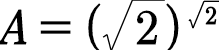
A = (sqrt{2})^(sqrt{2})
Can an irrational number raised to an irrational power yield an answer that is rational? This problem shows that
the answer is “yes.” (However, if you study the following solution very carefully, you’ll see that even though we’ve answered the question in the affirmative, we’ve not
pinpointed the specific case in which an irrational number raised to an irrational power is rational.)

(a) Let A = (sqrt{2})^(sqrt{2})
Now, either A is rational or A is irra-
tional. If A is rational, we are done. Why?

(b) If A is irrational, we are done. Why?
Hint Given: Consider A^(sqrt{2})
 

Attachments

  • 1623983872868.png
    1623983872868.png
    1.3 KB · Views: 187
  • Like
Likes   Reactions: Delta2
Physics news on Phys.org
If it's rational, do you understand why you are done?
 
Mathematics at times is so beautiful!
 
In my opinion the specific case is that ##A=\sqrt 2^{\sqrt 2}## is irrational and when we raise this irrational to the irrational power of ##\sqrt 2## we get a rational that is $$A^{\sqrt 2}={\left (\sqrt 2^{(\sqrt 2)}\right )}^{\sqrt 2}=(\sqrt 2)^{(\sqrt 2)(\sqrt 2)}=(\sqrt 2)^2=2$$.
 
Last edited:
  • Like
Likes   Reactions: Mayhem and nycmathguy
Office_Shredder said:
If it's rational, do you understand why you are done?
No. This is why I posted this question.
 
Delta2 said:
In my opinion the specific case is that ##A=\sqrt 2^{\sqrt 2}## is irrational and when we raise this irrational to the irrational power of ##\sqrt 2## we get a rational that is $$A^{\sqrt 2}={\left (\sqrt 2^{(\sqrt 2)}\right )}^{\sqrt 2}=(\sqrt 2)^{(\sqrt 2)(\sqrt 2)}=(\sqrt 2)^2=2$$.
This reply is your opinion but you are not really sure, right?
 
PeroK said:
Mathematics at times is so beautiful!
What does this have to do with (irrational)^(irrational)?
 
nycmathguy said:
This reply is your opinion but you are not really sure, right?
Yes I am not really sure as I can't provide a proof that ##A## is irrational.
 
  • Like
Likes   Reactions: nycmathguy
Delta2 said:
Yes I am not really sure as I can't provide a proof that ##A## is irrational.
Let me see if the answer is in the back of the book. If so, I will post here.
 
  • #10
Delta2 said:
In my opinion the specific case is that ##A=\sqrt 2^{\sqrt 2}## is irrational and when we raise this irrational to the irrational power of ##\sqrt 2## we get a rational that is $$A^{\sqrt 2}={\left (\sqrt 2^{(\sqrt 2)}\right )}^{\sqrt 2}=(\sqrt 2)^{(\sqrt 2)(\sqrt 2)}=(\sqrt 2)^2=2$$.
I just checked the book. This is an even number problem. The book does not provide answers, like most textbooks, to even number problems.
 
  • #11
Anyway we have two possible cases of (which one must be true):
  1. A is rational. Then we are done because A is of the form (irrational)^(irrational)
  2. A is not rational, that is A is irrational. Then we are done if we take the number ##A^{\sqrt 2}## which is of the form (irrational)^(irrational) (since A is irrational and ##\sqrt 2 ## is irrational too) and we can prove that ##A^{\sqrt 2}## is equal to 2 hence rational.
 
  • Like
Likes   Reactions: nycmathguy
  • #12
Delta2 said:
In my opinion the specific case is that ##A=\sqrt 2^{\sqrt 2}## is irrational and when we raise this irrational to the irrational power of ##\sqrt 2## we get a rational that is $$A^{\sqrt 2}={\left (\sqrt 2^{(\sqrt 2)}\right )}^{\sqrt 2}=(\sqrt 2)^{(\sqrt 2)(\sqrt 2)}=(\sqrt 2)^2=2$$.

Delta2 said:
Anyway we have two possible cases of (which one must be true):
  1. A is rational. Then we are done because A is of the form (irrational)^(irrational)
  2. A is not rational, that is A is irrational. Then we are done if we take the number ##A^{\sqrt 2}## which is of the form (irrational)^(irrational) (since A is irrational and ##\sqrt 2 ## is irrational too) and we can prove that ##A^{\sqrt 2}## is equal to 2 hence rational.
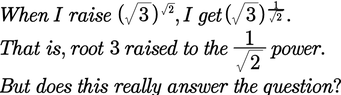
See attachment.
 

Attachments

  • 1624001577489.png
    1624001577489.png
    12.3 KB · Views: 208
  • #13
nycmathguy said:
See attachment.
Well I am not sure if I understand well what you write at the attachment (you say when you raise ##\sqrt{3}^{\sqrt 2}## but you are not saying the power to which you are raising it to, I guess you mean 1/2).
But yes you can work with ##A=\sqrt{3}^{\sqrt 2}## instead .
 
  • #14
or $$\sqrt{3}^{\sqrt 2}=(3^{\frac{1}{2}})^{\sqrt 2}=3^{\frac{\sqrt 2}{2}}=3^{\frac{1}{\sqrt 2}}$$ if that was what you were trying to say.
 
  • Like
Likes   Reactions: nycmathguy
  • #15
Delta2 said:
Well I am not sure if I understand well what you write at the attachment (you say when you raise ##\sqrt{3}^{\sqrt 2}## but you are not saying the power to which you are raising it to, I guess you mean 1/2).
But yes you can work with ##A=\sqrt{3}^{\sqrt 2}##
Delta2 said:
or $$\sqrt{3}^{\sqrt 2}=(3^{\frac{1}{2}})^{\sqrt 2}=3^{\frac{\sqrt 2}{2}}=3^{\frac{1}{\sqrt 2}}$$ if that was what you were trying to say.
Correct but does this answer the question? I understand this problem not to be the typical precalculus classroom question but I find it interesting as given in the David Cohen book Edition 4.
 
  • #16
No this doesn't answer the question, you have to work with ##A=3^{\frac{1}{\sqrt 2}}## with similar logic as before, that is to take cases if A is rational or irrational (if it rational we are done, if it is irrational we take the number ##A^{\sqrt 2}## and we are done cause it is equal to 3.
 
  • Like
Likes   Reactions: nycmathguy
  • #17
Delta2 said:
No this doesn't answer the question, you have to work with ##A=3^{\frac{1}{\sqrt 2}}## with similar logic as before, that is to take cases if A is rational or irrational (if it rational we are done, if it is irrational we take the number ##A^{\sqrt 2}## and we are done cause it is equal
Let me work on this some more.
 
  • Like
Likes   Reactions: Delta2
  • #18
nycmathguy said:
What does this have to do with (irrational)^(irrational)?
@PeroK is expressing pleasure in that elegant mathematical technique, the non-constructive proof. The problem as given does not require you to find a specific example, merely to show that there must be one.
https://en.m.wikipedia.org/wiki/Constructive_proof

Is your attachment in post #12 an attempt at a constructive proof?
There are numerous cases for which no constructive proof is known.
 
  • Like
Likes   Reactions: pbuk, PeroK and Delta2
  • #19
nycmathguy said:
Let me work on this some more.
This problem, when you get it, is one of the simplest results in existence. I think mostly it requires just thinking about the words that are being used, and not like, doing actual work.

##\sqrt{2}## is an irrational number. If we can find some other irrational number ##x## such that ##x^\sqrt{2}## is rational, then we have succeeded.One proposal is ##x=\sqrt{2}##.

There are two possibilities.
1.) ##\sqrt{2}^\sqrt{2}## is rational. What is it that we wanted to be true in the first place? Do we have any more work left to do in this case?

2.) ##\sqrt{2}^\sqrt{2}## is irrational. Then we can just try ##x=\sqrt{2}^\sqrt{2}##. What do we want to be true about that number?
 
  • Like
Likes   Reactions: nycmathguy
  • #20
Office_Shredder said:
This problem, when you get it, is one of the simplest results in existence. I think mostly it requires just thinking about the words that are being used, and not like, doing actual work.

##\sqrt{2}## is an irrational number. If we can find some other irrational number ##x## such that ##x^\sqrt{2}## is rational, then we have succeeded.One proposal is ##x=\sqrt{2}##.

There are two possibilities.
1.) ##\sqrt{2}^\sqrt{2}## is rational. What is it that we wanted to be true in the first place? Do we have any more work left to do in this case?

2.) ##\sqrt{2}^\sqrt{2}## is irrational. Then we can just try ##x=\sqrt{2}^\sqrt{2}##. What do we want to be true about that number?
1. We are done. No more work needed.

2. We want that number to be irrational.
 
  • #21
nycmathguy said:
2. We want that number to be irrational.
No, "that number" is "##x=\sqrt{2}^\sqrt{2}##" and we are in case 2:
Office_Shredder said:
2.) ##\sqrt{2}^\sqrt{2}## is irrational
So we already know it is irrational.
There is another property we need it to have:
Office_Shredder said:
find some other irrational number ##x## such that ##x^\sqrt{2}## is rational,
 
  • #22
haruspex said:
No, "that number" is "##x=\sqrt{2}^\sqrt{2}##" and we are in case 2:

So we already know it is irrational.
There is another property we need it to have:
If the number A is irrational, than A^sqrt(2) is rational. Yes?

Proof:

I know that sqrt[2] is irrational. So, if A=sqrt[2] and B=sqrt[2] satisfy the conclusion of the theorem, then I am done.
If they do not, then sqrt[2]^sqrt[2] is irrational, so I let A be this number.
Then, letting A=sqrt[2]^sqrt[2] and B=sqrt[2], it is easy for me to verify that A^B=2 which is rational and so would satisfy the conclusion of the theorem. This is my guess.

You say?
 
  • #23
How about the approach of raising x to the power ##log_3 x ## or any other Rational base?
 
  • #24
WWGD said:
How about the approach of raising x to the power ##log_3 x ## or any other Rational base?
How would you prove that's irrational to begin with?
nycmathguy said:
If the number A is irrational, than A^sqrt(2) is rational. Yes?

Proof:

I know that sqrt[2] is irrational. So, if A=sqrt[2] and B=sqrt[2] satisfy the conclusion of the theorem, then I am done.
If they do not, then sqrt[2]^sqrt[2] is irrational, so I let A be this number.
Then, letting A=sqrt[2]^sqrt[2] and B=sqrt[2], it is easy for me to verify that A^B=2 which is rational and so would satisfy the conclusion of the theorem. This is my guess.

You say?

This looks good to me.
 
  • Like
Likes   Reactions: nycmathguy
  • #25
Office_Shredder said:
This looks good to me.
Me too.
 
  • Like
Likes   Reactions: Delta2
  • #26
haruspex said:
Me too.
Me three.
 
  • #27
PS alternatively, of course, you can do a proof by contradiction:

Conjecture: any irrational raised to the power of an irrational is always irrational.

Therefore: ##A = \sqrt 2^{\sqrt 2}## is irrational, and likewise ##A^{\sqrt 2}## is irrational.

However, ##A^{\sqrt 2} = 2##, which is a contradiction.

Conclusion: the original conjecture must be false.
 
Last edited:
  • Like
Likes   Reactions: Delta2
  • #28
Office_Shredder said:
How would you prove that's irrational to begin with?This looks good to me.
Thank you. I took me a while to come up with this proof.
 
  • #29
Office_Shredder said:
How would you prove that's irrational to begin with?This looks good to me.
By contradiction. Assume ##log_3 2=p/q##. Edit: Then ##3^{p/q}=2##. Get rid of exponent... ( just a hint for OP).
 
Last edited:
  • #30
WWGD said:
By contradiction. Assume ##log_3 2=p/q##. Then ##2^{p/q}=3##. Get rid of exponent... ( just a hint for OP).
Or, perhaps, ##3^{p/q} = 2##?
 

Similar threads

  • · Replies 2 ·
Replies
2
Views
2K
  • · Replies 1 ·
Replies
1
Views
2K
  • · Replies 5 ·
Replies
5
Views
3K
  • · Replies 19 ·
Replies
19
Views
4K
  • · Replies 2 ·
Replies
2
Views
2K
Replies
5
Views
2K
  • · Replies 2 ·
Replies
2
Views
2K
  • · Replies 85 ·
3
Replies
85
Views
9K
  • · Replies 5 ·
Replies
5
Views
3K
  • · Replies 13 ·
Replies
13
Views
3K