Hello jackin,
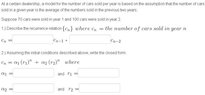
1.) If the current year's number of sales is the average of the previous two year's sales, then we may state:
$$c_{n}=\frac{c_{n-1}+c_{n-2}}{2}=\frac{1}{2}c_{n-1}+\frac{1}{2}c_{n-2}$$
2.) To find the closed form, let's write the recurrence as:
$$2c_{n}-c_{n-1}-c_{n-2}=0$$
Thus, we find the characteristic equation is:
$$2r^2-r-1=(r-1)(2r+1)=0$$
Hence, the characteristic roots are:
$$r=-\frac{1}{2},\,1$$
And so the closed form is:
$$c_{n}=\alpha_1\left(-\frac{1}{2} \right)^n+\alpha_2(1)^n$$
We may simplify this as:
$$c_{n}=\alpha_1\left(-\frac{1}{2} \right)^n+\alpha_2$$
Now we may use the given initial values to determine the parameters.
$$c_{1}=-\frac{1}{2}\alpha_1+\alpha_2=70$$
$$c_{2}=\frac{1}{4}\alpha_1+\alpha_2=100$$
Multiplying the second equation by 2 and adding to the first, there results:
$$3\alpha_2=270\implies \alpha_2=90$$
And using this value for $\alpha_2$ in the first equation, we find:
$$\alpha_1=40$$
And so the closed form is:
$$c_{n}=40\left(-\frac{1}{2} \right)^n+90$$