Special One
- 32
- 1
- Homework Statement
- Explain how did we get the formula used in the question answer.
- Relevant Equations
- Magnetic field
Problem 52:
A solenoid is 40 cm long, has a diameter of 3.0 cm, and is wound with 500 turns. If the current through the windings is 4.0 A, what is the magnetic field at a point on the axis of the solenoid that is (a) at the center of the solenoid, (b) 10.0 cm from one end of the solenoid, and (c) 5.0 cm from one end of the solenoid? (d) Compare these answers with the infinite-solenoid case.
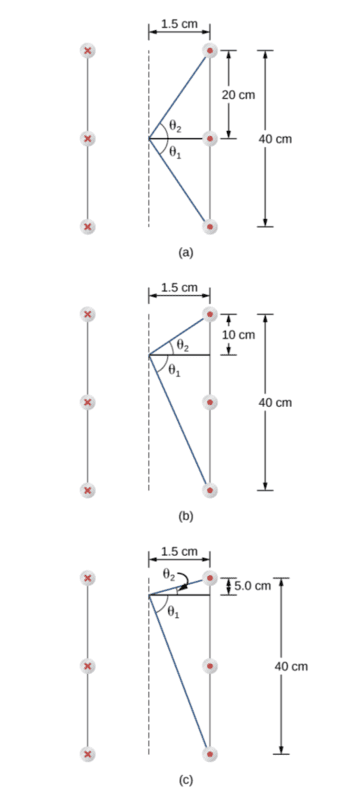
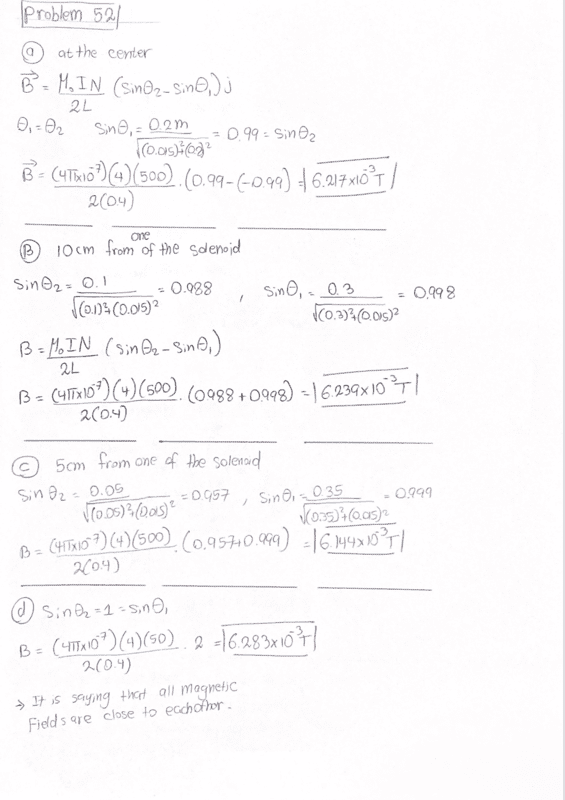
I didn't get the second half of the formula, which is ( sinΘ2-sinΘ1 ) ?
And why when we substitute we consider the Θ1 as negative??
A solenoid is 40 cm long, has a diameter of 3.0 cm, and is wound with 500 turns. If the current through the windings is 4.0 A, what is the magnetic field at a point on the axis of the solenoid that is (a) at the center of the solenoid, (b) 10.0 cm from one end of the solenoid, and (c) 5.0 cm from one end of the solenoid? (d) Compare these answers with the infinite-solenoid case.
I didn't get the second half of the formula, which is ( sinΘ2-sinΘ1 ) ?
And why when we substitute we consider the Θ1 as negative??