Matrix of reflection and rotation with composition properties

  • Topic:
  • Thread starter mathmari
  • Start date
  • Tags Tags
    Rotations
4 replies · 2K views · last reply
mathmari
Gold Member
MHB
Messages
4,984
Reaction score
7
Hey! :o

Let $ \tau_v: \mathbb{R}^2 \rightarrow \mathbb{R}^2, \ \ x \mapsto x + v $ be the shift by the vector $ v \in \mathbb{R}^2 $.

Let $ \sigma_a: \mathbb{R}^2 \rightarrow \mathbb{R}^2 $ be the reflection on the straight line through the origin, where $ a $ describes the angle between the straight line and the positive $ x $ axis.

One can show that the mapping $\sigma_a$ is linear.

  1. Determine $\sigma_a\begin{pmatrix} 1\\ 0\end{pmatrix}$ and $\sigma_a\begin{pmatrix} 0\\ 1\end{pmatrix}$ by making a sketch. Determine the matrix $s_a: = M (\sigma_a)$.
  2. Show that
    • $\tau_v\circ \tau_w=\tau_{v+w}$
    • $\delta_a\circ \tau_v=\tau_{\delta_a(v)}\circ \delta_a$
    • $\sigma_a\circ \sigma_a=\text{id}_{\mathbb{R}^2}$
  3. Let's consider rotation around an arbitrary point. Let $d_{a,v}:\mathbb{R}^2\rightarrow \mathbb{R}^2, \ \ x\mapsto Ax+w$ the rotation around the angle $a$ and the pont $v$. Show at a graph that $d_{a,v}=\tau_v\circ d_a\circ \tau_{-v}$. Determine then $A\in M_2(\mathbb{R})$ and $w\in \mathbb{R}^2$ in respect to $ a$ and $ v$ .
I have done the following:

  1. For $\sigma_a\begin{pmatrix} 1\\ 0\end{pmatrix}$ we do the following:

    We draw an unit circle that goes through the point $(1,0)$.

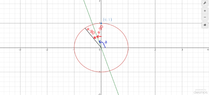
    $a$ is the angle between the x-axis and the line, say $g$. From that line $g$ we draw a line such that the angle between these two lines is equal to $a$. The intersection point of that line and the unit circle is the desired image point $(x,y)$.

    View attachment 9540

    We have a rotation around the origin by $a+a=2a$.

    We calculate the coordinates of the image point using the rotation matrix \begin{equation*}\begin{pmatrix}\cos (2a) & -\sin (2a) \\ \sin (2a)& \cos (2a)\end{pmatrix}\begin{pmatrix} 1\\ 0\end{pmatrix}=\begin{pmatrix} \cos (2a)\\ \sin (2a)\end{pmatrix}\end{equation*}
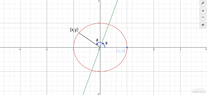
    For $\sigma_a\begin{pmatrix} 0\\ 1\end{pmatrix}$ do we consider the following graph:

    View attachment 9541
  2. For the first bullet:
    $$(\tau_v\circ \tau_w)(x)=\tau_v(\tau_w(x))=\tau_v(x+w)=(x+w)+v=x+(w+v)=\tau_{w+v}(x)$$

    For the second bullet:
    \begin{align*}&(\delta_a\circ \tau_v)(x)=\delta_a(\tau_v(x))=\delta_a(x+v)=d_a\cdot (x+v)=d_a\cdot x+d_a\cdot v \\ &(\tau_{\delta_a(v)}\circ \delta_a
    )(x)=\tau_{\delta_a(v)}( \delta_a(x))=\tau_{\delta_a(v)}( d_a\cdot x)=d_a\cdot x+\delta_a(v)=d_a\cdot x+d_a\cdot v\end{align*}

    For the third bullet:
    \begin{align*}(\sigma_a\circ \sigma_a)(x)&=\sigma_a(\sigma_a(x))=\sigma_a\left (\begin{pmatrix}\cos (2a) & \sin (2a) \\ \sin (2a) &-\cos (2a)\end{pmatrix}x\right )=\begin{pmatrix}\cos (2a) & \sin (2a) \\ \sin (2a) &-\cos (2a)\end{pmatrix}\begin{pmatrix}\cos (2a) & \sin (2a) \\ \sin (2a) &-\cos (2a)\end{pmatrix}x \\ & =\begin{pmatrix}\cos^2 (2a)+\sin^2(2a) & \cos(2a)\sin (2a)-\sin(2a)\cos(2a) \\ \sin (2a)\cos(2a)-\cos(2a)\sin(2a) &\sin^2(2a)+\cos^2 (2a)\end{pmatrix}x=\begin{pmatrix}1 & 0 \\ 0 & 1\end{pmatrix}x=x\end{align*}
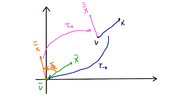
  3. We translate by v to the origin to make the rotation by the origin. Then we make the rotation at the origin by the angle a. Then we translate by v such that we get the rotation around the point v by the angle a.

    We have that \begin{equation*}d_{a,v}(x)=\tau_v(\delta_a(\tau_{-v}(x)))=\tau_v(\delta_a(x-v))=\tau_v(d_a\cdot (x-v))=d_a\cdot (x-v)+v=d_a x+ (I-d_a)v \end{equation*}
    So we get $A=d_a$ and $w=(I-d_a)v$.

    Is everything correct and complete?
 
Attachments
  • Desmos graph of a unit circle centred at the origin with a green line through the origin, a radius to a point (x,y) on the circle, and labels a for the angle between the line and the x-axis.
    spie1.png
    40.7 KB · Views: 199
  • Desmos graph of a unit circle centred at the origin with a green line through the origin, a point labelled (0, 1) on the circle, and red and blue hand-drawn angle annotations labelled a-90 and a.
    spie2.png
    36.8 KB · Views: 205
Last edited by a moderator:
mathmari said:
Let $ \sigma_a: \mathbb{R}^2 \rightarrow \mathbb{R}^2 $ be the reflection on the straight line through the origin, where $ a $ describes the angle between the straight line and the positive $ x $ axis.
One can show that the mapping $\sigma_a$ is linear.

1. Determine $\sigma_a\begin{pmatrix} 1\\ 0\end{pmatrix}$ and $\sigma_a\begin{pmatrix} 0\\ 1\end{pmatrix}$ by making a sketch. Determine the matrix $s_a: = M (\sigma_a)$.

I have done the following:
For $\sigma_a\begin{pmatrix} 1\\ 0\end{pmatrix}$ we do the following:
We draw an unit circle that goes through the point $(1,0)$.
$a$ is the angle between the x-axis and the line, say $g$. From that line $g$ we draw a line such that the angle between these two lines is equal to $a$. The intersection point of that line and the unit circle is the desired image point $(x,y)$.
We have a rotation around the origin by $a+a=2a$.
We calculate the coordinates of the image point using the rotation matrix \begin{equation*}\begin{pmatrix}\cos (2a) & -\sin (2a) \\ \sin (2a)& \cos (2a)\end{pmatrix}\begin{pmatrix} 1\\ 0\end{pmatrix}=\begin{pmatrix} \cos (2a)\\ \sin (2a)\end{pmatrix}\end{equation*}

Hey mathmari!

I think we are not supposed to use the matrix. (Worried)
Aren't we supposed to find the matrix as the last part of the question?

Instead we can find the image geometrically.
That is, we can draw the unit circle and read off the x- and y-coordinates of the image, which are the cosine respectively the sine of the angle of $2a$ in the picture.
View attachment 9543
Alternatively we can draw a right triangle and find those coordinates with trigonometry.

From your picture we can see that the coordinates are $(\cos(2a),\sin(2a))$.
It corresponds to the point $(\cos t,\sin t)$ in the picture of the unit circle.

Since it is the image of $(1,0)$, it follows that it must be the first column in the matrix $M(\sigma_a)$. (Thinking)

mathmari said:
For $\sigma_a\begin{pmatrix} 0\\ 1\end{pmatrix}$ do we consider the following graph:

Yes.
We can find the image of (0,1) from it, which will be the second column of the matrix $M(\sigma_a)$. (Thinking)

mathmari said:
2. For the first bullet:
$$(\tau_v\circ \tau_w)(x)=\tau_v(\tau_w(x))=\tau_v(x+w)=(x+w)+v=x+(w+v)=\tau_{w+v}(x)$$

For the second bullet:
\begin{align*}&(\delta_a\circ \tau_v)(x)=\delta_a(\tau_v(x))=\delta_a(x+v)=d_a\cdot (x+v)=d_a\cdot x+d_a\cdot v \\ &(\tau_{\delta_a(v)}\circ \delta_a
)(x)=\tau_{\delta_a(v)}( \delta_a(x))=\tau_{\delta_a(v)}( d_a\cdot x)=d_a\cdot x+\delta_a(v)=d_a\cdot x+d_a\cdot v\end{align*}

For the third bullet:
\begin{align*}(\sigma_a\circ \sigma_a)(x)&=\sigma_a(\sigma_a(x))=\sigma_a\left (\begin{pmatrix}\cos (2a) & \sin (2a) \\ \sin (2a) &-\cos (2a)\end{pmatrix}x\right )=\begin{pmatrix}\cos (2a) & \sin (2a) \\ \sin (2a) &-\cos (2a)\end{pmatrix}\begin{pmatrix}\cos (2a) & \sin (2a) \\ \sin (2a) &-\cos (2a)\end{pmatrix}x \\ & =\begin{pmatrix}\cos^2 (2a)+\sin^2(2a) & \cos(2a)\sin (2a)-\sin(2a)\cos(2a) \\ \sin (2a)\cos(2a)-\cos(2a)\sin(2a) &\sin^2(2a)+\cos^2 (2a)\end{pmatrix}x=\begin{pmatrix}1 & 0 \\ 0 & 1\end{pmatrix}x=x\end{align*}

All correct. (Nod)

Alternatively, we could show the relationships geometrically. (Thinking)

mathmari said:
3. Let's consider rotation around an arbitrary point. Let $d_{a,v}:\mathbb{R}^2\rightarrow \mathbb{R}^2, \ \ x\mapsto Ax+w$ the rotation around the angle $a$ and the pont $v$. Show at a graph that $d_{a,v}=\tau_v\circ d_a\circ \tau_{-v}$. Determine then $A\in M_2(\mathbb{R})$ and $w\in \mathbb{R}^2$ in respect to $ a$ and $ v$ . We translate by v to the origin to make the rotation by the origin. Then we make the rotation at the origin by the angle a. Then we translate by v such that we get the rotation around the point v by the angle a.

We have that \begin{equation*}d_{a,v}(x)=\tau_v(\delta_a(\tau_{-v}(x)))=\tau_v(\delta_a(x-v))=\tau_v(d_a\cdot (x-v))=d_a\cdot (x-v)+v=d_a x+ (I-d_a)v \end{equation*}
So we get $A=d_a$ and $w=(I-d_a)v$.

Is everything correct and complete?

It is correct. (Nod)

But didn't the question ask for a graph?
And to show the relationship through the graph?
And subsequently find the matrix $A$ and the vector $w$. (Wondering)
 
Attachments
  • Unit circle with x and y axes; a radius at angle t from the positive x-axis ends at a labelled point (cos t, sin t), with the radius marked 1 and the angle t shown as an arc.
    240px-Unit_circle.svg.png
    2.9 KB · Views: 193
Klaas van Aarsen said:
It is correct. (Nod)

But didn't the question ask for a graph?
And to show the relationship through the graph?
And subsequently find the matrix $A$ and the vector $w$. (Wondering)

Do we draw the following graph for that?

View attachment 9545

(Wondering)
 
Attachments
  • Hand-drawn diagram in the plane showing a vector x-bar in green from the origin, a rotated copy in orange labelled with angle alpha, a translation labelled tau_v in pink and tau_-v in blue, with v-bar drawn along the negative horizontal axis.
    comp.JPG
    30.3 KB · Views: 166
Klaas van Aarsen said:
That is the intended graph yes. (Nod)

Great! Thanks! (Yes)