Isn't the Correct Name 4-(1-Chloroethyl)-4-Methylheptane?

  • Thread starter Thread starter Qube
  • Start date Start date
Click For Summary
SUMMARY

The correct name for the compound in question is 4-(1-chloroethyl)-4-methylheptane, as confirmed by Chemoffice and three consulted textbooks. The discussion emphasizes the importance of selecting the longest carbon chain and the most substituted chain according to IUPAC nomenclature rules. The 1979 and 1993 IUPAC rules support this naming convention, prioritizing substitutive nomenclature over simple chain length. Ultimately, the teacher revised their stance to align with this conclusion.

PREREQUISITES
  • IUPAC nomenclature rules
  • Understanding of substitutive nomenclature
  • Familiarity with functional groups in organic chemistry
  • Knowledge of carbon chain structures
NEXT STEPS
  • Study IUPAC nomenclature rules in detail
  • Learn about substitutive vs. functional class nomenclature
  • Examine examples of complex alkyl substituents
  • Research the impact of halogens on naming conventions
USEFUL FOR

Chemistry students, organic chemists, educators in chemical nomenclature, and anyone involved in chemical compound identification and naming.

Qube
Gold Member
Messages
461
Reaction score
1
My teacher insists the name of this compound is (2S)-chloro-3-methyl-3-propylhexane

Shouldn't it be 4-(1-chloroethyl)-4-methylheptane? (Ignore R,S configuration for now).

Chemoffice also tells me 4-(1-chloroethyl)-4-methylheptane.
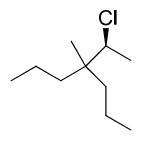
Do52y.png


I think it's the latter because I've consulted three textbooks; all say pick out the longest chain of carbon atoms.

I've also consulted Wikipedia; it says pick the parent chain with the following rules in mind (in descending order of importance):

1) Pick the most substituted chain - the chain with the most substituents of the parent suffix ("ane") - so that would mean either the hexane or the heptane chain, right? The hexane chain has a methyl and an propyl substituent, and a chloro substituent (it's a halogen, however, so it doesn't count). The heptane chain has a complex alkyl substituent and a methyl substituent too.

2) Pick the longest chain. So the heptane chain should win here.
 
Last edited:
Physics news on Phys.org
This is a tough one. I've been going over the IUPAC rules, and I would lean towards your teacher being right.

From the 1979 rules, we have
IUPAC said:
(2) The formation of a name for a chemical compound usually involves the following steps, to be taken so far as they are applicable in the order given:

(a) From the nature of the compound determine the type of nomenclature to be used (substitutive, radicofunctional, additive, subtractive, conjunctive or replacement); or treat as an assembly of identical units.

(b) Determine the kind of characteristic group for use as the principal group, if any. Only one kind of characteristic group should be cited as suffix or functional class name. All substituents not so cited must be named as prefixes.
and also
IUPAC said:
Although radicofunctional nomenclature is described in this Subsection, it is to be understood that substitutive nomenclature is, in general, to be preferred.

In the 1993 rules, we find
IUPAC said:
(a) from the nature of the compound, determine the type(s) of nomenclature operations (see Section R-1.2) to be used. Although the so-called "substitutive nomenclature" is emphasized in these recommendations, other kinds of names, for example, functional class names, are often given, usually as alternatives;

From this, I would conclude that the chain containing the chlorine is to take precedence (as this makes it a "substitutive nomenclature"), even if the chain length is shorter.

The one thing that makes me uncertain is the fact that a halogen can only be named as a prefix. If the functional group was an alcohol (OH), then it would clealy take precedence: 3-methyl-3-propylhexan-2-ol. My guess is that the same approach should apply here.
 
  • Like
Likes   Reactions: 1 person
Thank you for the thorough response. It seems that our textbooks greatly simplify naming considerations to picking out the longest chain. My teacher also changed the answer to 4-(1-chloroethyl)-4-methylheptane. Oh well.
 

Similar threads

  • · Replies 3 ·
Replies
3
Views
3K
  • · Replies 7 ·
Replies
7
Views
3K
Replies
2
Views
3K
  • · Replies 2 ·
Replies
2
Views
2K
  • · Replies 2 ·
Replies
2
Views
4K
  • · Replies 3 ·
Replies
3
Views
3K