Navier-Stokes equation in a triangular coordinate system

Click For Summary

Discussion Overview

The discussion centers on the application of the Navier-Stokes equations within different coordinate systems, particularly focusing on the potential advantages of using a triangular coordinate system compared to a Cartesian grid. Participants explore the implications of these coordinate choices on modeling fluid dynamics, including the behavior of particles in a homogeneous medium and the formation of vortices.

Discussion Character

  • Debate/contested
  • Conceptual clarification
  • Technical explanation

Main Points Raised

  • One participant suggests that a triangular mesh may better represent fluid dynamics than a rectangular mesh, proposing that it allows for the logical formation of vortex structures.
  • Another participant argues that the Navier-Stokes equations are derived for a continuum and do not account for molecular interactions, questioning the relevance of a triangular coordinate system.
  • Concerns are raised about the implications of non-orthogonal coordinate systems, which may complicate the independence of movement in different directions.
  • One participant challenges the notion that molecular interactions can lead to the formation of ordered structures in fluids, asserting that such structures do not exist in reality.
  • Another participant emphasizes that solving for individual fluid particles is impractical due to the vast number of molecules in even small volumes of fluid.
  • There is a dispute regarding the influence of gravity on molecular motion, with one participant stating that gravity is negligible at the molecular scale.
  • Participants express skepticism about the proposed mechanism of impulse transmission leading to vortex formation, with one participant outright rejecting the claim as incorrect.
  • One participant clarifies that homogeneity does not depend on crystal structure, noting that a homogeneous medium can still be amorphous.
  • A later reply indicates that the original question regarding the grid was not addressed, highlighting a need for clarification on the impulse experienced by a plate in fluid dynamics.

Areas of Agreement / Disagreement

Participants express multiple competing views regarding the appropriateness of different coordinate systems for modeling fluid dynamics, the relevance of molecular interactions, and the nature of homogeneity in fluids. The discussion remains unresolved with significant disagreement on key points.

Contextual Notes

Limitations include the dependence on definitions of homogeneity and the challenges of applying the Navier-Stokes equations to molecular interactions. The discussion also highlights unresolved assumptions about the practicality of modeling individual particles in fluid dynamics.

MasterOgon
Messages
6
Reaction score
21
TL;DR
Is it possible to solve the Navier-Stokes equation in a triangular coordinate system and wouldn't this be more accurate?
The Navier-Stokes equation is solved in a vector grid in a Cartesian coordinate system. That is, rectangular. But does a rectangular mesh relate to what happens in a gas or liquid, and is it better to use a triangular mesh?

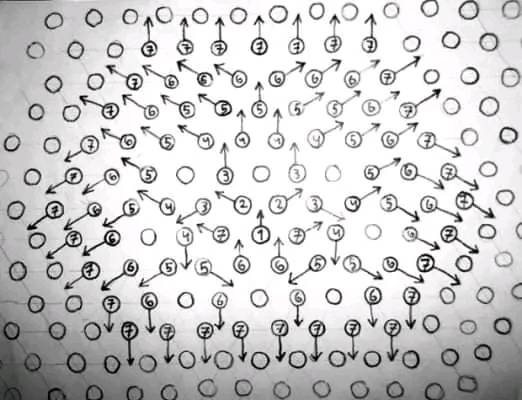
Undoubtedly, it is incredibly difficult to take into account all the factors even in a triangular or tetrider coordinate system, which is difficult even for visual perception. And in its direct form such a solution is impossible. But it is precisely this system that allows the logical formation of figures that we can see in water - a ring vortex or torus, similar to a figure eight (infinity) and a hexagon, similar to a snowflake or polar vortexes of gas giants.

Let's imagine a homogeneous medium that consists of individual particles. The only possible position of the particles relative to each other, at which absolute homogeneity is achieved, is a tetrider, or for simplicity, a triangular lattice in one plane, at the intersections of which the particles are located. Thus, all distances between particles are the same. Particles interact with each other by being attracted at a distance and repelled upon collision, which is caused by the forces of molecular attraction and repulsion.

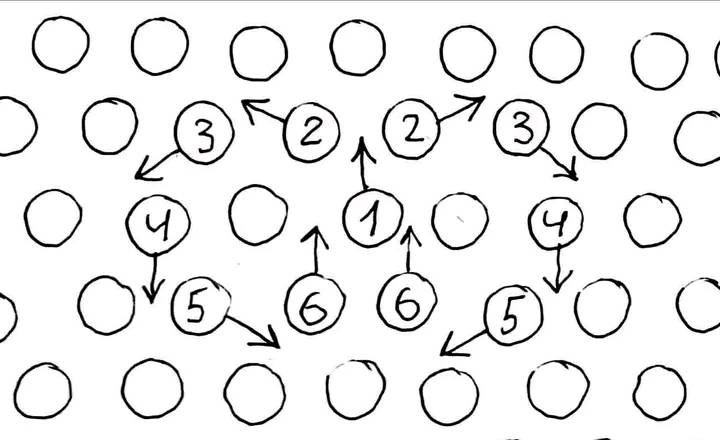
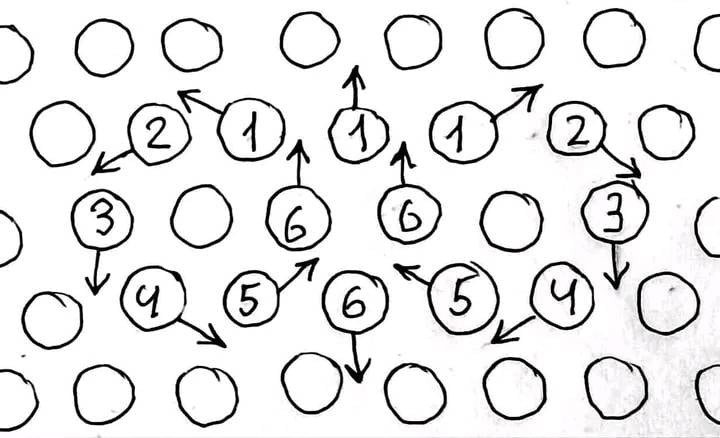
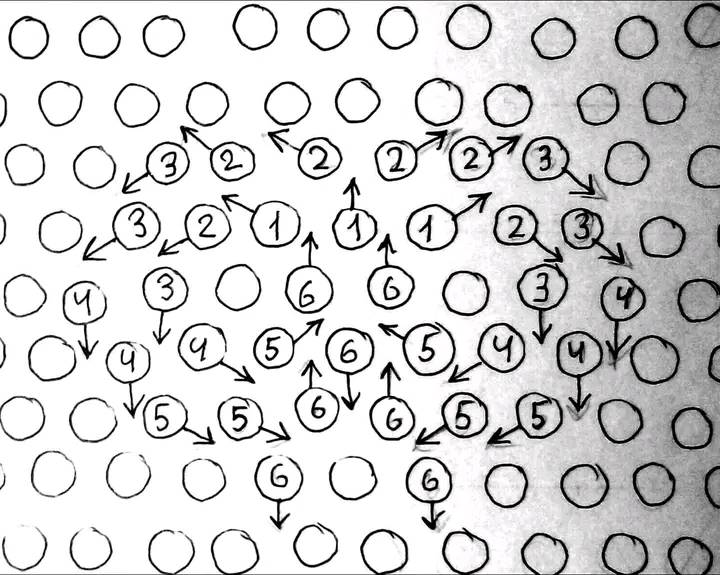
Now suppose one particle received an impulse and moved from its place in the direction of the other two. If we considered particles as billiard balls, then we could assume that the momentum would be divided into two. But in this case we have forces of molecular attraction and repulsion, which allow us to regard further interaction as a chain reaction similar to the domino principle, where momentum is transmitted indefinitely due to the force of gravity. Having logically followed the trajectory of the particles, we will see that the impulse in a circle on both sides, forming a figure eight, returned to the first part, which caused the action, which will lead to an endless repetition of the process. It is precisely this mechanism that underlies the ring vortex, which under ideal conditions, according to viscous friction, can exist endlessly dissipating its energy.
1707192044849.jpg


1707192052710.jpg
1707192059726.jpg
1707192064644.jpg
 
Physics news on Phys.org
Several remarks:
  • The Navier-Stokes equations themselves are derived for a continuum (in which all particles are smeared out over space) and thus have nothing to do with molecular interactions what so ever.
  • I've never seen or heard of the application of a triangular coordinate system, but I don't know that much about Mathematics, however, what I do know is that any coordinate system which is not orthogonal has as major disadvantage that movement in one direction is never independent from the other directions. Navier-Stokes are actually 3 equations. One equation for one dimension, this will then not work anymore.
  • The nice ordered hexagonal structure in the drawings you provide simply don't exist in a fluid, certainly not in a gas but also not in a liquid. So this molecular interaction you hypothesize has no influence whatsoever on the shapes you see on macro scale in a fluid.
  • You suggest we should solve for every fluid particle (molecule?). This is not even in the slightest way possible for any real application whatsoever. Even the tiniest of droplets contain way to many molecules for that to be feasible, have a look at Avogadro's constant...

MasterOgon said:
... where momentum is transmitted indefinitely due to the force of gravity.

Gravity on molecular scale is way too small to even be measurable. It has no effect on the local motion of molecules.

MasterOgon said:
Having logically followed the trajectory of the particles, we will see that the impulse in a circle on both sides, forming a figure eight, returned to the first part, which caused the action, which will lead to an endless repetition of the process. It is precisely this mechanism that underlies the ring vortex,

Absolutely not true. Where did you get this from?!?

MasterOgon said:
which under ideal conditions, according to viscous friction, can exist endlessly dissipating its energy.
This is an oxymoron...
 
  • Like
Likes   Reactions: MasterOgon
MasterOgon said:
Let's imagine a homogeneous medium that consists of individual particles. The only possible position of the particles relative to each other, at which absolute homogeneity is achieved, is a tetrider, ...

This is by the way also very much not true. Homogeneity has nothing to do with crystal structure. It just means that you have the same stuff everywhere, not how this stuff is organized in space (glass is homogeneous but amorphous, i.e. has no crystal structure). Note that density in a gas or to much lesser extent in liquid may vary (sound waves can only travel in an elastic medium, which by definition means variable density, sound also travels in water). Also, the reason that a liquid behaves as a liquid is because the molecules can move relatively freely in the medium.
 
  • Like
Likes   Reactions: MasterOgon
Thank you. My question was not corrected regarding the grid. This is a liquid model and if not every separate particle in reality, then their simplified generalization. I needed this in order to explain the impulse that the attached mass of air tells the plate after it stopped at the top point (video). I could not find this explanation anywhere.
feature=shared
 

Similar threads

  • · Replies 3 ·
Replies
3
Views
1K
  • · Replies 18 ·
Replies
18
Views
2K
  • · Replies 2 ·
Replies
2
Views
2K
Replies
20
Views
6K
  • · Replies 11 ·
Replies
11
Views
4K
  • · Replies 2 ·
Replies
2
Views
5K
  • · Replies 40 ·
2
Replies
40
Views
5K
  • · Replies 12 ·
Replies
12
Views
3K
  • · Replies 7 ·
Replies
7
Views
3K
  • · Replies 2 ·
Replies
2
Views
3K