Need my mind refreshed on geometry

9 replies · 1K views · last reply
You must make an attempt at answering it yourself before we can help you.

No one wants to open a strange link from a stranger. Write the problem up here. Supply the relevant equations.
 
  • Like
Likes   Reactions: phinds, berkeman and DaveE
Oops, my bad. Here is the attached image in jpg format.

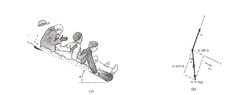
I solved the problem in this topic, but I want to geometrically prove a part of the solution (w cos alpha). I tried the concept of interior angles but it looks like I kind of forgot about it, which is why I'm asking for help in this forum (been reviewing the whole day, currently 3am in my country so the prof. is unavailable). I want to at least remember before I sleep how the angle alpha got there if the slope is angled from the horizontal.

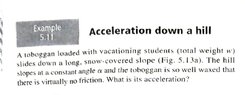
Textbook page showing Example 5.11, Acceleration down a hill, with a photo of a toboggan on a snowy slope and a free-body diagram of the toboggan on an incline labeled w sin alpha, w cos alpha, alpha, and w = mg.
 
Last edited by a moderator:
For clarity:
 
Attachments
  • Printed textbook page showing Example 5.11, Acceleration down a hill, with a problem about a toboggan with total weight w sliding frictionless down a snow-covered slope at constant angle alpha, asking for its acceleration.
    CamScanner 01-22-2025 03.24_1.jpg
    25.8 KB · Views: 97
  • Two-part figure: (a) line drawing of three people sliding down an incline on a sled, with angle alpha marked at the base of the slope; (b) free-body diagram with forces n, w = mg, w sin alpha and w cos alpha, angle alpha, axes x and y, and acceleration a.
    CamScanner 01-22-2025 03.24_2.jpg
    13.6 KB · Views: 107
ishigg said:
For clarity:
The only "work" that we have seen evidence of here is that you wanted to use "the concept of interior angles".

I do not know what the "concept of interior angles" is. Or what it has to do with this exercise.
 
ishigg said:
I want to at least remember before I sleep how the angle alpha got there if the slope is angled from the horizontal.
Yes, the slope of the hill is α. It is the angle between the force of gravity and the force on the toboggan ground from the ground toboggan. It "got there" because the toboggan is on a hill. It was given to you by the person that devised the problem.

Otherwise, I (we?) don't know what you are asking about. Show us some of your work; equations, sketches...

edit: oops! sorry, it's the force on the ground from the toboggan. 180o different.
 
Last edited:
Hello! Thank you everyone for your response! After using all my 4am energy on it, I think I finally got what I wanted to see.

I apologize if my line of questioning was unclear.

Please check if my work is accurate.

I wanted to show geometrically why angle alpha was used as an angle between the y component of the weight force and the weight force. Intuitively I know that it is true, but I felt like even though I knew how and why, it would not matter if I couldn't explain it to myself, for better understanding of the topic.

My work:
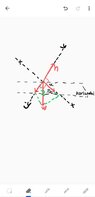
I first drew the FBD, and then added dotted lines representing the horizontal.

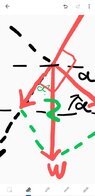
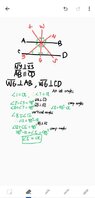
I then drew another diagram, turning vectors into line segments, extending the lines to find the angles and prove why it is alpha a.

See attached photos. Thank you for your feedback.
 
Attachments
  • Handwritten free-body diagram on an incline: red normal force n and weight w vectors, dashed x and y axes, horizontal dashed lines, angle alpha marked, and green dashed components of the weight.
    IMG_20250122_052304.jpg
    8.7 KB · Views: 92
  • Hand-drawn free-body diagram in red and black on a slope: a red weight vector W points straight down, with dashed black horizontal lines and a green dashed triangle, and a red right-angle construction of the components, with the angle alpha marked at the top.
    IMG_20250122_052316.jpg
    17.9 KB · Views: 98
  • Handwritten geometry diagram: two parallel lines AB and CD crossed by transversal lines labelled W, N, S, Y, G with angles marked 1 to 8 and alpha, plus green derivation of angle relations.
    IMG_20250122_052332.jpg
    16.9 KB · Views: 95
ishigg said:
I want to at least remember before I sleep how the angle alpha got there if the slope is angled from the horizontal.

View attachment 356172
I am guessing that you mean (in the following diagram): why is ##\angle CAD = \angle ABC##?

Geometry diagram of a line AB sloping down to the right, with vertical line AC dropping from A to a horizontal line through C and B, a red arrow from A pointing down toward C, and point D on a rectangle-like shape near A.

Note the red arrow represents the weight, BC is horizontal and ##\angle BCA = \angle DAB = 90^\circ##.

Let ##\alpha## be ##\angle ABC##.

Can you answer these questions?
Q1. How big is ##\angle BAC##?
Q2. How are ##\angle BAC## and ##\angle CAD## related?
Q3. How big is ##\angle CAD##?

Edits - spellings corrected.
 
  • Like
Likes   Reactions: gmax137, DaveE and ishigg
Thanks for your help! I actually answered my own inquiry already, (and posted it in the previous reply) but I'm glad to see your response.

Edit: I'm back

For Q1: it should be 90 - alpha
Q2: Complimentary
Q3: alpha

Can you check my earlier reply to this thread? I posted my work and I think our diagrams are similar. I have to admit it though, yours looks so much better!
 
Last edited:
  • Like
Likes   Reactions: Steve4Physics
ishigg said:
Can you check my earlier reply to this thread? I posted my work and I think our diagrams are similar. I have to admit it though, yours looks so much better!
It looks correct - but (IMO) is too long/complicated. In particular:
a) There is no need to label all 12 angles! Most are not needed.
b) The proof can be much shorter.
c) Your diagram (used for your proof) does not look much like the diagram in the original question - making your proof harder to follow.

A short/simple proof could, for example, be:

Since ##\angle 2 = 90^\circ## and the sum of internal angles in a triangle is ##180^\circ##:
##\angle 6 = 180^\circ - 90^\circ - \angle 1 = 90^\circ - \angle 1##

Since ##\angle 5 + \angle 6 = 90^\circ##:
##\angle 5 = 90^\circ - \angle 6 = 90^\circ - (90^\circ - \angle 1) = \angle 1##