Normality of errors and residuals in ordinary linear regression

  • Context: Undergrad 
  • Thread starter Thread starter fog37
  • Start date Start date
  • Tags Tags
    Errors
Click For Summary
SUMMARY

The discussion centers on the normality of residuals in ordinary linear regression, emphasizing that while the assumption of normally distributed residuals is commonly cited, it is not critical for model validity. Participants highlight that violations of this assumption can occur, particularly in cases where the dependent variable (Y) is constrained to positive values. They suggest that log transformations may be appropriate in such scenarios. The conversation also clarifies that the Gaussian error structure is not a fundamental requirement for regression analysis, but when assumed, it enhances the precision of least squares estimates.

PREREQUISITES
  • Understanding of ordinary linear regression principles
  • Familiarity with residual analysis and its significance
  • Knowledge of Gaussian distributions and their properties
  • Experience with statistical transformations, such as log transformations
NEXT STEPS
  • Explore the implications of non-normally distributed residuals in regression analysis
  • Learn about log transformations and their application in regression models
  • Investigate the use of Cochran's theorem in validating statistical assumptions
  • Study methods for assessing residual normality, including Q-Q plots and histograms
USEFUL FOR

Statisticians, data analysts, and researchers involved in regression modeling who seek to understand the implications of residual normality on model accuracy and validity.

fog37
Messages
1,566
Reaction score
108
TL;DR
Checking for normality of errors and residuals in ordinary linear regression
Hello,
In reviewing the classical linear regression assumptions, one of the assumptions is that the residuals have a normal distribution...I also read that this assumption is not very critical and the residual don't really have to be Gaussian.
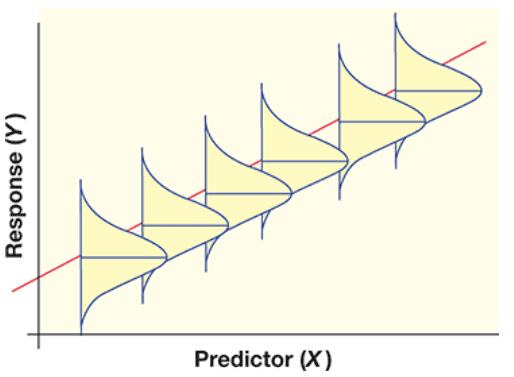
That said, the figure below show ##Y## values and their residuals with a normal distribution of equal variance at the ##X## value:
1704757020147.png


To check for residual normality, should we check the distribution of residuals at each ##X## (not very practical)? Instead, we usually plot a histogram of ALL the residuals at different X values...But that is not what the assumption is about (normality of residuals for each predictor ##X## value)...

Thank you...
 

Attachments

  • 1704756869482.png
    1704756869482.png
    11.7 KB · Views: 116
Physics news on Phys.org
fog37 said:
one of the assumptions is that the residuals have a normal distribution...I also read that this assumption is not very critical
Critical for what? You should probably be careful about any probability or confidence intervals that come from a model where the random term is not normal.
fog37 said:
and the residual don't really have to be Gaussian.
There are glaring and common examples that violate that assumption. If all the ##Y## must be positive, then a lot of the negative normal tail might be missing. If the random variance is a percentage of the ##Y## values, then a log transformation should be looked at.
fog37 said:
That said, the figure below show ##Y## values and their residuals with a normal distribution of equal variance at the ##X## value:

View attachment 338295

To check for residual normality, should we check the distribution of residuals at each ##X## (not very practical)? Instead, we usually plot a histogram of ALL the residuals at different X values...But that is not what the assumption is about (normality of residuals for each predictor ##X## value)...
True. A lot depends on the subject matter expertise of the statistician. Does he have a valid reason to model the subject as a linear model with a random normal term?
 
  • Like
Likes   Reactions: fog37
The assumption of a Gaussian error structure is not part of the basic regression assumptions. IF that assumption is added then things like the distributions of the LS estimates are exact rather than approximate as they are without it.

When the Gaussian assumption is made it is this: the error terms are i.i.d normal with mean 0 and variance sigma squared. This links to your picture of the bell curves superimposed on the regression line as follows:
- in this case Y1 through Yn are each normally distributed with mean b0 + bx1 and variance sigma squared
- the bell curves on the regression plot don't show the distribution of the errors, it is meant to show each normal distribution of the Y values

This leads to your question: we don't need to check the error distribution for each value of x since those values don't influence the error distributions: the error distributions are, as I mentioned above, i.i.d with mean 0 and constant variance, so the checks we use on them work

You should also remember this: there is no such thing as any data that is truly normally distributed: that is an ideal, and our checks are done simply to see whether our collected data's distribution is similar enough to that of the ideal to allow us to use normal-based calculations.
 
  • Like
Likes   Reactions: fog37 and FactChecker
I believe, using Cochran's theorem, it justifies the distribution of the associated Anova statistics.
 

Similar threads

  • · Replies 23 ·
Replies
23
Views
4K
  • · Replies 30 ·
2
Replies
30
Views
4K
  • · Replies 8 ·
Replies
8
Views
3K
  • · Replies 1 ·
Replies
1
Views
2K
  • · Replies 7 ·
Replies
7
Views
2K
  • · Replies 7 ·
Replies
7
Views
3K
  • · Replies 8 ·
Replies
8
Views
3K
  • · Replies 11 ·
Replies
11
Views
2K
Replies
3
Views
3K
  • · Replies 8 ·
Replies
8
Views
2K