Potentiometer : how that balancing point is reached?

Click For Summary
SUMMARY

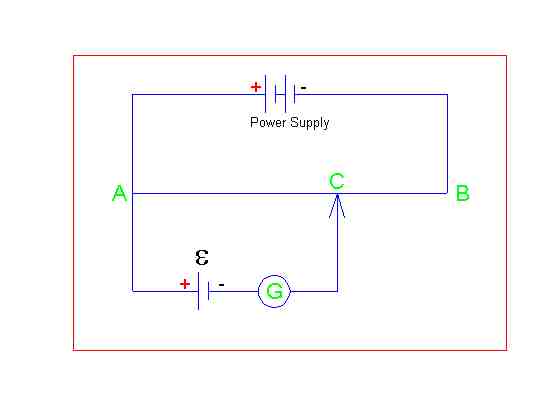
The discussion focuses on the operation of a potentiometer in measuring and comparing the electromotive force (emf) of cells. It establishes that the balancing point occurs when the current through the galvanometer is zero, indicating that the potential drop across the segment AC equals the emf of the cell. A key point raised is the application of Kirchhoff's voltage rule, which suggests that potential differences exist even in unbalanced conditions, leading to confusion regarding the definition of a balanced point.

PREREQUISITES
  • Understanding of potentiometer circuits
  • Familiarity with Kirchhoff's voltage law
  • Knowledge of electromotive force (emf) concepts
  • Basic circuit analysis skills
NEXT STEPS
  • Study the principles of potentiometer operation in detail
  • Learn about Kirchhoff's voltage law applications in circuit analysis
  • Explore the concept of balancing points in electrical circuits
  • Investigate the role of galvanometers in measuring current and voltage
USEFUL FOR

Students and professionals in electrical engineering, physics enthusiasts, and anyone interested in understanding the principles of potentiometers and circuit analysis.

fbgiant
Messages
4
Reaction score
0
When potentiometer is used to measure and compare emf of cells, how that balncing point is reached?...
this is the circuit diagram what i mentioned..
p23pot1.jpg


in the description it is said that at that balancing point (current through that galvanometer shows zero), potential drop across AC is equal to E emf of the cell.

But my doubt is that " by Kirchoff's voltage rule , consider that loop A-G-C-A, potential drop across AC is equal to E without any conditions like balanced or not. Then we have to say that each and every point is a balanced point, right?"
 
Physics news on Phys.org
In general, if the arrangement is not balanced, there will be a pd across the galvanometer, G. This will only be zero when the pd between A and C is equal to the emf of the cell
 
i can't understand.
even if it is balanced, there should be a pd across the galvanometer.(kirchoff's voltage rule).
the voltage in that closed loop should be zero...
technician said:
In general, if the arrangement is not balanced, there will be a pd across the galvanometer, G.
 
I do not have a good working knowledge of physics yet. I tried to piece this together but after researching this, I couldn’t figure out the correct laws of physics to combine to develop a formula to answer this question. Ex. 1 - A moving object impacts a static object at a constant velocity. Ex. 2 - A moving object impacts a static object at the same velocity but is accelerating at the moment of impact. Assuming the mass of the objects is the same and the velocity at the moment of impact...

Similar threads

  • · Replies 2 ·
Replies
2
Views
3K
Replies
12
Views
1K
  • · Replies 11 ·
Replies
11
Views
3K
  • · Replies 26 ·
Replies
26
Views
7K
  • · Replies 13 ·
Replies
13
Views
12K
  • · Replies 4 ·
Replies
4
Views
2K
  • · Replies 2 ·
Replies
2
Views
13K
  • · Replies 6 ·
Replies
6
Views
9K
  • · Replies 2 ·
Replies
2
Views
2K
Replies
5
Views
3K