Predicates and Models ... Goldrei

  • Context: Undergrad 
  • Thread starter Thread starter Math Amateur
  • Start date Start date
  • Tags Tags
    Models
Click For Summary

Discussion Overview

The discussion revolves around the representation of the mathematical expression "x < y" using predicates and models as presented in Goldrei's book. Participants seek clarification on Exercise 4.5, specifically how the expression can be formulated using existential quantifiers and logical operators. The scope includes theoretical understanding of predicate calculus and its application in formal logic.

Discussion Character

  • Exploratory
  • Technical explanation
  • Debate/contested

Main Points Raised

  • Some participants express difficulty in reading the scanned images of the book, particularly regarding the symbols used in the exercise.
  • One participant clarifies that the symbol "*" represents addition, leading to the interpretation of the expression as "there exists a z such that x + z = y and x ≠ y."
  • Another participant suggests that the notation could be clearer if the variable z were placed outside the brackets, although this is how it appears in the book.
  • There is a discussion on the validity of the formulas in different domains of quantification, with one participant noting that the first formula could represent "less than" in the context of real numbers or rationals, while another later corrects this, stating it only represents "not equal" in those domains.
  • Participants explore the implications of the second formula, which includes the condition z ≠ 0, and its applicability across different number sets.

Areas of Agreement / Disagreement

Participants do not reach a consensus on the correct representation of the "less than" predicate across different domains. There are competing interpretations regarding the applicability of the formulas in various mathematical contexts.

Contextual Notes

Some assumptions about the symbols and their meanings are not fully clarified, leading to uncertainty in the interpretation of the predicates. The discussion highlights the importance of notation clarity in formal logic.

Math Amateur
Gold Member
MHB
Messages
3,920
Reaction score
48
I am reading Goldrei's book: "Propositional and Predicate Calculus: A Model of Argument", Chapter 4: Predicates and Models.

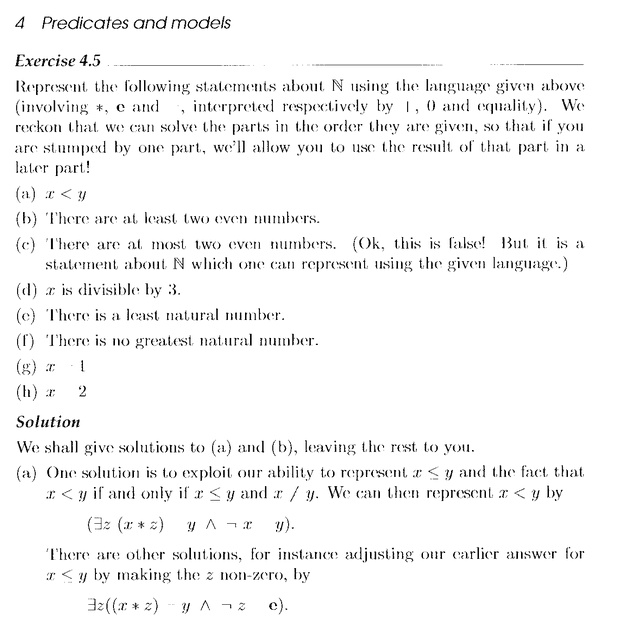
I need help in understanding Goldrei's answer to Exercise 4.5 (a) ...

Exercise 4.5 together with Goldrei's solution reads as follows:
Goldrei page 138.png


Can someone please explain exactly how x < y can be represented by

## ( \exists z \ (x * z) = y \land \neg x = y ) ##
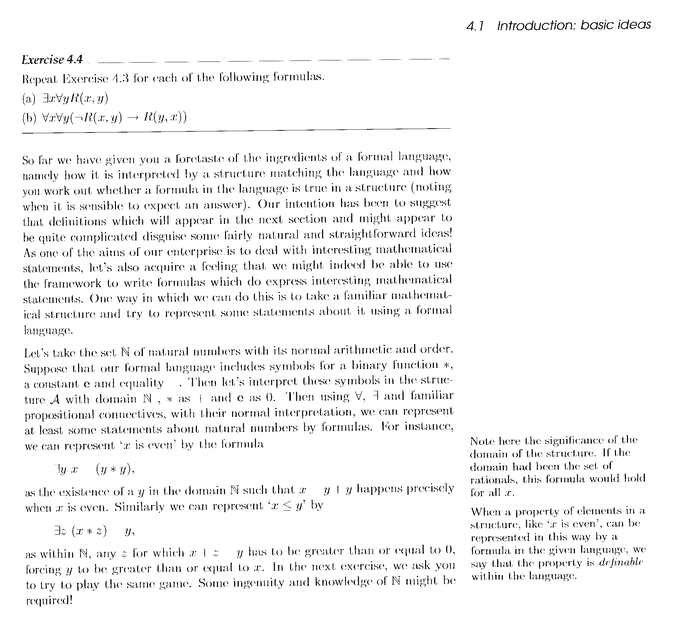
Help will be much appreciated.Goldrei mentions the language given above ... that reads as follows:
Goldrei page 137.png

Peter
 
Physics news on Phys.org
Your scanned or photographed images are difficult to read, especially because some symbols don't show up.
In the image for ex. 4.5, it says "(involving *, e and , interpreted respectively by 1 (?), 0, and equality)." It looks like whatever was written after "and" doesn't show up. Possibly it was in a different color. Also, is the first symbol after "respectively by" the digit 1 or the symbol |? It looks like the latter, but I don't know what that means in this context.

Math Amateur said:
Can someone please explain exactly how x < y can be represented by
##(\exists z (x * z) = y \wedge \neg x = y)##
The text in the second image is smaller, so more difficult to read. Several symbols in the explanation in this image also don't show up, so I still don't understand what is meant by *.
 
* represents addition (I agree it's very tough to read). In more standard mathematical language:
$$( \exists z \ (x * z) = y \land \neg x = y )$$
says that there's a ##z## such that ##x+z=y## and ##x\neq y##. Alternatively, the other explanation
$$( \exists z \ (x * z) = y \land \neg z = \mathbf{e} )$$
says that there's a ##z## such that ##x+z=y## and ##z\neq 0##.
 
  • Like
Likes   Reactions: Math Amateur
TeethWhitener said:
Alternatively, the other explanation
$$( \exists z \ (x * z) = y \land \neg z = \mathbf{e} )$$
says that there's a ##z## such that ##x+z=y## and ##z\neq 0##.
For clarity of notation, I think it is probably better to have the ##z## variable to be outside all of the brackets.

===========One thing to note about these formulas is that since the predicate is of the form ##less(x,y)##, any variables other than ##x## and ##y## that are used must be bound. This is true in general regardless of the specific predicate so it is worth a mention [since checking for it can sometimes help identify a mistake in more complicated formulas].

Also, I agree that it is not difficult to understand the solution if you write it with more familiar symbols.
(1) ##\exists z [x+z=y] \land (x\neq y)##
(2) ##\exists z [(x+z=y) \land (z\neq 0)]##

In the first formula if you look separately at:
##\exists z [x+z=y] ##
then this is just the representation of predicate ##x \leq y##. So the first formula is just saying that ##x<y## iff we have (i) ##x \leq y## and (ii) ##x \neq y##.
 
Last edited:
  • Like
Likes   Reactions: Math Amateur
SSequence said:
For clarity of notation, I think it is probably better to have the z variable to be outside all of the brackets.
I agree, but that’s how it was written in the book. Not sure why.
 
TeethWhitener said:
I agree, but that’s how it was written in the book. Not sure why.
Given the first image posted in OP, the book does put ##\exists z## outside all of the brackets in the second formula!

Anyway, it also occurred to me that formula-(1) in post#4 also works [as in correctly describes "less than" predicate] even if the domain of quantification is ##\mathbb{R}## or ##\mathbb{Q}##. However, while formula-(2) works for ##\mathbb{N}##, it doesn't work for ##\mathbb{R}## or ##\mathbb{Q}##.
 
  • Like
Likes   Reactions: TeethWhitener and Math Amateur
SSequence said:
Anyway, it also occurred to me that formula-(1) in post#4 also works [as in correctly describes "less than" predicate] even if the domain of quantification is ##\mathbb{R}## or ##\mathbb{Q}##.
Sorry for the mistake. Formula-(1) in post#4 doesn't represent the "less than" predicate either [if the domain of quantification is ##\mathbb{R}## or ##\mathbb{Q}##]. It represents the "not equal" predicate in that case.

In fact, if we look at it:
(1) ##\exists z [x+z=y] \land (x\neq y)##
Then basically it is just equivalent to the predicate ##x\neq y## if the domain of quantification is ##\mathbb{R}##, ##\mathbb{Q}## or ##\mathbb{Z}##.And while we are at it, we might also look at the second formula:
(2) ##\exists z [(x+z=y) \land (z\neq 0)]##
This formula is also equivalent to the predicate ##x\neq y## if the domain of quantification is ##\mathbb{R}##, ##\mathbb{Q}## or ##\mathbb{Z}##.
 
Last edited:

Similar threads

  • · Replies 5 ·
Replies
5
Views
2K
  • · Replies 10 ·
Replies
10
Views
1K
  • · Replies 3 ·
Replies
3
Views
2K
  • · Replies 4 ·
Replies
4
Views
3K
  • · Replies 23 ·
Replies
23
Views
4K
  • · Replies 2 ·
Replies
2
Views
2K
  • · Replies 2 ·
Replies
2
Views
2K
  • · Replies 3 ·
Replies
3
Views
2K
  • · Replies 1 ·
Replies
1
Views
2K
  • · Replies 11 ·
Replies
11
Views
4K