Proving A + B is smallest and A ∩ B is largest submodule

  • Level: Undergrad 
  • Thread starter Math Amateur
  • Start date
2 replies · 3K views · last reply
Math Amateur
Gold Member
MHB
Messages
3,920
Reaction score
48
I am reading T. S. Blyth's book "Module Theory: An Approach to Linear Algebra" ... ... and am currently focussed on Chapter 2: Submodules; Intersections and Sums ... ...

I need help with understanding two claims that Blyth makes concerning submodules ...

The relevant text is as follows: ( see end of post for other text that may be relevant)
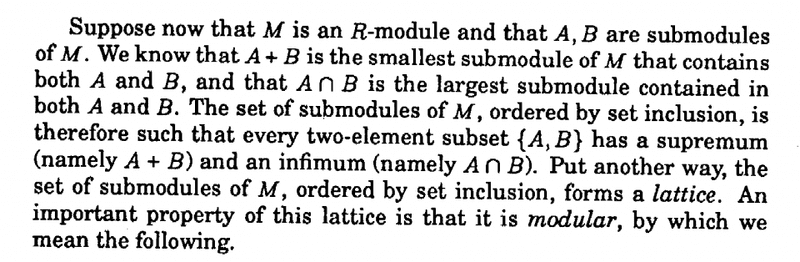
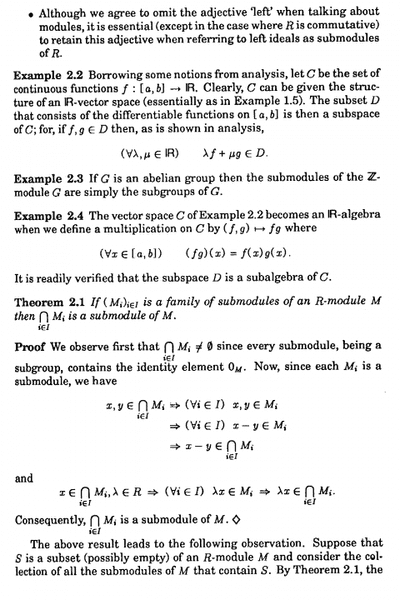
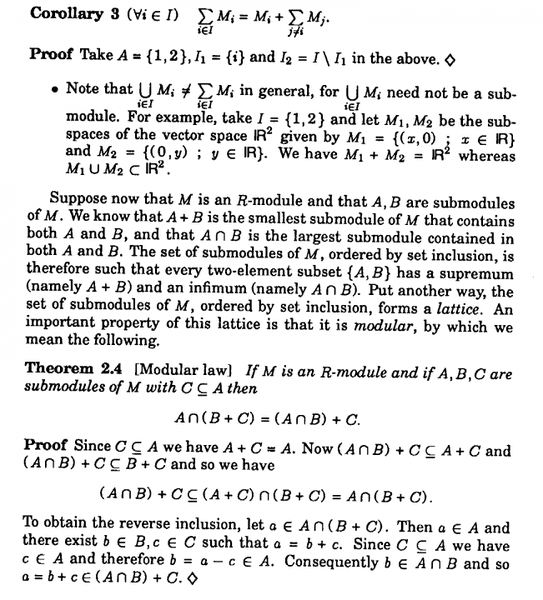
Printed page of text from a module theory book: submodules A and B of module M, A + B as smallest containing submodule, A ∩ B as largest contained submodule, and the modular lattice property.

I have two questions concerning the above text ... ...
Question 1In the above text we read:

" ... ... We know that ##A + B## is the smallest submodule of ##M## that contains both ##A## and ##B##, ... ... "My question is: how exactly do we know this ... ? How would we formally and rigorously prove this ... ?
Question 2In the above text we read:

" ... ... and that ##A \cap B## is the largest submodule contained in both ##A## and ##B##, ... ... "My question is: how exactly do we know this ... ? How would we formally and rigorously prove this ... ?Hope that someone can help with the above two questions ...

Peter

==============================================================================

PS Just in case readers need to reference some of Blyth's definitions or theorems in Chapter 2, I am providing the relevant text as follows:
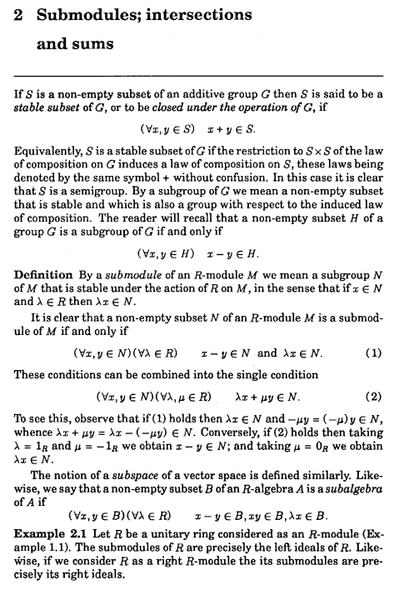
Printed textbook page, Section 2 'Submodules; intersections and sums', giving the definition of a submodule of a module M over a ring R with conditions (1) and (2).

Printed textbook page on submodules: a bullet remark on dropping the word 'left', Examples 2.2 to 2.4 on function spaces and algebras, Theorem 2.1 with its proof that an intersection of submodules is a submodule.

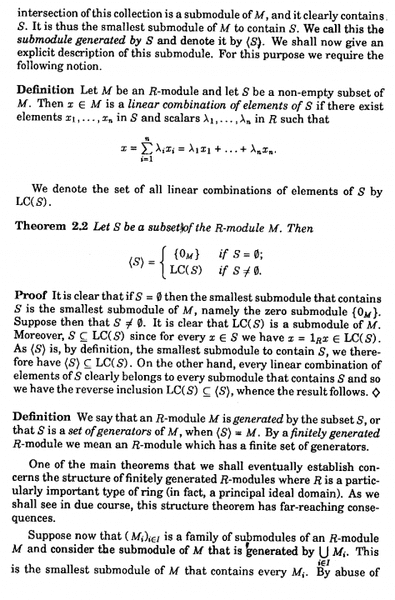
Scanned page of a textbook on module theory, covering the submodule generated by a set, linear combinations, Theorem 2.2, and definitions of generated and finitely generated modules.

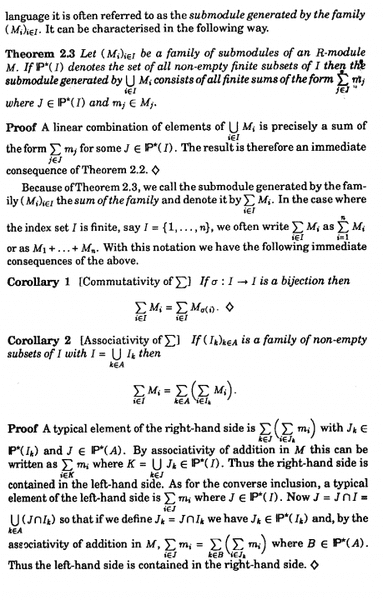
Printed textbook page with definitions and theorems on submodules: Theorem 2.3 on sums of a family of submodules, its proof, and Corollaries 1 and 2 on commutativity and associativity of sums.

Printed textbook page showing Corollary 3, a proof with a counterexample about unions of submodules, Theorem 2.4 (modular law) with its proof, and the lattice of submodules discussion.
 
Attachments
  • Printed page of text from a module theory book: submodules A and B of module M, A + B as the smallest submodule containing both, A ∩ B as the largest contained in both, forming a modular lattice.
    Blyth - Modules ch 2 .. A plus B ... and ... A intersect B ....png
    40.9 KB · Views: 669
  • Printed textbook page, section 2 'Submodules; intersections and sums', giving the definition of a submodule and conditions (1) and (2) for it, plus an example about ideals of a ring R.
    Blyth - 1 - Chapter 2 - Page 1 ... ....png
    39.4 KB · Views: 748
  • Page of printed mathematical text covering submodules, subrings and examples in analysis, followed by Theorem 2.1 that an arbitrary intersection of submodules is a submodule, with its proof.
    Blyth - 2 - Chapter 2 - Page 2 ... ....png
    40.6 KB · Views: 769
  • Scanned page of printed text from a algebra textbook covering submodules, linear combinations, Theorem 2.2 with its piecewise definition of the submodule generated by S, and the definition of generated and finitely generated modules.
    Blyth - 3 - Chapter 2 - Page 3 ... ....png
    52.9 KB · Views: 641
  • Page of printed text from a algebra textbook covering submodule sums and families of submodules, with Theorem 2.3, Proof, Corollaries 1 and 2, and associativity of sums.
    Blyth - 4 - Chapter 2 - Page 4 ... ....png
    48.3 KB · Views: 676
  • Typeset page from a module theory textbook showing Corollary 3, Proof with a counterexample using subspaces of R^2, and Theorem 2.4 (Modular law) with its proof.
    Blyth - 5 - Chapter 2 - Page 5 ... ....png
    67.3 KB · Views: 717
Math Amateur said:
" ... ... We know that ##A+B## is the smallest submodule of ##M## that contains both ##A## and ##B##, ... ... "
My question is: how exactly do we know this ... ? How would we formally and rigorously prove this ... ?
How are ##A+B## and ##LC(A\cup B)## related?
Then given any submodule ##C \subseteq M## which contains both, ##A## and ##B##, does it contain ##LC(A\cup B)##? And why?

Math Amateur said:
" ... ... and that ##A \cap B## is the largest submodule contained in both ##A## and ##B##, ... ... "
My question is: how exactly do we know this ... ? How would we formally and rigorously prove this ... ?
By theorem 2.1 ##A\cap B## is a submodule of ##M##. Then how are ##A\cap B## and ##LC(A\cap B)## related?
Now given any submodule ##C##, that is contained in ##A## as well as in ##B##, is it contained in ##A\cap B## or ##LC(A\cap B)##? And why?

And at last: If you know all this about any possible submodule ##C \subseteq M##, what does it tell you?
 
  • Like
Likes   Reactions: Math Amateur
Proof of Q1.
Define [itex]A+B\equiv \{a+b\ :\ a\in A\wedge b\in B\}[/itex]. This is easily shown to be closed under addition and scalar multiplication, and hence a module. It must be a subset of [itex]M[/itex] because [itex]M[/itex] is closed under addition and scalar multiplication and every element of [itex]A+B[/itex] can be expressed as the addition or scalar, multiplication of elements of [itex]A[/itex] and/or [itex]B[/itex], which are elements of [itex]M[/itex].

Let ##G_A## and ##G_B## be generating sets for ##A## and ##B## respectively. Then, by the definition of [itex]A+B[/itex], [itex]G_A\cup G_B[/itex] is a generating set for [itex]A+B[/itex].

Let [itex]C[/itex] be a submodule of [itex]M[/itex] that contains [itex]A[/itex] and [itex]B[/itex]. Then [itex]C[/itex] contains both [itex]G_A[/itex] and [itex]G_B[/itex] and hence contains [itex]G_A\cup G_B[/itex]. Any element of [itex]A+B[/itex] is a finite linear combination of elements of [itex]G_A\cup G_B[/itex] and, since that union is in [itex]C[/itex] which, being a module, is closed under finite linear combinations, the element must also be in [itex]C[/itex]. So we have [itex]A+B\subseteq C[/itex].

I imagine the proof for Q2 may be similar but using intersections of generating sets rather than unions. Why not have a go at that and let me know if you get stuck.

Andrew
 
  • Like
Likes   Reactions: Math Amateur