Proving Sin(120) = Sin(60) with Trigonometry

  • Thread starter Thread starter simphys
  • Start date Start date
  • Tags Tags
    Trigonometry
simphys
Messages
327
Reaction score
46
Homework Statement
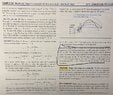
Please refer to the picture (not really needed) so that you are able to see in what context it is meant. —> question is under the figure
Relevant Equations
R=v^2sin^2(2alpha) / g
It is about that the rznge of 60 degrees = R of 30 degrees, but how would I prove that?

Sin(120) needs to equal sin(60)
How can i prove that theyll be the same range(without air resistance?)

My take: (only looking at the sin(alpha) part as that neefs to be equal)

using trig identity
- Sin(120) = sin(90+30) = sin90cos30 + 0 = cos 30
- Sin(60) = cos30 compelemntary

So they’ll be equal.

Not really comfortable with complementary anglesso wanted to assure that this is correct. TIA!
 

Attachments
  • 77CBD9BF-EB31-46D7-A6D5-BB7C019504C9.jpeg
    77CBD9BF-EB31-46D7-A6D5-BB7C019504C9.jpeg
    108.3 KB · Views: 179
Last edited:
simphys said:
Not really comfortable with complementary angles so wanted to assure that this is correct
As pointed out, the expression for ##R## contains a sine, not sin^2.

Solving ##R_1 = R_2## with same ##v## and ##g## ends up with an equation ##\sin 2\alpha_1 = \sin 2\alpha_2##. Draw a plot of ##\sin 2\alpha## for ##\ [0,{\pi\over 2}]\ ## to see the relationship between ##\alpha_1## and ##\alpha_2##.

##\ ##
 
Lnewqban said:
I believe the relevant equation is incorrect, the way is shown in the OP.
Please, see:
https://courses.lumenlearning.com/boundless-physics/chapter/projectile-motion/

I would draw those two double angles (2x30 and 2x60) and see what you can deduce at a glace regarding the value of their sines for that particular combination of launch angles (30 and 60).
Thanks for the help! and indeed, it was a typo, my apologies.
BvU said:
As pointed out, the expression for ##R## contains a sine, not sin^2.

Solving ##R_1 = R_2## with same ##v## and ##g## ends up with an equation ##\sin 2\alpha_1 = \sin 2\alpha_2##. Draw a plot of ##\sin 2\alpha## for ##\ [0,{\pi\over 2}]\ ## to see the relationship between ##\alpha_1## and ##\alpha_2##.

##\ ##
Thanks for the help as well! (and that was indeed a type my apologies)You guys said to draw, I didn't think of it at all, was solving it algebraically, thanks for the tip!
 
  • Like
Likes   Reactions: Lnewqban

Similar threads

  • · Replies 1 ·
Replies
1
Views
1K
  • · Replies 8 ·
Replies
8
Views
3K
  • · Replies 1 ·
Replies
1
Views
2K
Replies
9
Views
5K
  • · Replies 7 ·
Replies
7
Views
3K
  • · Replies 9 ·
Replies
9
Views
3K
  • · Replies 20 ·
Replies
20
Views
11K
  • · Replies 14 ·
Replies
14
Views
5K
  • · Replies 3 ·
Replies
3
Views
2K
  • · Replies 1 ·
Replies
1
Views
3K