Proving Sin(120) = Sin(60) with Trigonometry

  • Thread starter Thread starter simphys
  • Start date Start date
  • Tags Tags
    Trigonometry
Join the discussion
Registration is free. Ask a follow-up in this thread, or start your own.
3 replies · 3K views
simphys
Messages
327
Reaction score
46
Homework Statement
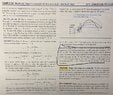
Please refer to the picture (not really needed) so that you are able to see in what context it is meant. —> question is under the figure
Relevant Equations
R=v^2sin^2(2alpha) / g
It is about that the rznge of 60 degrees = R of 30 degrees, but how would I prove that?

Sin(120) needs to equal sin(60)
How can i prove that theyll be the same range(without air resistance?)

My take: (only looking at the sin(alpha) part as that neefs to be equal)

using trig identity
- Sin(120) = sin(90+30) = sin90cos30 + 0 = cos 30
- Sin(60) = cos30 compelemntary

So they’ll be equal.

Not really comfortable with complementary anglesso wanted to assure that this is correct. TIA!
 

Attachments
  • 77CBD9BF-EB31-46D7-A6D5-BB7C019504C9.jpeg
    77CBD9BF-EB31-46D7-A6D5-BB7C019504C9.jpeg
    108.3 KB · Views: 182
Physics news on Phys.org
Last edited:
simphys said:
Not really comfortable with complementary angles so wanted to assure that this is correct
As pointed out, the expression for ##R## contains a sine, not sin^2.

Solving ##R_1 = R_2## with same ##v## and ##g## ends up with an equation ##\sin 2\alpha_1 = \sin 2\alpha_2##. Draw a plot of ##\sin 2\alpha## for ##\ [0,{\pi\over 2}]\ ## to see the relationship between ##\alpha_1## and ##\alpha_2##.

##\ ##
 
Lnewqban said:
I believe the relevant equation is incorrect, the way is shown in the OP.
Please, see:
https://courses.lumenlearning.com/boundless-physics/chapter/projectile-motion/

I would draw those two double angles (2x30 and 2x60) and see what you can deduce at a glace regarding the value of their sines for that particular combination of launch angles (30 and 60).
Thanks for the help! and indeed, it was a typo, my apologies.
BvU said:
As pointed out, the expression for ##R## contains a sine, not sin^2.

Solving ##R_1 = R_2## with same ##v## and ##g## ends up with an equation ##\sin 2\alpha_1 = \sin 2\alpha_2##. Draw a plot of ##\sin 2\alpha## for ##\ [0,{\pi\over 2}]\ ## to see the relationship between ##\alpha_1## and ##\alpha_2##.

##\ ##
Thanks for the help as well! (and that was indeed a type my apologies)You guys said to draw, I didn't think of it at all, was solving it algebraically, thanks for the tip!
 
Reply
  • Like
Likes   Reactions: Lnewqban