Science Advisor
- 934
- 312
I know it did not rain on Tatooine and the planet does not exist.
My question is would a rainbow look like on a planet in a binary star system?
Assume that it does rain, the raindrops come in a broad range of sizes including some showers with fairly uniform drop size, and that there is an atmosphere with similar density and light scattering as earth.
I expect that blue stars will have more intense blue bands and red stars create more intense red. Is that always correct?
I believe the rainbow would be identical to a rainbow on Earth at the point where the bow's tangent line is parallel to the line connecting the stars. I am not sure what happens on the rest of the arc. Would it look like a reflection rainbow. Except that the arcs would not converge at the horizon.
 It is also not clear to me what supernumary rainbows would look like. They are created by an interference pattern but does that mean a binary star system has more of them, less, or relatively the same?
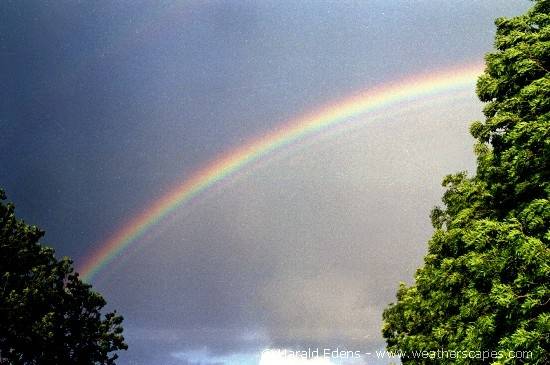
Feel free to add any ideas on what effect a different atmosphere would have.
My question is would a rainbow look like on a planet in a binary star system?
Assume that it does rain, the raindrops come in a broad range of sizes including some showers with fairly uniform drop size, and that there is an atmosphere with similar density and light scattering as earth.
I expect that blue stars will have more intense blue bands and red stars create more intense red. Is that always correct?
I believe the rainbow would be identical to a rainbow on Earth at the point where the bow's tangent line is parallel to the line connecting the stars. I am not sure what happens on the rest of the arc. Would it look like a reflection rainbow. Except that the arcs would not converge at the horizon.
Feel free to add any ideas on what effect a different atmosphere would have.