What Causes Huge Raman Shifts in Water?

Click For Summary
SUMMARY

The discussion centers on the significant Raman shifts observed in water, particularly a peak at 2100 cm^-1 that is 15 times higher than the typical hydrogen stretching peak at 3430 cm^-1. Participants debate the potential causes of these shifts, with some attributing them to experimental artifacts or impurities rather than genuine molecular changes. The original study referenced was conducted by scientists at the Chinese National Academy of Science, suggesting a possible alteration in the inter-molecular structure of water. The conversation highlights the need for rigorous experimental details to validate such findings.

PREREQUISITES
  • Understanding of Raman spectroscopy principles
  • Familiarity with molecular vibrations and spectral lines
  • Knowledge of water's molecular structure and behavior
  • Experience with spectroscopic equipment, specifically Raman spectrometers
NEXT STEPS
  • Research the principles of Raman spectroscopy and its applications
  • Explore the effects of temperature and impurities on Raman spectra
  • Investigate the specifications and advancements in modern Raman spectrometers
  • Study the molecular dynamics of water and how they relate to spectral shifts
USEFUL FOR

Researchers, students, and professionals in the fields of chemistry and physics, particularly those interested in spectroscopy and molecular analysis.

Rainbows_
Hi,

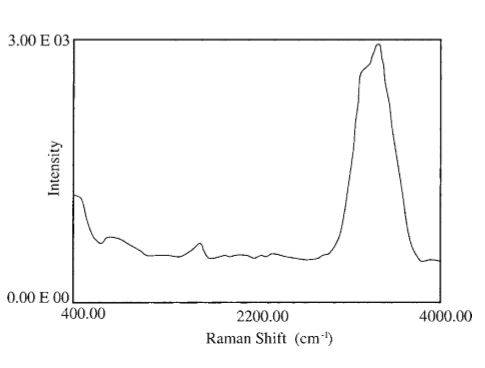
The following is the typical raman spectra of water.
dGSsdP.jpg

In their normal form, water molecules maintain a simple configuration: an oxygen atom is in the center and two hydrogen atoms are on the two sides symmetrically. Under ambient conditions, water molecules within liquid water give rise to a strong Raman shift peak at 3,430 cm^-1 and a weaker peak at 1,635 cm^-1, respectively.
The background laser Raman spectra showed that there is a stretching vibrational peak for OH at 3,410 cm^-1, and a deformed and weak vibrational peak for HOH at 1,635 cm^-1 at about 12 C.

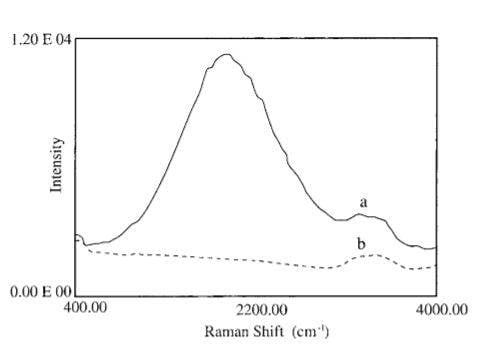
Now look at the following Raman spectra of the same water.
6JSjWX.jpg


Notice the 15 times bigger raman shift centered at 2100 cm^-1 and the spectral intensity of the peak is about 15 times higher than the strong hydrogen stretching peak at 3,430 cm..
Does anyone know what can cause such huge raman shifts.. what do you need to do to water before it can cause such effect for instance? And what part of the molecules are affected? What is your opinion?
 
Physics news on Phys.org
This looks as if it is taken from a paper. What does the caption of the picture say a and b are?
 
mjc123 said:
This looks as if it is taken from a paper. What does the caption of the picture say a and b are?

The second or b is after the water was put inside a microwave oven. I need to know what molecular structure in the water were altered. I know Stroke lines means the substance gain energy and the scattered photons lose energy and anti strokes means the scattered photons gain energy after the substance lost the energy from excited states. Since the peak was on the left.. does it means it is Stroke lines or the position is independent whether it is stroke or antistroke?

Also I'd like to understand something. There are of millions of hydrogen-oxygen molecules in the water. How can millions of hydrogen stretching contribute to the same Raman peak at 3430 cm^-1? Does it mean if the water has less volume, the 3430 cm^-1 would be less?
 
Rainbows_ said:
Does anyone know what can cause such huge raman shifts.. what do you need to do to water before it can cause such effect for instance? And what part of the molecules are affected? What is your opinion?

To seriously answer such questions, there is need for more information about experimental details.
 
Lord Jestocost said:
To seriously answer such questions, there is need for more information about experimental details.

It was a lab result by amateur students and I think the result is wrong. Because when water is subjected to microwave exposure, it shouldn't change the molecular structure.. so it generally makes me interested in spectroscopy particularly Raman and I just want to build up my knowledge of it. It was wrong to use Intermediate in the title and should be more of Beginner.

How does one change the molecular structure of any substance to exhibit various raman shifts.. is there any table or public data about this?

Someone who studies Raman spectroscopy here?
 
I found this here: http://homepages.ihug.co.nz/~sai/DrYan_qi-wtr.html
Without being an expert on "external qi", it looks like completely unscientific drivel, especially when it says the same results were obtained applying the qi over a distance of 1900 km.
I don't know what that very broad intense peak is, but it's nothing to do with the molecular structure of water. Molecular Raman bands are much narrower, as in your first spectrum, and for water are quite weak - that's why you can do Raman on aqueous solutions, while you can't do IR. I would suspect the feature, if real, was due to fluorescence of some impurity - maybe the microwave helps it dissolve? But if it was done by amateur students, it may well be an experimental artefact.
 
mjc123 said:
I found this here: http://homepages.ihug.co.nz/~sai/DrYan_qi-wtr.html
Without being an expert on "external qi", it looks like completely unscientific drivel, especially when it says the same results were obtained applying the qi over a distance of 1900 km.
I don't know what that very broad intense peak is, but it's nothing to do with the molecular structure of water. Molecular Raman bands are much narrower, as in your first spectrum, and for water are quite weak - that's why you can do Raman on aqueous solutions, while you can't do IR. I would suspect the feature, if real, was due to fluorescence of some impurity - maybe the microwave helps it dissolve? But if it was done by amateur students, it may well be an experimental artefact.

Oh, you found the source. I was trying to analyze how the Raman shifts can occur. It was done not only by students but by scientists at the Chinese National Academy of Science. They reported: "These results, for the first time, indicate that the structure of liquid water at the molecular level, most likely the inter-molecule structure, experienced a dramatic change—perhaps some kind of ordering or coherency among individual water molecules".

So can some kind of ordering or coherency among individual water molecules produce the huge Raman shifts.. or what kind of effects must you do to the molecules to produce roughly the effect?
 
Rainbows_ said:
I was trying to analyze how the Raman shifts can occur. It was done not only by students but by scientists at the Chinese National Academy of Science. They reported: "These results, for the first time, indicate that the structure of liquid water at the molecular level, most likely the inter-molecule structure, experienced a dramatic change—perhaps some kind of ordering or coherency among individual water molecules".

Probably, you're flogging a dead horse. This work seems to be a hoax.
 
Lord Jestocost said:
Probably, you're flogging a dead horse. This work seems to be a hoax.

To make us feel more comfortable. Let's assume it was a hoax then. I should have just drawn it. My point is I just got curious about Raman spectroscopy in general and wondered what sort of molecule dynamics can you do where a broader Raman peak would be produced instead of just a narrow one. Anyone got an idea? This would increase my knowledge about spectroscopy in general and Raman in particular...
 
  • #10
Rainbows_ said:
To make us feel more comfortable. Let's assume it was a hoax then. I should have just drawn it. My point is I just got curious about Raman spectroscopy in general and wondered what sort of molecule dynamics can you do where a broader Raman peak would be produced instead of just a narrow one. Anyone got an idea? This would increase my knowledge about spectroscopy in general and Raman in particular...

I recommend to read the Wikipedia entry "Spectral line": https://en.wikipedia.org/wiki/Spectral_line#Broadening_and_shift
 
  • #11
Who is the most extreme expert of Raman Spectroscopy here in this forum? Can you please share how you can emulate or simulate a broad raman shift in water.. like what molecular structural changes must occur for that to happen? I understand there is a narrow stretching vibrational peak for OH at 3,410 cm^-1.. however if the entire water molecules are put in resonance of some kind can a broad Raman shift occurs? What substance have you seen similar large broad Raman shifts and why?
 
  • #12
Well, it's some time since I did any Raman spectroscopy, but I know a bit about it, and (speaking under correction) I can't think of any kind of "molecular structural changes" in water that would produce anything at all like the observed "results". Molecular vibrations just don't produce that kind of very broad band. The nearest thing I can think of is hydrogen-bonded O-H vibrations in IR spectra, and they are at higher frequency (ca. 2500-3500 cm-1), and would be much weaker in Raman. You aren't going to get a band that intense out of water, from the physics of it. Raman scattering arises from the polarisability of molecules; a highly polarisable molecule like I2 will give strong Raman scattering, but one of low polarisability like water will give weak scattering. As I said, the most likely origin of such a feature, if it is real, is probably fluorescence of some dissolved impurity.
I think you are barking up the wrong tree, frankly. Given the dubiousness of the source, the "results" are very doubtful, especially when they claim to get exactly the same results when applying the "effect" from 1900 km.
 
  • Like
Likes   Reactions: Rainbows_
  • #13
mjc123 said:
Well, it's some time since I did any Raman spectroscopy, but I know a bit about it, and (speaking under correction) I can't think of any kind of "molecular structural changes" in water that would produce anything at all like the observed "results". Molecular vibrations just don't produce that kind of very broad band. The nearest thing I can think of is hydrogen-bonded O-H vibrations in IR spectra, and they are at higher frequency (ca. 2500-3500 cm-1), and would be much weaker in Raman. You aren't going to get a band that intense out of water, from the physics of it. Raman scattering arises from the polarisability of molecules; a highly polarisable molecule like I2 will give strong Raman scattering, but one of low polarisability like water will give weak scattering. As I said, the most likely origin of such a feature, if it is real, is probably fluorescence of some dissolved impurity.
I think you are barking up the wrong tree, frankly. Given the dubiousness of the source, the "results" are very doubtful, especially when they claim to get exactly the same results when applying the "effect" from 1900 km.

What if all the water molecules align together and exhibit quantum coherence like bose condensate.. can it create the broad Raman band? just theoretically speaking.. it doesn't mean I believe the result is real.. just wanted now to understand if we can simulate the effect by doing anything to the molecules without limit such as quantum coherence of all water molecules..
 
  • #14
We're getting into fantasy land now. There's no such thing as a Bose condensate of water, and I don't think there could be (correct me if I'm wrong, someone). You'd never form it at liquid water temperatures, the thermal energy is too great. I've no idea what effect, if any, it would have on the Raman spectrum, and it doesn't matter, because it doesn't exist, and it is irrelevant as an explanation of the published "results". Honestly, I think you'd better drop this. Unless someone can enlighten us, I know of no mechanism for producing such a very broad, intense band from water, and I don't believe it. Asking what would happen if Father Christmas sprinkled magic fairy dust on it is a waste of time.
Of course I don't mean give up being interested in Raman spectroscopy, or science in general. But do some reading in reputable sources.
 
  • #15
mjc123 said:
We're getting into fantasy land now. There's no such thing as a Bose condensate of water, and I don't think there could be (correct me if I'm wrong, someone). You'd never form it at liquid water temperatures, the thermal energy is too great. I've no idea what effect, if any, it would have on the Raman spectrum, and it doesn't matter, because it doesn't exist, and it is irrelevant as an explanation of the published "results". Honestly, I think you'd better drop this. Unless someone can enlighten us, I know of no mechanism for producing such a very broad, intense band from water, and I don't believe it. Asking what would happen if Father Christmas sprinkled magic fairy dust on it is a waste of time.
Of course I don't mean give up being interested in Raman spectroscopy, or science in general. But do some reading in reputable sources.

Ok. It's rubbish then. Anyway. They made the testing in 1986 and the equipment they used was a SPEX 1403 laser Raman spectrometer. Its specifications are:
Resolution: 0.15 cm 1 (Hg 579.1 nm),
Raman shift range: 5–4,000 cm 1,
Wave number accuracy: 1 cm 1 ( 4,000 cm 1), and
Reproducibility: 0.2 cm 1.

from 1986 to now 2017 and 30 years later, are there major improvement in Raman spectrometer components (and accuracy)? What instrument have you used before? Do you know how much is the cheapest one available right now? I heard they have $299 IR pocket spectrometer now, how about the cheapest Raman spectrometer?
 
Last edited by a moderator:
  • #16
btw.. mjc123 or some who knows about Raman Spectroscopy, what other chemical product can produce broad band raman shifts? For example, can Molybdenum do that? It's more likely the water was contaminated with impurities.. So what impurities when dissolve in water can produce it? and also can any solid produce any Raman spectra or only liquid?
 

Similar threads

Replies
30
Views
7K
Replies
3
Views
3K
  • · Replies 1 ·
Replies
1
Views
2K
  • · Replies 5 ·
Replies
5
Views
6K
  • · Replies 2 ·
Replies
2
Views
2K
Replies
1
Views
5K
Replies
12
Views
7K
  • · Replies 3 ·
Replies
3
Views
4K
Replies
3
Views
8K
  • · Replies 0 ·
Replies
0
Views
3K