Rewrite an Expression to Eliminate Absolute Value

Join the discussion
Registration is free. Ask a follow-up in this thread, or start your own.
11 replies · 2K views
nycmathguy
Homework Statement
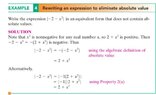
Rewrite an expression to eliminate absolute value.
Relevant Equations
n/a
See attachment.

I don't understand the solution given by David Cohen.

1. Note: x^2 is nonnegative for any real number x. This is because any value for x when squared is positive. Yes?

2. If x is greater than or equal to 0, then I can say that -2 - x^2 is negative in value, right?

3. What is David Cohen really trying to explain here?
 

Attachments
  • 20210622_112104.jpg
    20210622_112104.jpg
    26.2 KB · Views: 203
  • Like
Likes   Reactions: Delta2
Physics news on Phys.org
nycmathguy said:
Homework Statement:: Rewrite an expression to eliminate absolute value.
Relevant Equations:: n/a

See attachment.

I don't understand the solution given by David Cohen.

1. Note: x^2 is nonnegative for any real number x. This is because any value for x when squared is positive. Yes?
Yes
nycmathguy said:
2. If x is greater than or equal to 0, then I can say that -2 - x^2 is negative in value, right?
And you can say the same thing if ##x < 0##.
nycmathguy said:
3. What is David Cohen really trying to explain here?
That ##|-2 - x^2| = 2 + x^2##

Taking this further, it's easy to see that ##|-2 - x^2| \ge 2##.
 
Mark44 said:
Yes
And you can say the same thing if ##x < 0##.
That ##|-2 - x^2| = 2 + x^2##

Taking this further, it's easy to see that ##|-2 - x^2| \ge 2##.
Sorry but I don't understand what you're saying.
 
##-2-x^2## is negative for any real number x.
Hence by definition of absolute value it will be ##|-2-x^2|=-(-2-x^2)## and after that it is algebra 1 process to show that## -(-2-x^2)=2+x^2## (can give you the detailed in between algebra 1 steps if you are interested).
 
  • Like
Likes   Reactions: nycmathguy
Setting ##y=-2-x^2## we know that y<0 for any x, hence by definition of absolute value ##|y|=-y## in case you are wondering how we apply the definition in this case.
 
  • Like
Likes   Reactions: nycmathguy
I think the time has come for me to reconsider why I joined this site. Maybe I will leave.
 
nycmathguy said:
I think the time has come for me to reconsider why I joined this site. Maybe I will leave.
Why is that, the only thing I find wrong with you is that you post multiples of similar problems, my guess is that you do it in order to be absolutely sure that you got it right.
 
Delta2 said:
Why is that, the only thing I find wrong with you is that you post multiples of similar problems, my guess is that you do it in order to be absolutely sure that you got it right.
I am just thinking about it. I post multiple problems to get additional practice.
 
  • Like
Likes   Reactions: Delta2
I would recommend you not to leave. Even if some really good science advisors-homework helpers have unfriendly attitude towards you, and probably not willing to help you in the future, we can travel the road without them and see how it goes. I hope it goes well!

[Post edited by a Mentor]
 
Last edited by a moderator:
  • Like
Likes   Reactions: nycmathguy
In general. Think of the absolute value as a function (well it is), that is piecewise-defined.

Ie., |y| = y, if y≥ 0 or |y| = - y , if y<0.

So when ever you see the absolute value function in a problem, you should think about both cases.
However, with the problem you listed, we know that the square of any number is positive, and the sum of two positive numbers is positive...
 
  • Like
Likes   Reactions: nycmathguy and Delta2
MidgetDwarf said:
In general. Think of the absolute value as a function (well it is), that is piecewise-defined.

Ie., |y| = y, if y≥ 0 or |y| = - y , if y<0.

So when ever you see the absolute value function in a problem, you should think about both cases.
However, with the problem you listed, we know that the square of any number is positive, and the sum of two positive numbers is positive...
Thank you everyone.