Sean Carroll's view of the atom

  • Context: Graduate 
  • Thread starter Thread starter g.lemaitre
  • Start date Start date
  • Tags Tags
    Atom
Click For Summary

Discussion Overview

The discussion centers on Sean Carroll's representation of atoms in his lectures, particularly in relation to the delayed choice experiment and the interpretation of atomic structure. Participants explore the implications of Carroll's explanations and the use of the Bohr model in introductory contexts.

Discussion Character

  • Conceptual clarification
  • Debate/contested

Main Points Raised

  • One participant suggests that the delayed choice experiment indicates two types of atoms based on their wave-like and particle-like behavior depending on detection.
  • Another participant counters that there are not two different types of atoms, but rather different interpretations of electron behavior, comparing it to the concepts of "heads" and "tails" of a coin.
  • Some participants note that Carroll's use of the Bohr model is intended for introductory purposes and should not be taken literally, emphasizing that electrons, not atoms, occupy probability clouds.
  • There is a mention of Carroll's potential over-literal interpretation of electrons orbiting the nucleus, with participants suggesting he is aware of the limitations of this model.

Areas of Agreement / Disagreement

Participants express differing views on the interpretation of Carroll's statements and the implications of the Bohr model. There is no consensus on the correctness of the interpretations regarding atoms and electrons.

Contextual Notes

Some participants highlight that the discussion relies on the introductory nature of Carroll's lecture and the potential misinterpretation of visual representations in teaching atomic structure.

Who May Find This Useful

Readers interested in quantum mechanics, atomic theory, and the pedagogical approaches to teaching complex scientific concepts may find this discussion relevant.

g.lemaitre
Messages
267
Reaction score
2
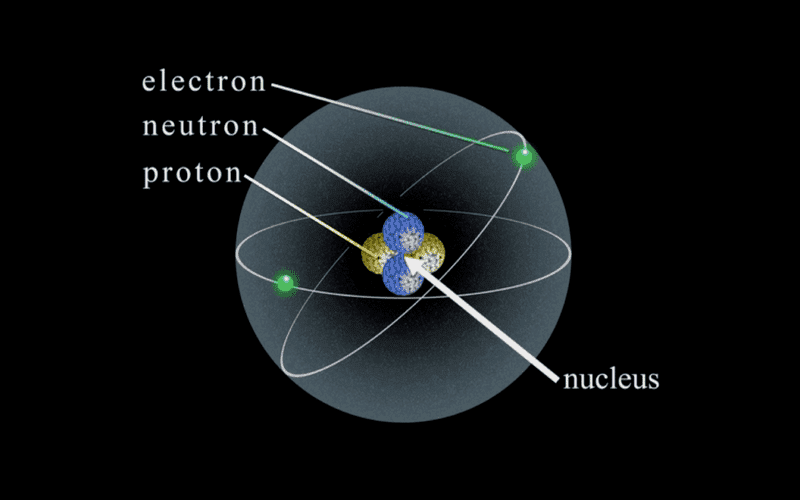
Here's a pic from Sean Carroll's lectures on Dark Matter and Dark Energy available through the Teaching Company:
Screenshot2012-08-04at61637AM.png


I just want to double check, there are two types of atoms, if I understand the delayed choice experiment correctly, just the knowledge that you can detect the atom transforms it from occupying a probability cloud (wave-like) where the electron does not really occupy a point in space to occupying a definite place (particle-like). I'm pretty sure I'm right and I don't understand why Carroll didn't throw in a few quantum mechanical slogans such as knowing that you can detect an atoms transforms it from x to y.
 
Physics news on Phys.org
That would not be correct - those are not two different types of atoms, but different ways of looking at electrons. Just like "heads" and "tails" are not two different kinds of coins.

The picture is non-physical, representative only. Electrons are not observed to orbit like that. It is probably intended to illustrate the basic components of the Bohr model.
 
g.lemaitre said:
Here's a pic from Sean Carroll's lectures on Dark Matter and Dark Energy available through the Teaching Company:

Which lecture # (and if you know, at what time point in the lecture) ?
 
phinds said:
Which lecture # (and if you know, at what time point in the lecture) ?

Do you have the lecture series? It's from the first lecture probably around the 10the minute, give or take 5 minutes.
 
g.lemaitre said:
Do you have the lecture series? It's from the first lecture probably around the 10the minute, give or take 5 minutes.

Yeah, I'll take a look
 
He's just using the old Bohr model to give an introductory talk about the PARTS of atoms exactly as Simon suggested ... he definitely doesn't mean it to be literal.

Atoms don't occupy probability clouds ... that's what the electrons do. Carrol is a bit overly literal when he talks about electrons spinning around the nucleus (as though that picture was literal) but this is an introductory discussion and he certainly knows better.
 
phinds said:
He's just using the old Bohr model to give an introductory talk about the PARTS of atoms exactly as Simon suggested ... he definitely doesn't mean it to be literal.
Atoms don't occupy probability clouds ... that's what the electrons do. Carrol is a bit overly literal when he talks about electrons spinning around the nucleus (as though that picture was literal) but this is an introductory discussion and he certainly knows better.


Thanks, I appreciate your help.
 

Similar threads

  • · Replies 11 ·
Replies
11
Views
4K
Replies
0
Views
2K
  • · Replies 6 ·
Replies
6
Views
2K
Replies
14
Views
3K
  • · Replies 5 ·
Replies
5
Views
2K
  • · Replies 8 ·
Replies
8
Views
3K
  • · Replies 5 ·
Replies
5
Views
2K
  • · Replies 58 ·
2
Replies
58
Views
5K
  • · Replies 9 ·
Replies
9
Views
2K
  • · Replies 4 ·
Replies
4
Views
2K