Second derivative of tan y = x using inverse functions

15 replies · 3K views · last reply
chwala
Gold Member
Messages
2,854
Reaction score
436
Homework Statement
See attached question and ms
Relevant Equations
differentiation
The question and ms guide is pretty much clear to me. I am attempting to use a non-implicit approach.
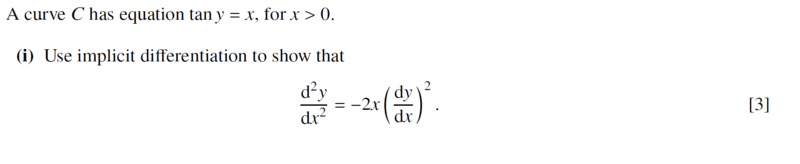
Printed exam question: A curve C has equation tan y = x, for x > 0. (i) Use implicit differentiation to show that d²y/dx² = -2x (dy/dx)², [3].


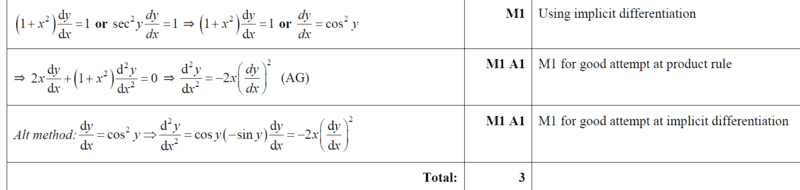
Marking scheme table: (1+x^2)dy/dx = 1 or sec^2 y dy/dx = 1 implies dy/dx = cos^2 y; then 2x dy/dx + (1+x^2) d^2y/dx^2 = 0 implies d^2y/dx^2 = -2x (dy/dx)^2; alternative method with cos y(-sin y) dy/dx; marks M1, M1 A1, total 3.
##\tan y=x, ⇒y=\tan^{-1} x##
We know that ##1+ \tan^2 x= \sec^2 x##
##\dfrac{dx}{dy}=sec^2 y##
##\dfrac{dx}{dy}=1+\tan^2 y##
##\dfrac{dy}{dx}=\dfrac{1}{1+x^2}##
##\dfrac{d^2y}{dx^2}=\dfrac{(1+x)0-1(2x)}{(1+x^2)^2}##
##\dfrac{d^2y}{dx^2}=\dfrac{-2x}{(1+x^2)^2}##
##\dfrac{d^2y}{dx^2}=-2x ⋅\left(\dfrac{dx}{dy}\right)^2##

No question here ...just looking at the problem from a different perspective ...any insight is welcome...
 
chwala said:
##\dfrac{dx}{dy}=sec^2 y##
##\dfrac{dx}{dy}=1+\tan^2 y##
##\dfrac{dy}{dx}=\dfrac{1}{1+x^2}##
##\dfrac{d^2y}{dx^2}=\dfrac{(1+x)0-1(2x)}{(1+x^2)^2}##
Typo in the line above, but it doesn't affect the subsequent work. The first product in the numerator should be ##(1 + x^2)0##.
chwala said:
##\dfrac{d^2y}{dx^2}=\dfrac{-2x}{(1+x^2)^2}##
##\dfrac{d^2y}{dx^2}=-2x ⋅\left(\dfrac{dx}{dy}\right)^2##

No question here ...just looking at the problem from a different perspective ...any insight is welcome...
 
Mark44 said:
Typo in the line above, but it doesn't affect the subsequent work. The first product in the numerator should be ##(1 + x^2)0##.
Argggggh @Mark44 :cool:... let me grab some coffee now. Cheers mate.
 
All this flipping of x and y is confusing, not just for the reader but for you too (your final result has dx/dy instead of dy/dx).

I would suggest not trying to modify the equation. Just differentiate ##tan(y)=x## with respect to ##x##, then do it again, then try to substitute all the trig functions for other things you know the value of.
 
  • Like
Likes   Reactions: Delta2
Office_Shredder said:
All this flipping of x and y is confusing, not just for the reader but for you too (your final result has dx/dy instead of dy/dx).

I would suggest not trying to modify the equation. Just differentiate ##tan(y)=x## with respect to ##x##, then do it again, then try to substitute all the trig functions for other things you know the value of.
Let me amend that...thanks...

##\tan y=x, ⇒y=\tan^{-1} x##
We know that ##1+ \tan^2 x= \sec^2 x##
##\dfrac{dx}{dy}=sec^2 y##
##\dfrac{dx}{dy}=1+\tan^2 y##
##\dfrac{dy}{dx}=\dfrac{1}{1+x^2}##
##\dfrac{d^2y}{dx^2}=\dfrac{(1+x^2)0-1(2x)}{(1+x^2)^2}##
##\dfrac{d^2y}{dx^2}=\dfrac{-2x}{(1+x^2)^2}##
##\dfrac{d^2y}{dx^2}=-2x ⋅\left(\dfrac{dy}{dx}\right)^2##
 
  • Like
Likes   Reactions: Delta2
The way I would solve it is what is coined as "Alt" method in the picture. (Which has a typo too btw, the second equation should be $$\frac{d^2y}{dx^2}=2\cos y(-\sin y)\frac{dy}{dx}$$.
 
No, you're still missing the point. Your first step really looks like you don't see the point of implicit differentiation. If you're going to solve for y as a function of x, you might as well just do normal differentiation.

##\frac{d}{dx} \tan(y)=1##

Compute that, and differentiate again
 
Office_Shredder said:
No, you're still missing the point. Your first step really looks like you don't see the point of implicit differentiation. If you're going to solve for y as a function of x, you might as well just do normal differentiation.

##\frac{d}{dx} \tan(y)=1##

Compute that, and differentiate again
He is mentioning in the OP that he is going to use a non implicit differentiation method (thus ignoring the problem statement prompt).
 
Office_Shredder said:
No, you're still missing the point. Your first step really looks like you don't see the point of implicit differentiation. If you're going to solve for y as a function of x, you might as well just do normal differentiation.

##\frac{d}{dx} \tan(y)=1##

Compute that, and differentiate again
@Office_Shredder i understand implicit differentiation very well...as easy as {a,b,c}...I was looking at normal differentiation...
 
Delta2 said:
The way I would solve it is what is coined as "Alt" method in the picture. (Which has a typo too btw, the second equation should be $$\frac{d^2y}{dx^2}=2\cos y(-\sin y)\frac{dy}{dx}$$.
Interesting that a 'Further Maths' Marks scheme would have an error or typo...
 
  • Like
Likes   Reactions: Delta2
Delta2 said:
well when you implicitly differentiate ##cos^2y## you get $$2\cos y\frac{d\cos y}{dx}$$, its clearly a typo.
yeah...just looking at the implicit part again...is there a simple way of showing ##x=\cos y ⋅siny?##
As In the Implicit approach we shall have,

##tan y=x##

##sec^2 y \dfrac{dy}{dx} =1##

##\dfrac{dy}{dx}=cos^2y##

##\dfrac{d^2y}{dx^2}=-2\cos y\sin y \dfrac{dy}{dx}##

##\dfrac{d^2y}{dx^2}=-2\left[\dfrac{1}{\sqrt(1+x^2)} ⋅\dfrac{x}{\sqrt(1+x^2)}\right]\dfrac{dy}{dx}=-2x⋅\left[ \dfrac{1}{1+x^2}\right]\dfrac{dy}{dx}=-2x⋅\dfrac{dy}{dx}⋅\dfrac{dy}{dx}=-2x\left(\dfrac{dy}{dx}\right)^2##
 
Last edited:
It is $$x\frac{dy}{dx}=\cos y\sin y$$ actually. And yes it is not so straightforward but not very hard either. To reach to this, start from $$\frac{\sin y}{\cos y}=x$$ and multiply both sides by ##\cos^2y=\frac{dy}{dx}##
 
  • Like
Likes   Reactions: chwala
Typo again in your work (also you use a mix of implicit and explicit methods), the final result has the first derivative squared!
 
  • Like
Likes   Reactions: chwala
chwala said:
yeah...just looking at the implicit part again...is there a simple way of showing ##x=\cos y ⋅siny?##
As In the Implicit approach we shall have,

##tan y=x##

##sec^2 y \dfrac{dy}{dx} =1##

##\dfrac{dy}{dx}=cos^2y##

##\dfrac{d^2y}{dx^2}=-2\cos y\sin y \dfrac{dy}{dx}##

##\dfrac{d^2y}{dx^2}=-2\left[\dfrac{1}{\sqrt(1+x^2)} ⋅\dfrac{x}{\sqrt(1+x^2)}\right]\dfrac{dy}{dx}=-2x⋅\left[ \dfrac{1}{1+x^2}\right]\dfrac{dy}{dx}=-2x⋅\dfrac{dy}{dx}⋅\dfrac{dy}{dx}=-2x\left(\dfrac{dy}{dx}\right)^2##
Notice that ##\displaystyle -2\cos y\sin y \dfrac{dy}{dx}=-2\cos^2y \dfrac{\sin y}{\cos y}\dfrac{dy}{dx}##

##\displaystyle \quad\quad\quad\quad\quad\quad=-2\cos^2y \tan y\dfrac{dy}{dx}##

##\displaystyle \quad\quad\quad\quad\quad\quad=-2 ~~ \dfrac{dy}{dx}\quad x \quad \dfrac{dy}{dx}##
 
  • Like
Likes   Reactions: Delta2 and chwala
SammyS said:
Notice that ##\displaystyle -2\cos y\sin y \dfrac{dy}{dx}=-2\cos^2y \dfrac{\sin y}{\cos y}\dfrac{dy}{dx}##

##\displaystyle \quad\quad\quad\quad\quad\quad=-2\cos^2y \tan y\dfrac{dy}{dx}##

##\displaystyle \quad\quad\quad\quad\quad\quad=-2 ~~ \dfrac{dy}{dx}\quad x \quad \dfrac{dy}{dx}##
eeeeeeish @SammyS smart there!

I was just looking at the biography of Paul Erdos! "Is your brain open?" :biggrin::biggrin:What a Legend! A real Mathematician!
 
Last edited: