Solutions of the schrödinger eq. for a potential step

Click For Summary

Discussion Overview

The discussion revolves around the solutions of the Schrödinger equation for a potential step, specifically comparing different forms of wavefunctions in regions of free particles. Participants explore the mathematical derivation of these solutions and the implications of different definitions of constants involved.

Discussion Character

  • Technical explanation
  • Mathematical reasoning
  • Debate/contested

Main Points Raised

  • One participant derives the general solution for a free particle in region I as ##\psi_{I} = C \sin(\mathcal{L} x) + D \cos(\mathcal{L} x)## but questions its difference from the exponential form commonly found in textbooks.
  • Another participant points out that the limit of ##e^{icx}## as ##x \to \infty## does not lead to infinity, referencing Euler's formula to clarify the behavior of the wavefunction.
  • There is a discussion about the equivalence of the two forms of the wavefunction, with one participant asserting that the imaginary unit ##i## does not disappear but is included in the constants when expressed in exponential form.
  • One participant suggests that the constants ##C## and ##D## do not need to be real, which is supported by the nature of the solutions to the differential equation.
  • Another participant explains that the general solution can be expressed in terms of real constants and emphasizes the utility of complex exponentials in physics for simplifying integrals.

Areas of Agreement / Disagreement

Participants express differing views on the nature of the constants in the wavefunction solutions, the implications of using real versus complex forms, and the equivalence of the derived solutions. No consensus is reached on these points, and the discussion remains unresolved.

Contextual Notes

Participants highlight that the choice of constants and their definitions can affect the form of the wavefunction solutions. The discussion also touches on the implications of boundary conditions and the mathematical properties of the solutions without reaching a definitive conclusion.

71GA
Messages
208
Reaction score
0
Lets say we have a potential step as in the picture:
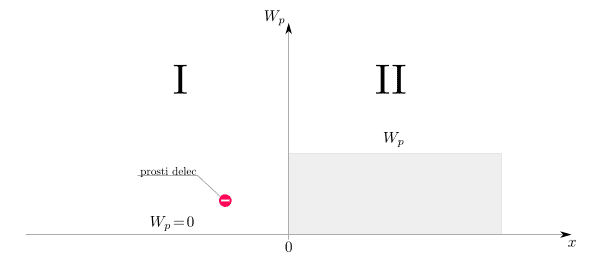
HB3XI.png


In the region I there is a free particle with a wavefunction ##\psi_I## while in the region II the wave function will be ##\psi_{II}##. Let me now take the Schrödinger equation and try to derive ##\psi_I## which bugs me:

\begin{align}
&~~W \psi = -\frac{\hbar^2}{2m}\, \frac{d^2 \Psi}{d\, x^2} + W_p \psi ~~~~~~~~~~~~~~~~~~~~~~~~~~~~~~~~~~~~~~~\nonumber \\
&~~W \psi = -\frac{\hbar^2}{2m}\, \frac{d^2 \Psi}{d\, x^2}\nonumber \\
&\frac{d^2 \Psi}{d\, x^2} = -\frac{2m W}{\hbar^2}\,\psi \nonumber\\
{\scriptsize \text{DE: }} &\boxed{\frac{d^2 \Psi}{d\, x^2} = -\mathcal L\,\psi}~\boxed{\mathcal{L} \equiv \sqrt{\tfrac{2mW}{\hbar^2}}} \nonumber\\
&~\phantom{\line(1,0){18.3}}\Downarrow \nonumber\\
{\scriptsize \text{general solution of DE: }} &\boxed{\psi_{I} = C \sin\left(\mathcal{L}\, x \right) + D \cos \left(\mathcal{L}\, x \right)}\nonumber
\end{align}

I got the general solution for the interval I, but this is nothing like the solution they use in all the books: ##\psi_{I} = C e^{i\mathcal L x} + D e^{-i \mathcal L x}## where ##\mathcal L \equiv \sqrt{{\scriptsize 2mW/\hbar^2}}##. I have a personal issue with this because if ##x= -\infty## part ##De^{-i \mathcal L x}## would become infinite and this is impossible for a wavefunction! I know that i would get exponential form if i defined constant ##\mathcal L## a bit differently as i did above:

\begin{align}
{\scriptsize \text{DE: }} &\boxed{\frac{d^2 \Psi}{d\, x^2} = \mathcal L\,\psi}~\boxed{\mathcal{L} \equiv -\sqrt{\tfrac{2mW}{\hbar^2}}} \nonumber\\
&~\phantom{\line(1,0){18.3}}\Downarrow \nonumber\\
{\scriptsize \text{general solution of DE: }} &\boxed{ \psi_{I} = C e^{\mathcal L x } + D^{-\mathcal L x} }\nonumber
\end{align}

This general solution looks more like the one they use in the books but it lacks an imaginary ##i## and ##\mathcal L## is defined with a - while in all the books it is positive. Could anyone tell me what am i missing here so i could connect all this into a solid one piece of knowledge?
 
Physics news on Phys.org
71GA said:
I have a personal issue with this because if ##x= -\infty## part ##De^{-i \mathcal L x}## would become infinite and this is impossible for a wavefunction! I know that i would get exponential form if i defined constant ##\mathcal L## a bit differently as i did above:
\end{align}
The problem is here :
lim_{x-> \infty} e^{icx} \neq \infty
Use the fact that:
e^(icx)=cos(cx)+isin(cx)
 
bp_psy said:
The problem is here :
$$lim_{x-> \infty} e^{icx} \neq \infty$$
Use the fact that:
$$e^{icx}=\cos(cx)+i\sin(cx)$$

That is eulers formula i know and i can ALMOST derive the connection between the example used in books: ##\scriptsize \psi_I = Ce^{i\mathcal L x} + De^{-i \mathcal L x}## and the first general solution to the DE: ##\scriptsize \psi_I = C\cos (\mathcal L x) + D \sin (\mathcal L x)##.

Here it goes:

$$
\scriptsize
\begin{split}
\underbrace{Ae^{i\mathcal L x} + B e^{-i \mathcal L x}}_{{\scriptsize \text{used in the books}}} = A \cos(\mathcal L x) +A i \sin (\mathcal L x) + B \cos(\mathcal L x) - B i \sin(\mathcal L x) = \underbrace{(A+B)}_{\equiv C} \cos(\mathcal L x) + \underbrace{(A-B)}_{\equiv D} i \sin (\mathcal L x) \neq \underbrace{C\cos (\mathcal L x) + D \sin (\mathcal L x)}_{{\scriptsize \text{solution to the DE}}}
\end{split}
$$

I can notice that the function used in books is NOT equal to the solution to the DE. It is diffrent for an imaginary number ##i##... Here is allso one small snippet from Griffith where he doesn't use ##i##. Take a closer look to the eq. 2.149. I am sorry for posting a snippet, i can remove it if necessary. So my question is why or how does ##i## dissapear?

22.png
 
You are right except that D=(A-B)i, the i is included there and the two forms of the solution are equivalent.
 
The constants don't have to be real.
 
71GA said:
I got the general solution for the interval I, but this is nothing like the solution they use in all the books: ##\psi_{I} = C e^{i\mathcal L x} + D e^{-i \mathcal L x}## where ##\mathcal L \equiv \sqrt{{\scriptsize 2mW/\hbar^2}}##.

Eulers formula.
 
So if i conclude all this (and please correct me if i am in any way wrong). I have a schrödinger equation which for a free particle can be rearanged like this:
$$
\frac{d^2 \Psi}{d\, x^2} = -\frac{2m W}{\hbar^2}\,\psi
$$
This is ofcourse a differential equation whose general solutions depend on how we define the constant ##\mathcal L##.
\begin{align}
\mathcal L \equiv \sqrt{\frac{2mW}{\hbar^2}} \Longrightarrow \underbrace{\psi = C \sin(\mathcal L x) + D \cos (\mathcal L x)}_{\text{1st general solution where $\mathcal L$ is real}}~~~~~~~~\mathcal L \equiv \sqrt{-\frac{2mW}{\hbar^2}} \Longrightarrow \!\!\!\!\!\!\!\!\!\!\!\!\!\!\underbrace{\psi = C e^{\mathcal L x} + D e^{\mathcal L x}}_{\text{2nd general solution where $\mathcal L$ is complex}}
\end{align}
We choose 1st solution which has real ##\mathcal L## and a complex constant ##D## (which can be seen from):
$$
\scriptsize
\begin{split}
\!\!\underbrace{A}_{\text{real}}\!e^{i\mathcal L x} + \!\!\underbrace{B}_{\text{real}}\! e^{-i \mathcal L x}= A \cos(\mathcal L x) +A i \sin (\mathcal L x) + B \cos(\mathcal L x) - B i \sin(\mathcal L x) = \underbrace{(A+B)}_{\equiv C} \cos(\mathcal L x) + \underbrace{(A-B)\,i}_{\equiv D} \sin (\mathcal L x) = C\cos (\mathcal L x) + \!\!\!\!\underbrace{D}_{{\scriptsize \text{complex}}}\!\!\! \sin (\mathcal L x)
\end{split}
$$
From above equation it can be seen that i can write ##\psi = C \sin(\mathcal L x) + D \cos (\mathcal L x)## in a form ##Ae^{i\mathcal L x} + Be^{-i \mathcal L x}## where ##A## and ##B## are real and ##\mathcal L## is also real ##{\scriptsize \mathcal L \equiv \sqrt{2mW/\hbar^2}}##. Please correct me if i am wrong or confirm my assumptions.
 
Neither constant are (C,D) necessarily real or complex they are determined by your boundary conditions.
The usual argument in a ODE class is that a second order ODE with a characteristic equation with complex roots we have:
f(x)=e^{(a+bi)x}
g(x)=e^{(a-bi)x}
as solutions. Then by superposition we can get two other solutions

u(x)=f(x)+g(x)=e^ax(e^{ibx}+e^{-ibx})=2e^{ax} cos(bx)
v(x)=f(x)-g(x)=e^ax(e^{ibx}+e^{-ibx})=2i e^{ax} sin(bx)
Since the a solution multiplied by a real or complex constant is still a solution we can ignore the constants,we get the two solutions
u(x)=e^{ax} cos(bx)
v(x)= e^{ax} sin(bx)
Then the general solution by superposition will be :
v(x)=A e^{ax} cos(bx) +Be^{ax}sin(bx) where A and B are two constants set by your boundary conditions.
For physics it is usually better to work with the complex exponential form because the integrals are usually more simple.
 
Thank you. This solved my issue.
 

Similar threads

  • · Replies 0 ·
Replies
0
Views
2K
  • · Replies 7 ·
Replies
7
Views
2K
  • · Replies 17 ·
Replies
17
Views
3K
  • · Replies 4 ·
Replies
4
Views
3K
  • · Replies 3 ·
Replies
3
Views
2K
Replies
2
Views
2K
  • · Replies 2 ·
Replies
2
Views
1K
  • · Replies 14 ·
Replies
14
Views
3K
  • · Replies 10 ·
Replies
10
Views
2K
  • · Replies 17 ·
Replies
17
Views
2K