Solve Cartesian Product Without Symbol: Find Answers Here

  • Thread starter Thread starter momentum
  • Start date Start date
  • Tags Tags
    Cartesian Product
Click For Summary

Homework Help Overview

The discussion revolves around the concept of Cartesian products in relational algebra, specifically focusing on the use of symbols and notation in expressing these products. Participants express confusion regarding the correct representation and interpretation of Cartesian products without certain symbols, as well as the implications of renaming attributes.

Discussion Character

  • Exploratory, Assumption checking, Conceptual clarification

Approaches and Questions Raised

  • Participants discuss the necessity of using symbols like the Greek letter rho for renaming in relational algebra. Questions arise about the correctness of solutions presented in a textbook, particularly regarding notation and the structure of expressions.

Discussion Status

The conversation is ongoing, with participants providing insights and questioning the clarity of the textbook examples. Some guidance has been offered regarding notation, but there is no explicit consensus on the correctness of the solutions or the interpretations of the symbols used.

Contextual Notes

Participants note the lack of clarity in the textbook's presentation of relational algebra, which may contribute to confusion. There are references to specific notations that are not universally recognized, leading to further questions about their meanings and applications.

momentum
Messages
111
Reaction score
0
<Moderator's note: Moved from a technical forum and thus no template.>

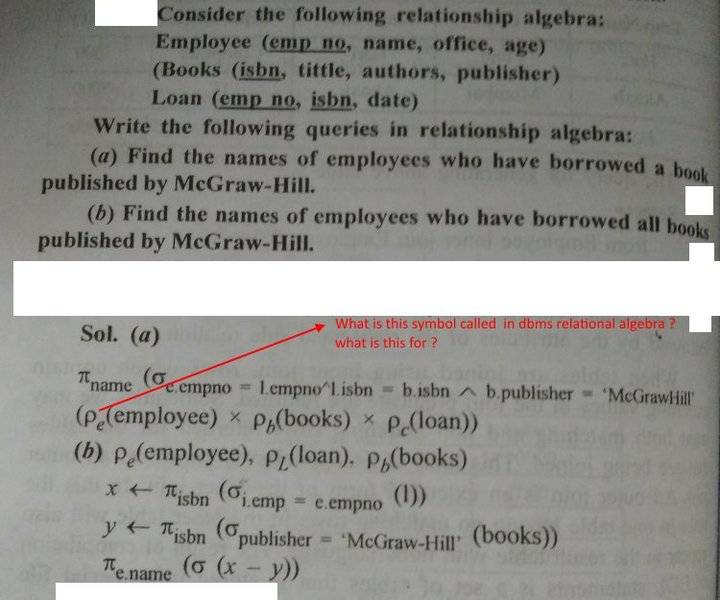
Here is a problem and solution given in my book.

this is using a symbol in cartesian product .

I checked other books for cartesian product examples but there was no such symbol being used.
iRrgWqa.jpg
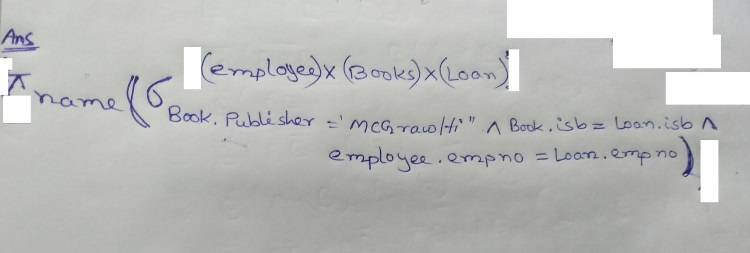
Here is my solution without that symbol
8zW5Tsd.jpg
Is my solution wrong ?

I'm confused.


Attachments

  • iRrgWqa.jpg
    iRrgWqa.jpg
    51.1 KB · Views: 837
  • 8zW5Tsd.jpg
    8zW5Tsd.jpg
    14.1 KB · Views: 724
Last edited by a moderator:
Physics news on Phys.org
I just looked this up. That is the greek character rho (##\rho##) which means rename according to wikipedia. So employee is renamed to e, books to b, loan to c, then it creates the cartesian product. Does that help?
 
verty said:
I just looked this up. That is the greek character rho (##\rho##) which means rename according to wikipedia. So employee is renamed to e, books to b, loan to c, then it creates the cartesian product. Does that help?
okay. But is my solution correct ?

I am not renaming. Can I do this ?
 
I don't want to mislead you but for some reason I have an inkling that it may be necessary in the relational algebra to use rename when attributes would clash. So for example, if you were joining from employee to employee and matching each staff member to their manager, it would be necessary to use rename. I think in this problem it isn't necessary.

Why did you write employee x books x loan at the top? Should it not be in line with the rest?
 
momentum said:
<Moderator's note: Moved from a technical forum and thus no template.>

Here is a problem and solution given in my book.

this is using a symbol in cartesian product .

I checked other books for cartesian product examples but there was no such symbol being used.

View attachment 232159Here is my solution without that symbol
View attachment 232160Is my solution wrong ?

I'm confused.

Without more context, especially the definition of a relation algebra, it is hard to tell.
##\rho## is the Greek letter ##r##, so one might suspect that it stands for relation. Also is it indexed by the three categories, which might indicate that ##\rho_{\text{employee}} \times \rho_{\text{books}} \times \rho_{\text{loan}}## is simply the phase space of all possible relations, resp. their tables in the database.
 
  • Like
Likes   Reactions: momentum
verty said:
Why did you write employee x books x loan at the top? Should it not be in line with the rest?
I believe notation of sigma says, at the top you put name of the relation and at bottom you put the condition. There is no in line stuff with this syntax. Is it wrong ?
 
momentum said:
I believe notation of sigma says, at the top you put name of the relation and at bottom you put the condition. There is no in line stuff with this syntax. Is it wrong ?

Wow I'm confused by your how your book has written these answers. I believe the answer to A given in the book should look like this (there was a typo):
$$\pi_{name} (\sigma_{e.empno = l.empno \land l.isbn = b.isbn \land b.publisher = 'McGraw-Hill'} (\rho_e(employee) \times \rho_l(loan) \times \rho_b(books)))$$
And I don't know what is going on with answer B. It just doesn't look right to me.

In your answer, I don't think putting the relation at the top is correct. Sorry, I'm doing the best I can to help.
 
verty said:
Wow I'm confused by your how your book has written these answers. I believe the answer to A given in the book should look like this:
$$\pi_{name} (\sigma_{e.empno = l.empno \land l.isbn = b.isbn \land b.publisher = 'McGraw Hill'} (\rho_e(employee) \times \rho_l(loan) \times \rho_b(books)))$$
And I don't know what is going on with answer B. It just doesn't look right to me.

In your answer, I don't think putting the relation at the top is correct. Sorry, I'm doing the best I can to help.

okay . I understand answer to A now.

But I am confused with answer to B.

What does these mean ?
x<--
y<---

I checked relational algebra notations but could not find such notations. And so I'm stuck to understand solution B .
If solution B is not correct solution. What is the right solution ?
 
momentum said:
okay . I understand answer to A now.

But I am confused with answer to B.

What does these mean ?
x<--
y<---

I checked relational algebra notations but could not find such notations. And so I'm stuck to understand solution B .
If this is not correct solution. What is the right solution ?
I thought it meant "Select ... as x , select ... as y , ... where ... " but I don't understand the minus in ##x-y##. Shouldn't it be an ##AND\,?##
 
  • #10
B should be something like:
##\rho_e(employee), \rho_l(loan), \rho_b(books)##
##x \leftarrow (\pi_{isbn} (\sigma_{e.empno = l.empno} (e \times l))##
##y \leftarrow (\pi_{isbn} (\sigma_{publisher = McGraw-Hill} (b))##
##\pi_{name} (\sigma_{j.isbn = l.isbn \land l.empno = e.empno} (e \times l \times \rho_j(\sigma (x - y))))##

Oh wait, this is not correct but I don't have time to fix it. This answers a different question but it's similar.

fresh_42 said:
I thought it meant "Select ... as x , select ... as y , ... where ... " but I don't understand the minus in ##x-y##. Shouldn't it be an ##AND\,?##

That x-y means tuples in x but not in y.
 
  • Like
Likes   Reactions: fresh_42
  • #11
momentum said:
okay . I understand answer to A now.

What does these mean ?
x<--
y<---

I checked relational algebra notations but could not find such notations. And so I'm stuck to understand solution B .
If solution B is not correct solution. What is the right solution ?

I think you may need a better book. Anyway, I don't want to explain every little thing. I think I have done the best I can here. That book looks to be particularly poor, I must say.
 

Similar threads

  • · Replies 1 ·
Replies
1
Views
2K
  • · Replies 3 ·
Replies
3
Views
2K
  • · Replies 5 ·
Replies
5
Views
2K
  • · Replies 5 ·
Replies
5
Views
2K
  • · Replies 8 ·
Replies
8
Views
2K
  • · Replies 6 ·
Replies
6
Views
2K
  • · Replies 6 ·
Replies
6
Views
2K
  • · Replies 10 ·
Replies
10
Views
2K
  • · Replies 1 ·
Replies
1
Views
2K
Replies
28
Views
5K