Solve for $x$ and $y$: Real Number Condition

  • Context:
  • Thread starter Thread starter anemone
  • Start date Start date
  • Tags Tags
    Condition
Join the discussion
Registration is free. Ask a follow-up in this thread, or start your own.
9 replies · 2K views
anemone
Gold Member
MHB
POTW Director
Messages
3,851
Reaction score
115
For two positive real numbers $x$ and $y$ that satisfy the condition $x^3=x+1$ and $y^6=3x+y$, show that $x>y$.
 
Mathematics news on Phys.org
anemone said:
For two positive real numbers $x$ and $y$ that satisfy the condition $x^3=x+1$ and $y^6=3x+y$, show that $x>y$.

View attachment 2460

$x^3=x+1----(1)$ and
$y^6=3x+y---(2)$
from (1)(2):
1<x<2 , 1<y<2(for x,y>0)
if we want to prove x>y we only have to prove :$x^6>y^6$
that is to prove :$x^2+2x+1>3x+y$
$=>x^2-x+1>y$
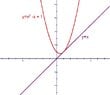
from the diagram x=y is the tangent line of $x^2-x+1 $ at point (1,1)
when x>1 then $y=x^2-x+1$ is all above $y=x$
and the prove x>y is done.
 

Attachments

  • x is bigger than y.jpg
    x is bigger than y.jpg
    10.5 KB · Views: 123
Albert said:
View attachment 2460

$x^3=x+1----(1)$ and
$y^6=3x+y---(2)$
from (1)(2):
1<x<2 , 1<y<2(for x,y>0)
if we want to prove x>y we only have to prove :$x^6>y^6$
that is to prove :$x^2+2x+1>3x+y$
$=>x^2-x+1>y$
from the diagram x=y is the tangent line of $x^2-x+1 $ at point (1,1)
when x>1 then $y=x^2-x+1$ is all above $y=x$
and the prove x>y is done.

$x^ 2 −x+1$ is all above y=x means x >y means it is rue but it does not mean that x >y $
 
consider the range when x>1 then we set:

$y_1=x^2-x+1$

$y_2=x$

compare $y_1 $ and $ y_2$(for the same $x$)
 
Albert said:
consider the range when x>1 then we set:

$y_1=x^2-x+1$

$y_2=x$

compare $y_1 $ and $ y_2$(for the same $x$)

if y < x this is true agreed

but x = 1.7 and y = 1.8 means

x^2 - x + 1 = 2.19 > y even though y is > x we need to prove y < x and not the other way around
 
Last edited:
from $x^3=x+1----(1)$
$y^6=3x+y--------(2)$
at first you must find the solution of (1)
and put the soluion x to (2) and find the solution of y and compare the value of x and y
so x and y must both meet the restriction of (1) and (2)
this can be said as find the solution of (1) and (2) and compare its value
are you sure x=1.7 and y=1.8 will satisfy (1) and (2) ?
the value of y is based on the same value of x in (1)
 
Last edited:
$x^3 =x+1−−−−(1)$

x has to be > 1 as $x^3>= 1$ and if

$x^3 - x - 1= x^2(x-1) - 1$ is monotonically increasing for x > 1

as x = 2 => $x^3 - x -1 = 5$ > 0 so x is between 1 and 2

$y^ 6 =3x+y$

$y^6$ > 1 so y > 1

as x < 2 so $y^6 - y < 6$ and y < 2 because $y^6- y$ monotonically increasing for y > 1 and for y = 2 it is 62

to show x > y we need to prove $x^6 > y^6$

or $x^2 +2x+1>3x+y$
=>$x 2 −x+1>y$

now $x 2 −x+1 = (x-1)^2 + x + 1$ > 2 ( as x > 1) > y

hence proved

edit: above is mistake
based on comment by Albert $x 2 −x+1 = (x-1)^2 + x $
it is > x and without proving x > y we cannot prove it > y so we are back to square one. I am sorry and thanks to Albert
 
Last edited:
kaliprasad said:
$x^3 =x+1−−−−(1)$

x has to be > 1 as $x^3>= 1$ and if

$x^3 - x - 1= x^2(x-1) - 1$ is monotonically increasing for x > 1

as x = 2 => $x^3 - x -1 = 5$ > 0 so x is between 1 and 2

$y^ 6 =3x+y$

$y^6$ > 1 so y > 1

as x < 2 so $y^6 - y < 6$ and y < 2 because $y^6- y$ monotonically increasing for y > 1 and for y = 2 it is 62

to show x > y we need to prove $x^6 > y^6$

or $x^2 +2x+1>3x+y$
=>$x 2 −x+1>y$

now $x 2 −x+1 = (x-1)^2 + x + 1$ > 2 ( as x > 1) > y

hence proved
you said : $x 2 −x+1 = (x-1)^2 + x + 1$
but :$x^ 2 −x+1 \neq (x-1)^2 + x + 1$
 
Albert said:
you said : $x 2 −x+1 = (x-1)^2 + x + 1$
but :$x^ 2 −x+1 \neq (x-1)^2 + x + 1$

Yes .It is my mistake
 
Albert said:
View attachment 2460

$x^3=x+1----(1)$ and
$y^6=3x+y---(2)$
from (1)(2):
1<x<2 , 1<y<2(for x,y>0)
if we want to prove x>y we only have to prove :$x^6>y^6$
that is to prove :$x^2+2x+1>3x+y$
$=>x^2-x+1>y$
from the diagram x=y is the tangent line of $x^2-x+1 $ at point (1,1)
when x>1 then $y=x^2-x+1$ is all above $y=x$
and the prove x>y is done.

Well done, Albert! And thanks for participating!:)

Here is another solution that I saw online that doesn't use the graphical method for proving the result and hence I will share it:
Note that $x^3>1$ which implies $x>1$ and $y^6>y$ and $\therefore y>1$.

Also, $x^6=x^2+2x+1 \ge 4x$ so we have $x^6-y^6 \ge 4x-y-3x=x-y$

$x^6-y^6 \ge x-y$

$(x-y)(x^5+x^4y+x^3y^2+x^2y^3+xy^4+y^5) \ge x-y$

If $x<y$, we have $(x^5+x^4y+x^3y^2+x^2y^3+xy^4+y^5) \le 1$ for all $x,\,y>0$ and this is clearly impossible.

If $x=y$, we have $x^5=4$ and $x^6=x^2+2x+1$ and we get $4x=x^2+2x+1$ which yields $x=1$ and this leads a contradiction since $x>1$.

So it must be $x>y$ that holds and we're done.