chwala
Gold Member
- 2,844
- 434
- Homework Statement
- see attached
- Relevant Equations
- linear programming
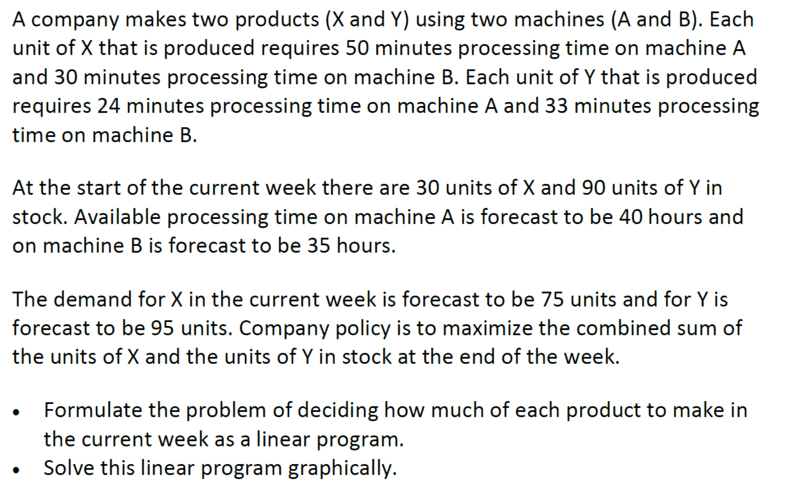
Find question and solution here;
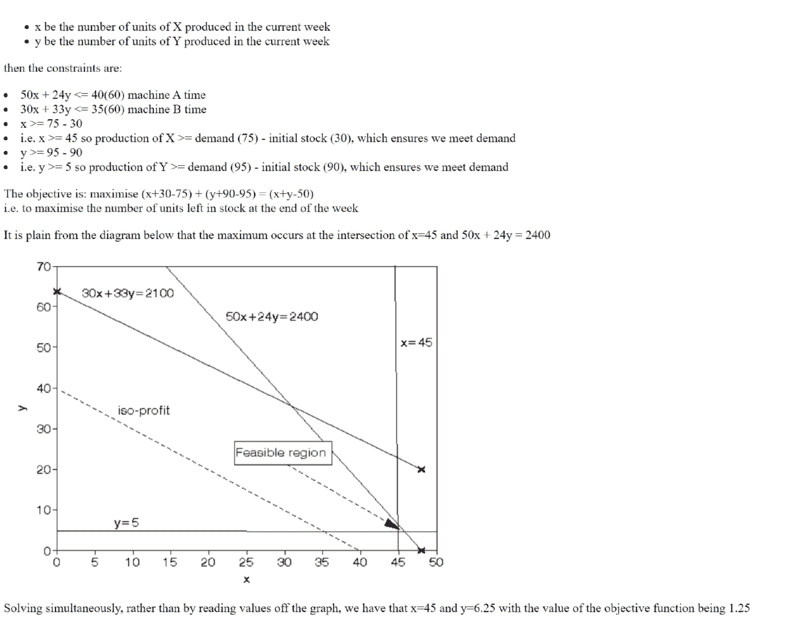
The initial steps were a bit confusing to me...i decided to use hours instead of minutes ...only then did it become more clear to me. See my graph,
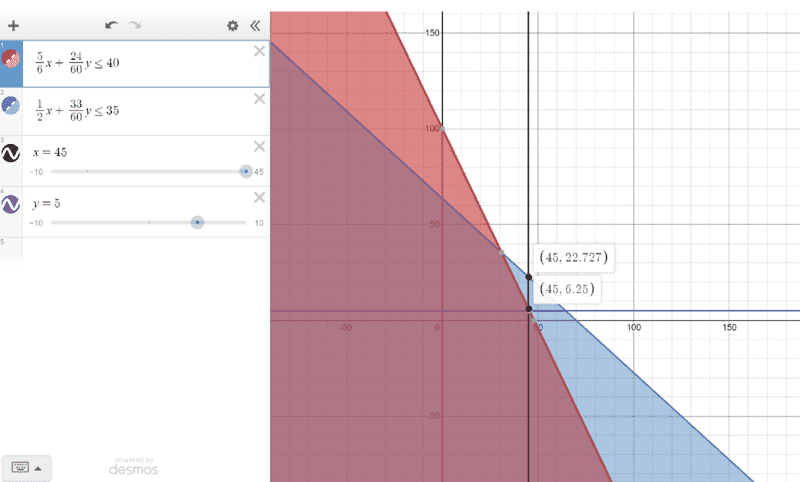
Ok i follow that the function would be optimised at ##x=45## and ##y=6.25## ...now to my question...we cannot have ##y=6.25## products...a product can only take natural numbers, ##1,2,3...##
I can follow that the objective function would be ##=1.25## this is clear...only on the part of ##y=6.25##.
The initial steps were a bit confusing to me...i decided to use hours instead of minutes ...only then did it become more clear to me. See my graph,
Ok i follow that the function would be optimised at ##x=45## and ##y=6.25## ...now to my question...we cannot have ##y=6.25## products...a product can only take natural numbers, ##1,2,3...##
I can follow that the objective function would be ##=1.25## this is clear...only on the part of ##y=6.25##.
Last edited: