Tenenbaum & Pollard Pages 53-54: Apparently does not make sense

  • Context: Graduate 
  • Thread starter Thread starter xorg
  • Start date Start date
Click For Summary

Discussion Overview

The discussion revolves around the interpretation of a differential equation presented in Tenenbaum & Pollard, specifically on pages 53-54. Participants are examining the behavior of the solution curve as it approaches the vertical line x = 1, questioning the apparent inconsistency between the differential equation and the graphical representation of its solutions.

Discussion Character

  • Debate/contested
  • Technical explanation
  • Mathematical reasoning

Main Points Raised

  • One participant expresses confusion about the behavior of the solution curve, noting that the differential equation suggests dy/dx approaches infinity as x approaches 1 with y < 0, while the graph does not reflect this.
  • Another participant suggests that there is a gap in understanding what it means for a graph to have a derivative, implying that further study of calculus may be necessary.
  • Participants clarify that the solution curve should not be asymptotic to the vertical line x = 1, despite the differential equation indicating a vertical tangent at that point.
  • Some participants agree that the differential equation and the graphical solution appear to conflict, leading to confusion about the validity of the solution method.
  • One participant provides a mathematical expression for the family of solutions, indicating that vertical tangents occur at x = 1 and x = -1 when y < 1, and discusses the conditions under which the problematic derivative disappears.
  • Matlab code is shared to illustrate the plotting of the solution curves, with specific values of the constant C being tested to visualize the behavior of the solutions.

Areas of Agreement / Disagreement

Participants generally express confusion and disagreement regarding the relationship between the differential equation and the graphical representation of its solutions. While some participants assert that the solution is correct, others highlight inconsistencies that remain unresolved.

Contextual Notes

There are unresolved questions about the assumptions underlying the differential equation and the graphical representation, particularly regarding the behavior of the solution as it approaches critical points.

xorg
Messages
15
Reaction score
0
Hi. I'm reading the bookhttp://amzn.com/0486649407 ,
S7ShG10.jpg

in self-study mode.
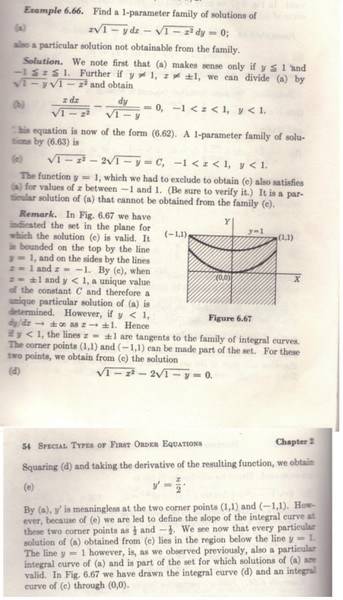
In page 53 and 54, below:
voXXhL8.jpg

Apparently does not make sense, because, If the differential equation is:
$$ \frac{\mathrm{d}y }{\mathrm{d} x} = x\frac{\sqrt{1-y}}{\sqrt{1-x^{2}}} $$

then dy/dx = ∞ when x = 1, and y < 0
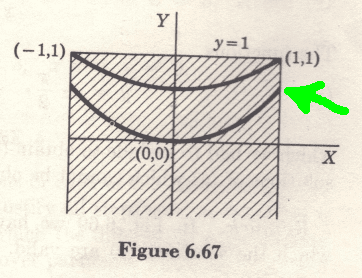
however, in Image:
Ifx1MI0.png

dy / dx is not ∞ in point marked in green.

Then, in this point, the graph changes radically the slope? Apparent, does not make sense, It seems that the correct curve would go up until tangent to x = 1, while the particular solution says otherwise.

Why the differential equation "fails", and the solution of the differential equation not? I did not catch that.

I am studying alone, thank you for your patience.
 
Last edited by a moderator:
Physics news on Phys.org
There is some gap in your knowledge about what it means for a graph to have a derivative. I would advice you read a calculus book and brush up on it. This idea is a very fundamental key point in ode.
 
To clarify the question: Why does the graph show a solution curve that is not asymptotic to the vertical line x = 1 ?

xorg said:
Apparently does not make sense, because, If the differential equation is:
$$ \frac{\mathrm{d}y }{\mathrm{d} x} = x\frac{\sqrt{1-y}}{\sqrt{1-x^{2}}} $$

then dy/dx = ∞ when x = 1, and y < 0

Did you mean "when y &lt; 1 ?

however, in Image:
Ifx1MI0.png

dy / dx is not ∞ in point marked in green.
 
Stephen Tashi said:
To clarify the question: Why does the graph show a solution curve that is not asymptotic to the vertical line x = 1 ?

Yes, if the dy/dx go to ∞ when x go to 1, then i guess in particular solution this should be the trend.
It is as if the particular solution and differential equation were conflicting.
Imagine that someone will draw the solution curves, from the dy / dx, at each point, does not match the presented solution.
However, the method of solution seems correct, that leaves me confused!

Did you mean "when y &lt; 1 ?

YES, when y<1. Sorry.
 
xorg said:
Yes, if the dy/dx go to ∞ when x go to 1, then i guess in particular solution this should be the trend.
It is as if the particular solution and differential equation were conflicting.
Imagine that someone will draw the solution curves, from the dy / dx, at each point, does not match the presented solution.
However, the method of solution seems correct, that leaves me confused!
YES, when y<1. Sorry.

You are correct: the illustration is erroneous. The solution is correct, however. If you plot the family of solutions, you will get curves with vertical tangent lines x = 1 and x = -1 when y < 1, as described by the text.
In particular, if you isolate y in the family of solutions, you will get y = \frac{1}{4}x^2 + C\sqrt{1-x^2} + \frac{3}{4} - C^2, from which you can find the explicit derivative. You can see that it is only when C = 0 that the problematic derivative of the square root at x = 1, and at x = -1, disappears.
 

Attachments

  • Contours.png
    Contours.png
    12.3 KB · Views: 490
Last edited:
  • Like
Likes   Reactions: xorg
slider142 said:
You are correct: the illustration is erroneous. The solution is correct, however. If you plot the family of solutions, you will get curves with vertical tangent lines x = 1 and x = -1 when y < 1, as described by the text.
In particular, if you isolate y in the family of solutions, you will get y = \frac{1}{4}x^2 + C\sqrt{1-x^2} + \frac{3}{4} - C^2, from which you can find the explicit derivative. You can see that it is only when C = 0 that the problematic derivative of the square root at x = 1, and at x = -1, disappears.

Thank You!

The solution:
$$ \sqrt{1-x^{2}} - 2\sqrt{1-y} = C $$
Results:
$$ y = \frac{3}{4} + \frac{x^{2}}{4} + \frac{C\sqrt{1-x^{2}}}{2} - \frac{C^{2}}{4} $$
(in your solution, yourC = C/2)

Matlab Code
PHP:
x = linspace(-1,1,1000);
clf;
grid on;
hold on;
c=0;
y=3/4+(x.^2)/4 +(c/2)*sqrt(1-(x.^2))-(c/2)^2;plot(x, y, 'r');
c=-0.5;
y=3/4+(x.^2)/4 +(c/2)*sqrt(1-(x.^2))-(c/2)^2;plot(x, y, 'b');
c=-1;
y=3/4+(x.^2)/4 +(c/2)*sqrt(1-(x.^2))-(c/2)^2;plot(x, y, 'g');

Matlab Result
CqzeJeY.png


c = 0

c = -0.5
c = -1


Thank you, Helped me a lot!
 

Similar threads

  • · Replies 1 ·
Replies
1
Views
10K
  • · Replies 5 ·
Replies
5
Views
2K
  • · Replies 18 ·
Replies
18
Views
3K
  • · Replies 5 ·
Replies
5
Views
2K
  • · Replies 4 ·
Replies
4
Views
3K
  • · Replies 1 ·
Replies
1
Views
2K
  • · Replies 8 ·
Replies
8
Views
2K
  • · Replies 2 ·
Replies
2
Views
3K
Replies
2
Views
2K
  • · Replies 2 ·
Replies
2
Views
3K