The Curse of Elon Musk: Redirect Satellites to Sun or His Backyard?

  • Context: Stargazing 
  • Thread starter Thread starter davenn
  • Start date Start date
Click For Summary

Discussion Overview

The discussion centers around the impact of satellite launches, particularly those by Elon Musk's Starlink, on astronomy and the night sky. Participants explore the legal, ethical, and practical implications of satellite visibility and interference with astronomical observations, touching on topics such as international space law, potential mitigation strategies, and the conflict between commercial interests and scientific pursuits.

Discussion Character

  • Debate/contested
  • Technical explanation
  • Conceptual clarification
  • Exploratory

Main Points Raised

  • Some participants express frustration over the perceived negative impact of satellites on astronomy, suggesting extreme measures like redirecting satellites into the sun or private property.
  • Others argue that the legality of satellite launches is not in question, as they comply with existing regulations, despite concerns about the lack of specific rules addressing their proliferation.
  • There is a discussion about the potential for making satellites less visible through design changes, such as using non-reflective materials, though some participants note the challenges posed by solar panels.
  • Participants propose technical solutions for mitigating the impact of satellites on imaging, including image stacking and software filtering, while acknowledging that these methods may not fully resolve the issue.
  • Concerns are raised about the implications of satellite visibility for specific astronomical projects, such as the Thirty Meter Telescope in Hawaii, with suggestions that relocating telescopes could be a solution.
  • Some participants highlight the broader societal implications of light pollution and environmental degradation, linking these issues to technological progress and commercial interests.
  • There are discussions about the visibility of Starlink satellites and their operational altitudes, with some participants noting that while they may be less visible under certain conditions, they still pose challenges for astronomers.

Areas of Agreement / Disagreement

Participants generally express disagreement regarding the implications of satellite launches on astronomy, with multiple competing views on the legality, ethical considerations, and potential solutions. The discussion remains unresolved, with no consensus reached on the best course of action or the extent of the problem.

Contextual Notes

Limitations in the discussion include a lack of clarity on the specific regulations governing satellite launches, the technical feasibility of proposed mitigation strategies, and the varying impacts on different astronomical projects. The conversation also reflects differing perspectives on the balance between commercial interests and scientific integrity.

davenn
Science Advisor
Gold Member
Messages
9,715
Reaction score
11,738
TL;DR
this guy should be locked up !!
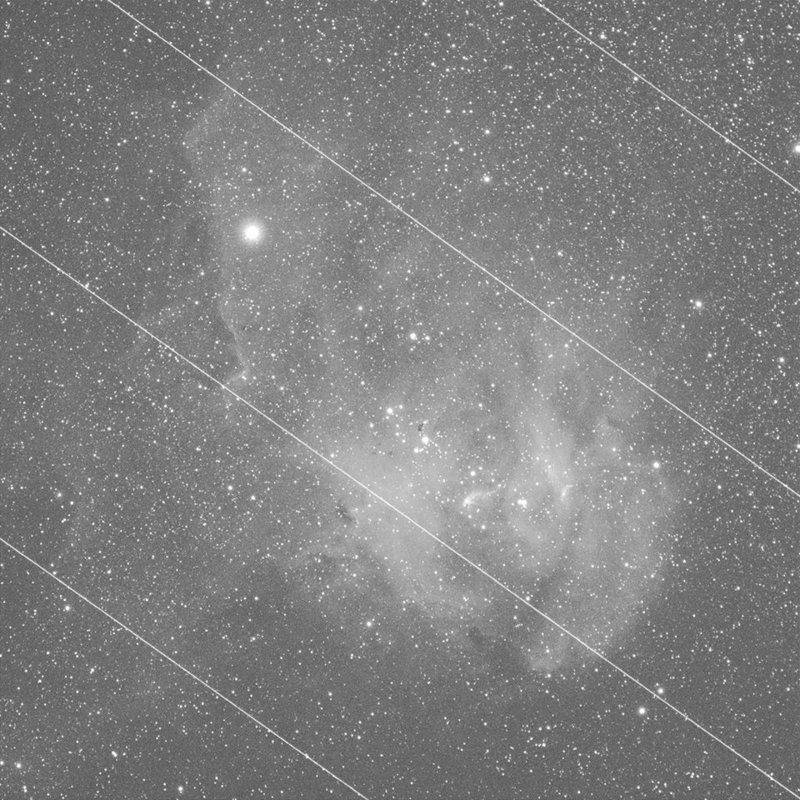
Seriously, this guy has destroyed astronomy for amateur and professional alike
His actions are criminal and this is just the start :oldmad::oldmad::oldmad:
just one recent example ...

elon musk satellites.jpg
Maybe he should redirect his satellites in a path that avoids blocking celestial objects that astronomers are interested in?
May I suggest a path directly INTO the sun? If not, how about directly into Elon's back yard? Either would suit me just fine...
 
  • Like
Likes   Reactions: tech99
Astronomy news on Phys.org
davenn said:
His actions are criminal

It is even worse. His actions are not criminal due to a lack of corresponding rules. As long as the satellites are duly registered they are perfectly legal. There is nothing that could stop him or others from spamming the sky.
 
DrStupid said:
It is even worse. His actions are not criminal due to a lack of corresponding rules. As long as the satellites are duly registered they are perfectly legal. There is nothing that could stop him or others from spamming the sky.

uh huh, maybe I should qualify the comment ... criminal to everyone outside the govt's that allow this sort of thing :frown:
 
davenn said:
the govt's that allow this sort of thing

They do not allow it. They just forgot to forbid it. Nobody considered this situation when the international space law has been established. But instead of a corresponding update there is currently reather a tendency to cancel international treaties.
 
  • Like
Likes   Reactions: Keith_McClary and russ_watters
Are there practical things that can make satellites like that more stealthy? Paint them with non-optically-reflective black paint?
 
  • Like
Likes   Reactions: Dragrath and davenn
berkeman said:
Are there practical things that can make satellites like that more stealthy?

In general, it's difficult as more often than not, the sat's surfaces are covered in solar panels for battery charging,
and they are very reflective, I haven't seen a photo of one of these actual satellites before launch
 
Or if the orbital data is available, can you program your camera to filter them out?
 
  • Like
Likes   Reactions: stefan r
Take multiple images and stack using median combine and that should remove them.
Regards Andrew
 
  • Like
Likes   Reactions: sophiecentaur
Post in on Twitter, maybe you get a response :biggrin:
 
  • Like
Likes   Reactions: Nick-stg
  • #10
Classical conflict of interests: some people want to earn money, others want to do science. The money people usually win.
 
  • Like
Likes   Reactions: swampwiz
  • #11
Ibix said:
Or if the orbital data is available, can you program your camera to filter them out?
there's too many of them and 100's more coming. trails like that cannot be filtered out
 
  • #12
andrew s 1905 said:
Take multiple images and stack using median combine and that should remove them.
Regards Andrew

Image stacking is the norm anyway, doesn't help, too many of these bl$$dy things
 
  • #13
Jando said:
The money people usually win.

Sad but true

This image from the International Astronomical Union
.
14352062-7102685-Experts_have_condemned_the_launch_of_Elon_Musk_s_Starlink_projec-a-3_15596516...jpg
 
  • #14
Isn't that typical of humans to soil their environment and think nothing of it, as long as it doesn't affect themselves.
Light pollution just gets getting more and more "disgusting." They built a new bridge here and what do they do - this is the federal gov't by the way who tries to pass themselves on as being environmental mindful - they light it up with those colored LED lights for show, and the public blabbers say what a sight - no regard for the little kids that will grow up and never see a clear sky in their growing up years and fantasize about the universe.

Well, technological progress, and the push for immediate gratification, does indeed have its downside.
 
  • Like
  • Sad
Likes   Reactions: Amrator, Nick-stg, Not anonymous and 2 others
  • #15
Do these satellites present any problems for the new Thirty Meter Telescope in Hawaii? If not how are they mitigating the presence of the satellites?
 
  • #16
gleem said:
Do these satellites present any problems for the new Thirty Meter Telescope in Hawaii? If not how are they mitigating the presence of the satellites?
They might mitigate the problem with satellites in the Hawaiian sky by building the telescope in the Canary Islands!
 
  • Like
Likes   Reactions: Keith_McClary
  • #17
berkeman said:
Are there practical things that can make satellites like that more stealthy? Paint them with non-optically-reflective black paint?
Thermal management is critical for satellites, so probably not.
 
  • Informative
  • Like
Likes   Reactions: sophiecentaur and berkeman
  • #18
davenn said:
Image stacking is the norm anyway, doesn't help, too many of these bl$$dy things
While I haven't experienced the Starlink specific issue yet, previously I would just reject subs that had this issue. But it should be possible to subtract the streaks from each sub before stacking. A dark streak has a whole lot less impact on the stack than a bright one.
 
  • #19
gleem said:
Do these satellites present any problems for the new Thirty Meter Telescope in Hawaii? If not how are they mitigating the presence of the satellites?

Every telescope anywhere on Earth with a latitude of ~ + - 65 deg going by the images I have seen
showing their satellite orbital coverage
websterling said:
They might mitigate the problem with satellites in the Hawaiian sky by building the telescope in the Canary Islands!

HUH ??! I have to assume that was a joke because if it wasn't, then you don't understand the problem !
 
  • #20
Paging @mfb -- was this part of the planning for these new arrays of communication satellites?
 
  • #21
HUH ??! I have to assume that was a joke because if it wasn't, then you don't understand the problem !
It was supposed to be a joke, hence the exclamation point! The joke being that any problem with anything in the Hawaiian sky (which was specifically mentioned) would be mitigated if the telescope were built in the Canary Islands.

I thought it was funny. And, FYI, I do understand the problem.
 
  • Like
Likes   Reactions: Dale
  • #22
davenn said:
Every telescope anywhere on Earth with a latitude of ~ + - 65 deg going by the images I have seen
showing their satellite orbital coverage
Then as far as they are concerned there is no (significant) issue with the satellites.
 
  • Skeptical
Likes   Reactions: davenn
  • #23
gleem said:
Then as far as they are concerned there is no (significant) issue with the satellites.
HUH ??
who are they ?
please explain your response
 
  • #24
gleem said:
Then as far as they are concerned there is no (significant) issue with the satellites.

Professional astronomers since they have been building new terrestrial telescopes since the first satellite was launched.
 
  • #25
The Starlink satellites are launched to a height of ~300 km and raise their orbit to 550 km using ion thrusters. To do so they fly in a low drag configuration, which makes the solar panels very visible around sunset/sunrise. After they reach their operational altitude the current satellites re-orient their solar panels and dim to magnitude 5-6, future satellites might become even dimmer (they are testing a new coating right now - you can't make it black, but they change the directions the light is reflected/scattered to). With 5-6 they are only visible in places with a very dark sky, if the new coating works well they will become completely invisible to the naked eye. Telescopes will still spot them, of course, just like they spot the thousands of other satellites, that is unavoidable.

Only a few batches of satellites are raising their orbit at the same time, and while they do so they have predicable orbits (so astronomers can plan ahead) and they enter the shadow of Earth quite soon due to their low orbits (they are not visible for most of the night). It's not a big deal for professional observations. They would prefer absolutely no satellites apart from orbital telescopes, obviously, but that's not realistic.
If you absolutely need to take an image of a region in the sky at the time a train of satellites will fly through you can still take many images and remove the satellites in software.
davenn said:
I haven't seen a photo of one of these actual satellites before launch
Here is one. With annotations here.
gleem said:
Professional astronomers since they have been building new terrestrial telescopes since the first satellite was launched.
It is not without impact, but the impact is not as large as some people claim.
Jando said:
Classical conflict of interests: some people want to earn money, others want to do science. The money people usually win.
Some people want internet access. About 3 billion of them do not have internet access at the moment, but such a satellite constellation can provide internet for nearly everyone - they only need a user terminal. I really hope they win. Internet access for everyone is so much more important than a few affected pictures of selected night sky objects.
 
  • Like
Likes   Reactions: StatGuy2000, sophiecentaur, Dragrath and 1 other person
  • #27
The appropriate requirement is for Elon Musk to provide free transport of astronomers, all the telescopes, a large amount of support equipment and material, and family members, to a base on the far side of the moon.

That's where you want to be to do astronomy anyway.
- No atmosphere to ruin exposures. No weather. No clouds. Nothing to block the parts of the spectrum that don't get through even clear air.
- Light pollution from cities far less important because no atmosphere to reflect it. Even when there are cities.
- Put up a sun shade and very little change in temperature. So your telescope is not going to "krink" as the daily temperature cycles.
- No wildlife to fly into the telescopes.
- Two week exposures with very little effort.
- And it is never "moon bright." Or even "Earth bright" on the far side.

Probably not a bad place for the gravity wave detector folk also.
 
  • Like
Likes   Reactions: swampwiz, trurle and berkeman
  • #29
mfb said:
Here is a system that blocks exposure for places where satellites are - all of them, not just Starlink. It uses tracking information and then just stops recording in the region directly around the satellite. Overall loss of exposure time is tiny.
Thanks @mfb that's an obvious solution that is not obvious until you think about it. So astronomers will be forced to use a system like that, but when they do the problem mostly goes away.

I read that companies other than SpaceX have similar plans for orbiting nets of satellites; on the order of 45K satellites planned so far.

It is hard to dispute that Internet access for all 7 billion people on the planet is a high priority human welfare issue. Maybe all of them will become PF members and post to this thread :rolleyes:
 
  • #30
anorlunda said:
It is hard to dispute that Internet access for all 7 billion people on the planet is a high priority human welfare Facebook issue.
OK, I admit it. . . I obviously messed with your quote. . . . 🤦‍♂️

Lol. . . I believe I made it "more truthful". . . . 😣
anorlunda said:
Maybe all of them will become PF members and post to this thread
Maybe all of them will become PF members, sometime, after they hold a Facebook

account ?

1580446890794.png

Carry on. . . . 😏.😛

.
 
  • Like
Likes   Reactions: davenn