Throwing force in target thrower

  • Thread starter Thread starter kamil.borkowski
  • Start date Start date
  • Tags Tags
    Force
Click For Summary

Discussion Overview

The discussion revolves around the design and mechanics of a target thrower, specifically focusing on the forces required to launch a target at a certain velocity. Participants explore concepts related to centrifugal force, energy calculations, and the relationship between linear and angular velocities in the context of a spring-powered clay pigeon launcher.

Discussion Character

  • Exploratory
  • Technical explanation
  • Mathematical reasoning
  • Debate/contested

Main Points Raised

  • One participant seeks to understand the force needed to throw a target and suggests that centrifugal force may be involved, but struggles to connect it with linear movement.
  • Questions arise about the meaning of "r0" in the provided diagram and whether there are multiple moving components in the mechanism.
  • Another participant confirms the target thrower is for launching clay pigeons and discusses the importance of the target rolling down the launch blade for stability.
  • Energy calculations are proposed, equating the energy stored in the spring with the energy of the moving arm and target, but the challenge of determining the angular velocity of the arm is highlighted.
  • Participants discuss the empirical nature of existing clay pigeon launchers and question the necessity of a full mathematical solution versus practical adjustments.
  • One participant expresses confusion about the mechanism and suggests drawing the initial and final positions of the mechanism bars to clarify relationships.
  • Another participant introduces second-order nonlinear differential equations to describe the system dynamics, indicating a complex mathematical approach to the problem.
  • A participant reports calculations yielding an angular velocity of the arm and an exit angle for the target, seeking validation of these results.

Areas of Agreement / Disagreement

Participants express varying levels of understanding and approaches to the problem, with no consensus on the best method to calculate the angular velocity of the arm or the overall mechanism design. Some participants propose empirical methods while others suggest a more rigorous mathematical approach.

Contextual Notes

The discussion includes unresolved aspects such as the dependence on the friction channel's impact on the target's launch and the complexity of the differential equations presented. There are also limitations in the clarity of the mechanism's operation as described by participants.

kamil.borkowski
Messages
8
Reaction score
0
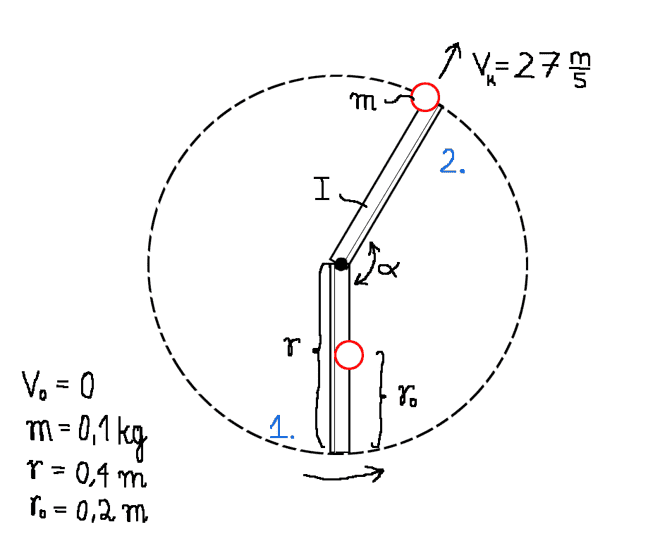
Hi! I need a help in desiging a target thrower. I can't find a force that is needed in order to throw a target with certain velocity. I assume that it's going to be a centrifugal force, but I can't find a connection with linear movement of target and rotation of an arm. Does anyone have an idea? Here's a picure:
711izk.jpg
 
Engineering news on Phys.org
What is r0? I see it in the diagram, but what is it doing there? Is there more than one moving component?
 
kamil.borkowski said:
Hi! I need a help in desiging a target thrower. I can't find a force that is needed in order to throw a target with certain velocity. I assume that it's going to be a centrifugal force, but I can't find a connection with linear movement of target and rotation of an arm. Does anyone have an idea? Here's a picure:

711izk.jpg

Welcome to the PF.

Is this for launching clay "pigeons" like in trap shooting? Is it a flat disk or a round ball that you are launching. If it's a flat disk like a clay pigeon, you will want it to roll a ways down the launch blade as the blade is going through its motion. That will give it the spin it needs to fly stably.

Is this a spring-powered launcher? If so, you may be able to do a pretty simple calculation equating the energy stored in the spring when cocked with the final energy of the moving arm and the moving target (linear velocity and energy stored in its rotation)...
 
DaveC426913 said:
What is r0? I see it in the diagram, but what is it doing there? Is there more than one moving component?

r0 is a path, that disc has to travel, from it's initial position (V0=0), to the moment when it leaves the arm (V=27)

berkeman said:
Welcome to the PF.

Is this for launching clay "pigeons" like in trap shooting? Is it a flat disk or a round ball that you are launching. If it's a flat disk like a clay pigeon, you will want it to roll a ways down the launch blade as the blade is going through its motion. That will give it the spin it needs to fly stably.

Is this a spring-powered launcher? If so, you may be able to do a pretty simple calculation equating the energy stored in the spring when cocked with the final energy of the moving arm and the moving target (linear velocity and energy stored in its rotation)...

Yes, it is a clay launcher/thrower. It is spring-powered. I was thinking about the energy calculations, but I thought that it would leave the aspect of WHEN the target leaves the arm. I want it to leave, when the arm travels about 160°-170°. In energy equation I need also ω of the arm and that's the problem. I can't find proper ω of the arm.
 
kamil.borkowski said:
r0 is a path, that disc has to travel, from it's initial position (V0=0), to the moment when it leaves the arm (V=27)
Ohhhh I see. So it follows a spiral path.
 
DaveC426913 said:
Ohhhh I see. So it follows a spiral path.

Yes, exactly! I'm using that equation: E=1/2*(m*V^2 + Iω^2 + Iω^2). I know V and ω of disc, but I don't know how to calculate ω of the arm.
 
Have you seen how basic clay pigeon launchers work? You tune the launch angle by moving the clay pigeon forward and back in a friction hold channel...
 
berkeman said:
Have you seen how basic clay pigeon launchers work? You tune the launch angle by moving the clay pigeon forward and back in a friction hold channel...

Yes, I know, but I have to calculate it somehow (ω of the arm), because I need it to equation of energy.
 
For the launchers I've used, it's pretty empirical. Why do you need a full mathematical solution? Are you going to hold the friction holding channel on the launcher to tight tolerances? And the clay pigeons? What accuracy are you shooting for (pun) in the launch angle?
 
  • #10
berkeman said:
For the launchers I've used, it's pretty empirical. Why do you need a full mathematical solution? Are you going to hold the friction holding channel on the launcher to tight tolerances? And the clay pigeons? What accuracy are you shooting for (pun) in the launch angle?

Well, maybe not full solution. The thing is I need to choose proper spring. I will do it from energy equation, just like You sugested. To do so, I need angular and linear velocity of clay target (which I have) and angular velocity of the arm. And that's the problem, how to calculate ω of the arm. I can't find connection between ω of arm and velocities of clay target. Not to mention, that the friction channel is complicating the case even more, because I don't have an idea how to take it to account neither.
 
  • #11
Please Kamil, I don't understand well how the mechanism works. I was trying to know the mechanism at Internet, but I didn't find an scheme of it.If you draw the two positions, the initial and the final position, of the mechanism bars, I think it woul be possible to find out the relations you are looking for.
 
  • #12
BTW, I know it's just a sketch but I'm pretty sure your exit trajectory is way off. The clay pigeon's trajectory will form a parabola, transformed into polar coordinates. So its exit from the launcher should look more like this:
 

Attachments

  • clay-pigeon.png
    clay-pigeon.png
    25.8 KB · Views: 1,127
  • Like
Likes   Reactions: berkeman
  • #13
Thanks Dave, I was thinking in other system, and I see the sketch shows the two position.
Kamil, I have not found an easy solution: two second order nonlinear differential equations, which, of course, there would be possible to solve numericaly .
x is the distance target-center of the bar
v es the speed of the target which is the vectorial sum of the two ortogonal vectors: \dot{x} and \dot{α}.x
k is the spring constant

The two differential equations are:

(1). \ddot{α}.(I+m.x)=k.α

(2). \ddot{x}=\dotα2.xSorry i don't know how to write the equations properly. I'll try to solve it.
 
Last edited:
  • #14
Whoa! Thank You guys for so many responces! I made some calculations and it came out, that ω of the arm equals 63,5 [rad/s]. Angle, for which target will leave arm, equals about 60°. You think these are pretty real results? Considering Dave's graph, I think that's a good angle.
 

Similar threads

  • · Replies 9 ·
Replies
9
Views
2K
Replies
6
Views
2K
  • · Replies 1 ·
Replies
1
Views
4K
Replies
6
Views
3K
  • · Replies 9 ·
Replies
9
Views
2K
  • · Replies 4 ·
Replies
4
Views
2K
Replies
23
Views
3K
  • · Replies 18 ·
Replies
18
Views
3K
  • · Replies 2 ·
Replies
2
Views
2K
  • · Replies 2 ·
Replies
2
Views
2K