Transient thermal analysis in ANSYS

Click For Summary
SUMMARY

The discussion focuses on performing a transient thermal analysis of a butt welded joint using ANSYS. The user applied a heat flow of 3200 watts, with boundary conditions for convection (coefficient of 11.14) and radiation (emissivity of 0.4), but encountered a minimum temperature of -132.52°C, which is unexpected. Troubleshooting steps suggested include disabling boundary conditions, checking for nonlinear material properties, and remeshing the geometry. The user is also exploring the possibility of implementing a cooling cycle in ANSYS Workbench.

PREREQUISITES
  • Understanding of ANSYS Workbench for thermal analysis
  • Knowledge of transient thermal analysis principles
  • Familiarity with boundary conditions in thermal simulations
  • Experience with nonlinear material properties in thermal modeling
NEXT STEPS
  • Learn how to implement cooling cycles in ANSYS Workbench
  • Research techniques for remeshing in ANSYS to improve simulation accuracy
  • Explore the effects of nonlinear material properties on thermal analysis results
  • Study the impact of boundary conditions on transient thermal simulations
USEFUL FOR

Engineers and analysts involved in thermal simulations, particularly those working with welding processes and transient thermal analysis in ANSYS.
happytolearn
Messages
10
Reaction score
0
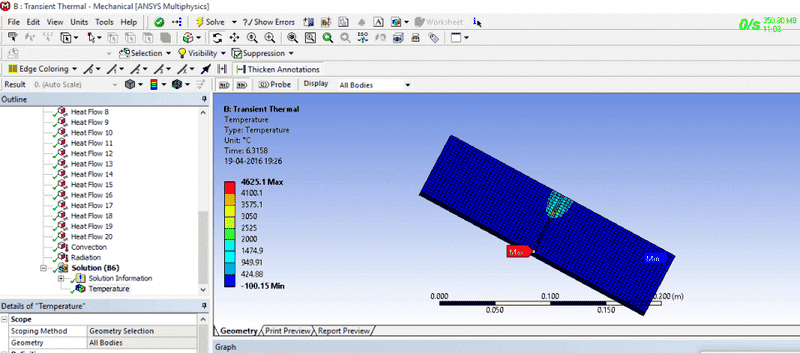
I want to do a transient thermal analysis in butt welded joint.The heat flow I have given 3200 watt(Q = efficiency x current x voltage = 0.8 x 160 amp x 25 volt)to the welding zone, given 20 load step(as welding is completed in 20 sec),convection co-efficient = 11.14, emissivity = .4 and applied both boundary condition convection and radiation on every surface except welding zone. But after solving the minimum temperature of the plate is coming in negative.Can anybody tell me what i am missing?
upload_2016-4-19_19-34-18.png
 
Engineering news on Phys.org
Where does this minimum temperature occur? Is it at a single node, or over a portion of the part? Also, what did you use for your starting temperature in the analysis?
 
It is coming in a region when I run the animation. I have selected the initial temperature as 22 degree centigrade
 
For troubleshooting purposes try disabling the convection and radiation boundary conditions one at a time and see if either is the culprit. I'm guessing one of those is causing an unexpected result for some reason...
 
I have tried to analyse the result by activating and deactivating one after another.But still it is coming very high temperature.One thing to mention i have applied the boundary conditions to the whole assembly(welding zone and the two plates).What can be the other possibilities for the troubleshooting?
 
upload_2016-4-21_15-9-26.png


Maximum temperature is coming 6042 .8 and minimum -132.52! Though i have selected initial temperature as 22 degree centigrade.
 
There's something weird going on with the boundary conditions, because there's really shouldn't be a cooling effect on the part based on what I'm seeing. Do you have any other boundary conditions set up other than the heat flows?
 
No i have just given heat flow,convection and radiation.should i add any other boundary condition?What is the thing i am missing. Please help.
 
Are you using nonlinear material properties? Honestly there isn't much more input we can provide without more context. Have you re-meshed the geometry with a higher density to see if the results change?
 
  • #10
yes I have used nonlinear (temperature dependent)material property. I am now trying to see the effect by remeshing according to your advice. One thing can we cool the assemble by applying cooling cycle?I have linked the transient analysis to a new transient analysis where i have omitted the load and run it for 20 second but the imported temperature has not changed.In journaIs I saw everyone cool the assemble for some time.Is there any way to run the cooling cycle in workbench?
 

Similar threads

  • · Replies 2 ·
Replies
2
Views
9K