synMehdi
- 38
- 0
- TL;DR
- understanding what happens to a rotor when an unbalance mass is added in a spring model bearing
I would like to undertand more the force caused by unbalance in a rotor, assume that the bearing is represented with 2 springs like above:
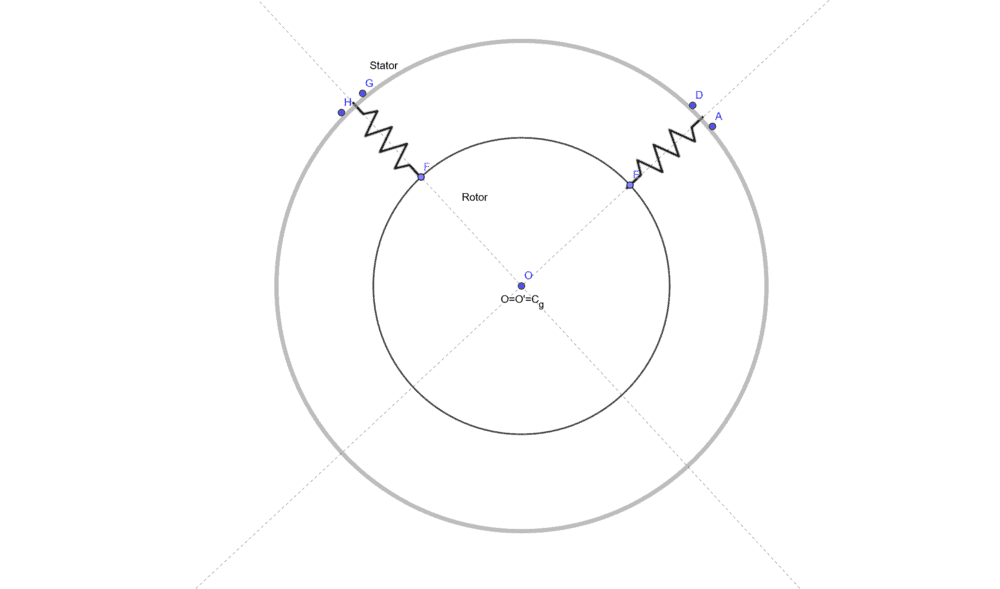
The geometrical center of the rotor ##O## is equivalent to it center of gravity ##C_g## and the center of the stator (bearing) ##O'##
The rotor is perfectly balanced all the centers coincide
When the rotor has an unbalance mass ##M_u##, the 3 centers no longer coincide:
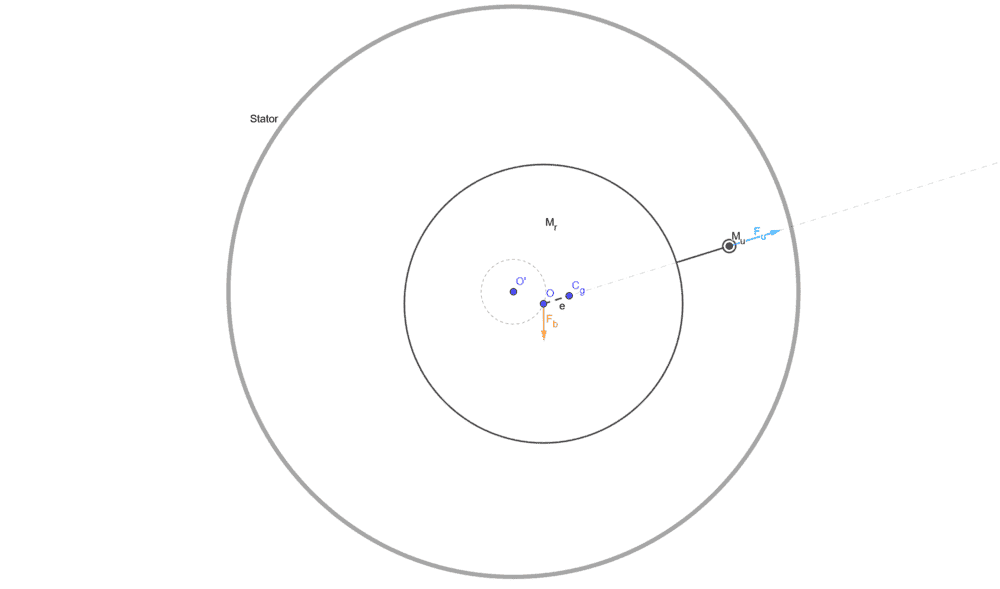
I ommited the springs representing the bearing. The rotor (with mass ##M_r##) turns and orbits around the center of the stator ##O'##
The unbalance force is defined as ##F_u=M_u\cdot r\cdot \omega^2 ##
My question is: What is ##r## ? Is it ##O'M_u## or ##OM_u##.
I understand that these two vectors are virtually the same in an up-to-scale rotor
The unbalance can also be defined as ##F_u=(M_r+M_u)\cdot e\cdot \omega^2 \approx M_r\cdot e\cdot \omega^2##
so my second question is: How about ##e##?. Is it ##O'Cg## or ##OCg## ?
This time the two vectors are not virtually the same
I guess I want to understand what's going on when the rotor is orbiting and turning around itself. My guess is ##e=O'C_g## because ##O'## will depend on the stiffness of the bearing. Infinite stiffness will make ##O'=O## and the unbalance force will be described with no problems. zero stifness will make ##O'=Cg## and zero unbalance force, right? It should seem ##e## should be ##O'Cg## but I don't fully understand why.
The geometrical center of the rotor ##O## is equivalent to it center of gravity ##C_g## and the center of the stator (bearing) ##O'##
The rotor is perfectly balanced all the centers coincide
When the rotor has an unbalance mass ##M_u##, the 3 centers no longer coincide:
I ommited the springs representing the bearing. The rotor (with mass ##M_r##) turns and orbits around the center of the stator ##O'##
The unbalance force is defined as ##F_u=M_u\cdot r\cdot \omega^2 ##
My question is: What is ##r## ? Is it ##O'M_u## or ##OM_u##.
I understand that these two vectors are virtually the same in an up-to-scale rotor
The unbalance can also be defined as ##F_u=(M_r+M_u)\cdot e\cdot \omega^2 \approx M_r\cdot e\cdot \omega^2##
so my second question is: How about ##e##?. Is it ##O'Cg## or ##OCg## ?
This time the two vectors are not virtually the same
I guess I want to understand what's going on when the rotor is orbiting and turning around itself. My guess is ##e=O'C_g## because ##O'## will depend on the stiffness of the bearing. Infinite stiffness will make ##O'=O## and the unbalance force will be described with no problems. zero stifness will make ##O'=Cg## and zero unbalance force, right? It should seem ##e## should be ##O'Cg## but I don't fully understand why.