Updates on the experiments X17

  • Level: Undergrad 
  • Thread starter kodama
  • Start date
  • Tags Tags
    Experiments
50 replies · 16K views · last reply
Vanadium 50 said:
Generalissimo Francisco Franco is still dead.
could you elaborate?
Slide titled 'A first look at the data sample' showing hit distribution plots from the drift chamber: an X-Y arc-shaped hit map and a Z-Y hit map, plus two momentum histograms labelled Monte-Carlo IPC and Data (including IPC and EPC) with p in GeV from 0 to 0.04.


what does this data mean?
 
Ibix said:
Franco still dead. I take it V50 means 'nothing new here'.
okay but what does this means

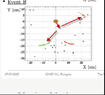
Slide titled Pair event display from LiPON data showing two events, A and B, each with an X-Y transverse view and a Y-Z side view; red e- hits, green e+ hits, and a brown target marked, with axes in cm.


what is actually happened here ?
it looks like e+e- pairs are emissions at an angle off the target
is the SM or x17?
 
Last edited:
If the experiment doesn't say they see something, having an outsider say that the do ois crackpotty. It puts the potty in cracpotty.
Seeing an e+e- pair is a very different think from seeing an X17.
 
Vanadium 50 said:
If the experiment doesn't say they see something, having an outsider say that the do ois crackpotty. It puts the potty in cracpotty.
Seeing an e+e- pair is a very different think from seeing an X17.
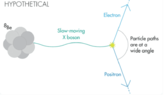
Two-panel diagram comparing 8Be decay. Top, Expected 8Be transition: a fast-moving photon converts to an electron and positron whose paths are close together. Bottom, Hypothetical: a slow-moving X boson gives an electron and positron at a wide angle.


Slide titled Pair event display from LiPON data showing two events, A and B, each with an X-Y plot and a Z-Y plot of hit points. Red e- hits and green e+ hits are shown, with a brown target marked near the origin.


a small fraction of the decay seems to be a wide angle e+e- pair the green and dotted red from brown dot target is what you would expect x17
 
ie

Two-panel event display of a pair event from LiPON data: left panel plots Y against X in cm, right panel plots Y against Z in cm, with red and green hit points and a brown target marked, plus a hand-drawn circle around the hit legend.

Two scatter plots labelled Event B: left panel plots Y [cm] against X [cm] and right panel plots Y [cm] against Z [cm], showing colored point tracks and a brown blob at the origin in each.
Hypothetical diagram: a grey 8Be nucleus emits a wavy green line labelled slow-moving X boson, which decays at a point into an electron and a positron whose paths diverge at a wide angle.
Scatter plot of detector hit points in the Y [cm] versus Z [cm] plane, with green and red track segments near Z 10 to 20 cm and a cluster of red and black points near Z 40 to 50 cm, plus a brown ellipse at upper left.

Slide scatter plot of Y [cm] against Z [cm] with black dots, a brown ellipse, red and green line segments, and three hand-drawn black circles marking clusters, footer reads The X17 search with MEG-II.
Slide plot of Y [cm] against Z [cm] showing point hits from a tracking detector, with a brown elliptical cluster at upper left, red arrows linking it to two yellow-highlighted clusters at upper right and lower centre, and a slide footer reading The X17 search with MEG-II, H. Benmansour, 13.
Hypothetical diagram: an 8Be nucleus emits a slow-moving X boson (wavy line), which decays at a point into an electron and a positron that travel off at a wide angle to each other.
Two-panel event display of pair hits from LiPON data, showing X-Y and Z-Y cross-sections in cm, with red and green hit points, a brown target marker, and a hand-drawn circle around the legend.


Event display titled Event B, scatter plot of Y [cm] against X [cm] with black dots for hits, orange and green track segments, and three hand-drawn black loops circling clusters of points.


Event display titled Event B from an ICHEP XLI Bologna slide, plotting Y [cm] against X [cm] with a brown spot at the origin, a green track and a red track curving away from it, and scattered dots.

MEG II data collected samples evidence of X17
 
Last edited:
Event display slide with two panels of hit points in X-Y and Z-Y projections, showing red and green hits and a brown target marker, with a hand-drawn circle around the target and legend.

e-e+ and target

actual MEG II data February 2022

Scatter plot titled Event B, with Y [cm] against X [cm] from -30 to 10 and -30 to 25, showing black dots for hits, green and red clusters of tracks, a brown circle at the origin and red arrows pointing from it to the tracks.


x17

Hypothetical diagram of a slow-moving X boson emitted from an 8Be nucleus, decaying into an electron and a positron that leave at a wide angle to each other.

same anomaly

independent evidence for x17
 
Attachments
  • Hypothetical diagram of a slow-moving X boson emitted by an 8Be nucleus, decaying into an electron and a positron whose paths diverge at a wide angle.
    image.png
    14 KB · Views: 225
  • Event display plot titled Event B, Y [cm] against X [cm], with black dots for hits, a brown dot at the origin, and red and green tracks with red arrows; footer reads 07-07-2022, ICHEP XLI, Bologna.
    Screenshot 2023-01-28 at 16-08-47 Updates on the experiments X17.png
    17.7 KB · Views: 234
It is very brave of you to claim an experiment sees something that they claim they don't.
 
just in

[Submitted on 15 Apr 2025]
Combined Evidence for the X17 Boson After PADME Results on Resonant Production in Positron Annihilation
Fernando Arias-Aragón, Giovanni Grilli di Cortona, Enrico Nardi, Claudio Toni

abstract

The Positron Annihilation into Dark Matter Experiment at the Laboratori Nazionali di Frascati has reported an excess of e+e− final-state events from positron annihilation on fixed-target atomic electrons. While the global significance remains at the 1.8σ level, the excess is centered around s√∼17MeV, coinciding with the invariant mass at which anomalous e+e− pair production has previously been observed in nuclear transitions from excited to ground states in 8Be, 4He and 12C, thereby strengthening the case for a common underlying origin, possibly involving a hypothetical new X17 boson. We discuss the significance of this independent accelerator-based evidence. Combining it with existing nuclear physics results, we obtain a value for the X17 mass of mX17=16.88±0.05 MeV, reducing the uncertainty from nuclear physics determinations alone by more than a factor of two.

Cite as: arXiv:2504.11439 [hep-ph]

conclusion independent accelerator-based evidence X17 mX17=16.88±0.05 MeV, 1.8σ

dark matter exhibit properties
 
On the Possible Detection of New Particles from Data on Soft Photons in Collisions of Protons and Nuclei and from Data on Ultra-High-Energy Cosmic Rays

Alexander T. D’yachenko(
St. Petersburg, INP and St. Petersburg State U.
)

2025
8 pages
Published in:

J.Phys.Conf.Ser. 2984 (2025) 1, 012019

Contribution to:

5th International Scientific Forum “Nuclear Science and Technologies”

Published: 2025

Abstract: (IOP)
In order to develop the statistical model for proton-nucleus collisions at the stage of expansion of the compound nuclear system, the adiabatic temperature change and the correction to the Boltzmann distribution of the multiplicity of emitted secondary particles are additionally taken into account. As a result, improved agreement with experimental data is obtained compared to previous studies for the soft-photon spectrum by transverse momentum in pp collisions at an incident proton momentum of 450 GeV/c in order to isolate a clearly expressed X17 signal at around 17 MeV. An interpretation of the detection of a boson with mass 38 MeV in the spectra of photons emitted in reactions of protons with carbon nuclei at an incident proton momentum of 5.5 GeV/c is proposed. Analyzing the spectra of ultra-high-energy cosmic rays (photons), confirmation of the existence of new particles — the X17 and X38 bosons, with masses of 17 MeV and 38 MeV, respectively, has been found
  • Published: 2025
DOI:

could a HEP comment on soft-photon spectrum by transverse momentum in pp collisionsat an incident proton momentum of 450 GeV/c in order to isolate a clearly expressed X17 signal at around 17 MeV.
 
[Submitted on 30 May 2025]
Search for a new 17 MeV resonance via e^+e^- annihilation with the PADME Experiment
F. Bossi, R. De Sangro, C. Di Giulio, E. Di Meco, D. Domenici, G. Finocchiaro, L.G. Foggetta, M. Garattini, P. Gianotti, M. Mancini, I. Sarra, T. Spadaro, C. Taruggi, E. Vilucchi, K. Dimitrova, S. Ivanov, Sv. Ivanov, K. Kostova, V. Kozhuharov, R. Simeonov, F. Ferrarotto, E. Leonardi, P. Valente, E. Long, G.C. Organtini, M. Raggi, A. Frankenthal

The PADME Experiment at the Frascati DA NE LINAC has searched for a hypothetical particle with mass around 17 MeV, commonly referred to as the X17, using a positron beam incident on a fixed target. The beam energy was varied between 262 and 296 MeV, corresponding to center-of-mass energies between 16.4 and 17.4 MeV. The X17 should be produced resonantly via annihilation when approaches its mass, inducing an excess of events with a two-body final state over the background expectation. The beam energy spacing was fixed to less than half the expected width of the resonance's line shape. Uncertainties below 1% per point were achieved. A blind analysis has been performed. The data are consistent with the expected background in most of the explored energy range, and limits are set in previously unexplored regions of the available parameter space. The most significant deviation is found for MeV, corresponding to a global significance of approximately 2 standard deviations over the null hypothesis expectation.

Comments: 23 pages, 24 figures
Subjects: High Energy Physics - Experiment (hep-ex)
Cite as: arXiv:2505.24797 [hep-ex]

2 standard deviations over the null hypothesis expectation isn't 5 standard deviations but " data are consistent with the expected background in most of the explored energy " and The most significant deviation is found for 17 MeV is progress towards x17
 
The new muon g-2 experimental results and SM prediction, which are within 0.6 sigma of each other, disfavor the X17 hypothesis.

A new fundamental boson at 16.9 MeV would almost surely impact the muon g-2 results given that a muon is 105.7 MeV and that the experiments are being conducted with muons with 3.1 GeV of combined mass-energy because they are accelerated (this "magic" energy level causes cofounding components that add noise to the muon g-2 measurement to cancel out).

But there is no sign of any such impact at a sub-parts per million level.

Obviously, it would be ideal for someone to model the expected X17 impact on muon g-2 with a particular bump in the data (which doesn't exceed 2 sigma locally) for an X17 with particular theoretically proposed quantum numbers and couplings. But my first impression mathematical intuition suggests that is is strongly disfavored.

Still, the closest thing I could find to an analysis of that on arXiv is rather more hopeful after doing are more quantitative analysis:

We discuss new physics phenomenology of hidden scalar (S), pseudoscalar (P), vector (V) and axial-vector (A) particles coupled to nucleons and leptons, which could give contributions to proton charge radius, (g−2)μ, 8Be-4He anomaly and electric dipole moment (EDM) of Standard Model (SM) particles. . . . The existence of light sub-GeV bosons could possibly explain the muon (g−2) anomaly observed. We also summarize existing bounds on ATOMKI X17(JP=0−,1±) boson coupling with neutron, proton and electron. We implement these constraints to estimate the contribution of P, V and A particles to proton charge radius via direct 1-loop calculation of Sachs form factors. The analysis reveals the corresponding contribution is negligible. . . .

D. V. Kirpichnikov, Valery E. Lyubovitskij, Alexey S. Zhevlakov, "Implication of the hidden sub-GeV bosons for the (g−2)μ . . . ." arXiv:2002.07496 (November 23, 2020).

This paper concluded that:

We estimate sensitivity of NA64 muon active target experiment to probe sub-GeV Vector and Scalar mediator of DM by using comprehensive GEANT4 MCsimulation. These bosons can possibly explain (g-2) anomaly. In case of NA64 null result of observing muon missing energy events associated with hidden vector and scalar particles, one can exclude new sub-GeV bosons as interpretation of (g-2) anomaly.

In hindsight, this is actually good news for the X17. But, it takes a certain amount of special pleading to produce a rather odd fifth force and odd properties of an X17 to get there.
 
Last edited:
ohwilleke said:
The new muon g-2 experimental results and SM prediction, which are within 0.6 sigma of each other, disfavor the X17 hypothesis.

A new fundamental boson at 16.9 MeV would almost surely impact the muon g-2 results given that a muon is 105.7 MeV and that the experiments are being conducted with muons with 3.1 GeV of combined mass-energy because they are accelerated (this "magic" energy level causes cofounding components that add noise to the muon g-2 measurement to cancel out).

But there is no sign of any such impact at a sub-parts per million level.

Obviously, it would be ideal for someone to model the expected X17 impact on muon g-2 with a particular bump in the data (which doesn't exceed 2 sigma locally) for an X17 with particular theoretically proposed quantum numbers and couplings. But my first impression mathematical intuition suggests that is is strongly disfavored.

Still, the closest thing I could find to an analysis of that on arXiv is rather more hopeful after doing are more quantitative analysis:


D. V. Kirpichnikov, Valery E. Lyubovitskij, Alexey S. Zhevlakov, "Implication of the hidden sub-GeV bosons for the (g−2)μ . . . ." arXiv:2002.07496 (November 23, 2020).

This paper concluded that:


In hindsight, this is actually good news for the X17. But, it takes a certain amount of special pleading to produce a rather odd fifth force and odd properties of an X17 to get there.

there's

arXiv:2505.21305 (hep-ph)
[Submitted on 27 May 2025]
Concurrent Exploration of Axion-Like Particle Interactions with Gauge Bosons at the LHC
Shirin Chenarani, Mojtaba Mohammadi Najafabadi

Axion-like particles (ALPs) are pseudo Nambu-Goldstone bosons associated with spontaneously broken global symmetries incorporated in the Standard Model (SM) Lagrangian in many models beyond the SM. The existence of a light ALP is plausible due to the long-standing problems that the SM has not been able to address, such as the dark matter (DM) problem and the observed matter-antimatter asymmetry.

and

arXiv:1609.01669 (hep-ph)
[Submitted on 6 Sep 2016 (v1), last revised 28 Oct 2016 (this version, v2)]
Possible Explanation of the Electron Positron Anomaly at 17 MeV in Transitions Through a Light Pseudoscalar
Ulrich Ellwanger, Stefano Moretti

We estimate the values of Yukawa couplings of a light pseudoscalar A with a mass of about 17 MeV, which would explain the
0038.png
0042.png?V=2.7.webp
0065.png?V=2.7.webp
anomaly observed in the Atomki pair spectrometer experiment. The resulting couplings of A to up and down type quarks are about 0.3 times the coupling of the standard Higgs boson. Then constraints from K and B decays require that loop contributions to flavour changing vertices cancel at least at the 10% level. Constraints from beam dump experiments require the coupling of A to electrons to be larger than about 4 times the coupling of the standard Higgs boson, leading to a short enough A life time consistent with an explanation of the anomaly.
Comments:12 pages, discussion of nuclear shell model corrected, to appear in JHEP
Subjects: High Energy Physics - Phenomenology (hep-ph)
Report number:LPT Orsay 16-54
Cite as:arXiv:1609.01669 [hep-ph]
 
ohwilleke said:
The new muon g-2 experimental results and SM prediction, which are within 0.6 sigma of each other, disfavor the X17 hypothesis.


In hindsight, this is actually good news for the X17. But, it takes a certain amount of special pleading to produce a rather odd fifth force and odd properties of an X17 to get there.

these are Positron Annihilation into Dark Matter Experiment) at Laboratori Nazionali di Frascati of INFN run 4 in 2025
PADME Experiment run 4 the hope to get enough data points and improve detectors for 5 sigma if successful

Preparations for PADME Run IV currently ongoing
▪ New Micromegas chambers ➔ 𝑒+𝑒− vs. 𝛾 background
separation and new signatures possible
▪ More beam operation stability measurements to reduce
systematic uncertainties
▪ More data taking! (to reduce statistical uncertainties)
• Expected to completely cover the open vector X17
parameter space
• Data taking soon!
https://indico.global/event/652/contributions/16905/attachments/57490/110416/UCLADM2025_PADME_v2.pdf

▪ More data taking! (to reduce statistical uncertainties)

• Expected to completely cover the open vector X17
parameter space

its possible that the 2-sigma will go away with More data taking like the 750 gev di photon excess but the hope is enough data with upgrade detector for 5 sigma
 
kodama said:
its possible that the 2-sigma will go away with More data taking like the 750 gev di photon excess but the hope is enough data with upgrade detector for 5 sigma
Hope away. But disappearing is more likely.
 
ohwilleke said:
Hope away. But disappearing is more likely.
how would your world view change if Positron Annihilation into Dark Matter Experiment run 4 or something similar Experiment provides the 5 sigma necessary for discovery?
and especially what does x17 and hidden sector implications for Deur?
 
kodama said:
how would your world view change if Positron Annihilation into Dark Matter Experiment run 4 or something similar Experiment provides the 5 sigma necessary for discovery?
Obviously, I'd take that very seriously. I believe in evidence and the scientific method. It would have to be considered in light of all of the evidence. But if you're at 5 sigma, you have replication, and you have a legitimate theory, then it's safe to say it is real.
kodama said:
and especially what does x17 and hidden sector implications for Deur?
Nothing about the X17 hypothesis makes it a good dark matter candidate. The observations come from atomic physics.
 
ohwilleke said:
Obviously, I'd take that very seriously. I believe in evidence and the scientific method. It would have to be considered in light of all of the evidence. But if you're at 5 sigma, you have replication, and you have a legitimate theory, then it's safe to say it is real.

Nothing about the X17 hypothesis makes it a good dark matter candidate. The observations come from atomic physics.

if you bother to review the literature, x17 is part of a hidden sector that may include many additional particles with very feeble to no interactions to the standard model. many proposals include x17 and sterile neutrinos

i.e

arXiv:2403.15387 (hep-ph)

[Submitted on 22 Mar 2024 (v1), last revised 10 Oct 2024 (this version, v2)]

Production of dark sector particles via resonant positron annihilation on atomic electrons​


Fernando Arias-Aragón, Luc Darmé, Giovanni Grilli di Cortona, Enrico Nardi


is a hidden sector or also called dark sector compatible with Deur or a paradigm crisis for Deur
 
kodama said:
if you bother to review the literature, x17 is part of a hidden sector that may include many additional particles with very feeble to no interactions to the standard model. many proposals include x17 and sterile neutrinos
Most of those proposals have little merit, including sterile neutrinos which are strongly disfavored by observational evidence.

kodama said:
is a hidden sector or also called dark sector compatible with Deur or a paradigm crisis for Deur
Deur's goal is to explain dark matter phenomena and dark energy phenomena with non-perturbative GR effects, thus ruling out the necessity of a hidden or dark sector.

The paradigm crisis right now is for dark matter particle theorists who just can't manage to find any candidates that aren't ruled out by observations that explain the data.

Extremely light bosonic dark matter candidates (with particle masses < 10-21 eV) are still in the running, but basically nothing else works. Time and time again, searches for evidence for a hidden or dark sector particles that could explain dark matter phenomena either come up empty, or are flat out contradicted.

But, even if a new particle was discovered, for example, a new carrier boson that imparted mass to neutrinos, or additional Higgs bosons, this wouldn't necessarily make the new fundamental particles good dark matter candidates.

The inferred distribution of dark matter from stellar dynamics in galaxies is very diffuse in deep space, so the candidates need to be stable (on a time frame of many billions of years), something that is usually not a property of additional Higgs bosons or carrier bosons for a force or mass generation.

The most fundamental problem when it comes to devising properties for dark matter particle candidates is that the inferred distribution of dark matter particles is very tightly correlated with the distribution of ordinary matter (far beyond what gravity alone should do), yet other constraints suggest that it should have almost no non-gravitational Standard Model force interactions with ordinary matter (direct dark matter detection experiments, for example, constrain dark matter particle candidates with GeV or larger masses to have cross-sections of interaction a million times or more weaker than neutrinos, and W and Z and Higgs boson decays and Neff constraints from cosmology and reactor data, tightly restrict the possibility of additional active neutrinos with sub-GeV masses). The problem of reconciling these twin constraints is intractable.

Ultra-light dark matter candidates try to reconcile this by having an extremely large (galaxy scale) Compton wave-length and Bose statistics, that basically makes the candidates a 5th force or fluid. I personally see this trend as likely to ultimately converge on a dark matter particle candidate that looks a whole lot like a graviton.

A newly discovered particle that wasn't a dark matter candidate, of course, wouldn't disturb the paradigm of Deur, or any other gravity based or modified gravity theory.

Likewise, extremely high energy hidden sectors (e.g. inflatons), which might be proposed as explanations of cosmic inflation, while they could be relevant in the era of the Big Bang and immediately afterwards, wouldn't be relevant to explain dark matter and dark energy phenomena in the next 13 billion plus years that follow that high energy era.

Any dark matter particle candidate with a low enough energy scale to be relevant post-Big Bang Nucleosynthesis (about 15 minutes or so after the Big Bang), is within the reach of Earth based current collider experiments. But, we've seen nothing convincing so far, which means that it would have to be almost completely sterile (i.e. having virtually no non-gravitational interactions other than self-interactions with particles of the same type). A 17 MeV particle emitted in connection with beta-decay wouldn't be a viable dark matter particle candidate even if it existed.
 
well Positron Annihilation into Dark Matter Experiment run 4 and MEG II
X17 masses between 16.5 MeV/c2 and 17.1 MeV/c2. The
Atomki X17 hypothesis was tested and a 6.2% (1.5σ ) p-
value was obtained. Improved sensitivity to the particle pro-
duction can be achieved with higher statistics to be collected
at the 1030 keV resonance
Search for the X17 particle in 7Li(p,e+e−)8Be7Li(p,e+e−)8Be processes with the MEG II detector

MEG IICollaboration
•

K. Afanaciev(
Dubna, JINR
)

et al.
(Nov 12, 2024)

e-Print:
2411.07994 [nucl-ex]