Velocity/acceleration/speed of a particle

  • Context: MHB 
  • Thread starter Thread starter ineedhelpnow
  • Start date Start date
  • Tags Tags
    Particle
Click For Summary

Discussion Overview

The discussion revolves around the velocity, acceleration, and speed of a particle, specifically focusing on the calculations and graphical representations of these concepts. Participants are examining the mathematical expressions for acceleration and velocity, as well as how to visualize them in a three-dimensional space.

Discussion Character

  • Technical explanation, Conceptual clarification, Debate/contested, Mathematical reasoning

Main Points Raised

  • One participant states that the acceleration vector a(t) is given as $\left\langle 0,2,0 \right\rangle$, leading them to conclude that a(1) should also be $\left\langle 0,2,0 \right\rangle$. However, they reference a source (Chegg) that provides a different value for a(1), which is $\left\langle 1,2,0 \right\rangle$.
  • Another participant agrees with the first, asserting that Chegg's value is incorrect and explains that differentiating the position function twice for the i-component results in zero.
  • Participants discuss the representation of vectors v(1) and a(1) and express confusion about how to draw these vectors accurately in relation to a graph.
  • A participant provides a link to an external resource illustrating how to draw a vector, emphasizing the orientation of the axes in a 3D space.
  • There is a request for clarification on how to draw vectors on the surface of another graph or curve, indicating uncertainty about the graphical representation of vectors.
  • One participant expresses that they initially struggled with drawing vectors but later claims to have figured it out.

Areas of Agreement / Disagreement

Participants generally agree on the value of the acceleration vector a(1) being $\left\langle 0,2,0 \right\rangle$ and challenge the value provided by Chegg. However, there is ongoing confusion regarding the graphical representation of vectors, indicating that the discussion remains unresolved in that aspect.

Contextual Notes

There are limitations in the discussion regarding the clarity of the graphical representations and the specific assumptions made about the vectors' origins and directions. The mathematical steps leading to the conclusions about the vectors are not fully resolved.

ineedhelpnow
Messages
649
Reaction score
0
i made a calculator thread regarding this same question.

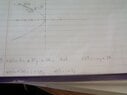
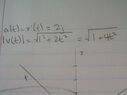
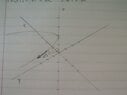
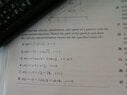
its number 7. ignore the graph on the first picture. its from the last question. the graph for this one is on the last picture. and excuse my sloppy handwriting. i was in a rush. since a(t)=2j meaning $\left\langle 0,2,0 \right\rangle$ i figured a(1) would be $\left\langle 0,2,0 \right\rangle$ but I am looking at how they did it on chegg and they did $a(1)= \left\langle 1,2,0 \right\rangle$ can someone please explain this?

View attachment 3200View attachment 3201View attachment 3202View attachment 3203
 

Attachments
  • DSC00004.JPG
    DSC00004.JPG
    20.5 KB · Views: 94
  • DSC00005.JPG
    DSC00005.JPG
    18.8 KB · Views: 84
  • DSC00006.JPG
    DSC00006.JPG
    16.6 KB · Views: 93
  • DSC00007.JPG
    DSC00007.JPG
    17.2 KB · Views: 93
Last edited:
Physics news on Phys.org
ineedhelpnow said:
i made a calculator thread regarding this same question.

its number 7. ignore the graph on the first picture. its from the last question. the graph for this one is on the last picture. and excuse my sloppy handwriting. i was in a rush. since a(t)=2j meaning $\left\langle 0,2,0 \right\rangle$ i figured a(1) would be $\left\langle 0,2,0 \right\rangle$ but I am looking at how they did it on chegg and they did $a(1)= \left\langle 1,2,0 \right\rangle$ can someone please explain this?

View attachment 3200https://www.physicsforums.com/attachments/3201View attachment 3202https://www.physicsforums.com/attachments/3203

Next time, please crop your picture in MS Paint or Gimp or Picasa down to only what you want people to look at. Increases the signal-to-noise ratio (always a good thing).

Anyway. You are correct, and chegg is wrong. If you differentiate $t$ twice, as you need to do for the $\mathbf{i}$ component, you get zero.
 
Ackbach said:
Next time, please crop your picture in MS Paint or Gimp or Picasa down to only what you want people to look at. Increases the signal-to-noise ratio (always a good thing).
yes sir (Nod)

Ackbach said:
Anyway. You are correct, and chegg is wrong. If you differentiate $t$ twice, as you need to do for the $\mathbf{i}$ component, you get zero.
im kind of confused. can you draw both vectors v(1) and a(1) so i can see what they look like?
 
So, we have
\begin{align*}
\mathbf{r}(t)&=\langle t,t^2,2 \rangle \\
\mathbf{v}(t)&=\langle 1,2t,0 \rangle \\
\mathbf{a}(t)&=\langle 0,2,0 \rangle \\
\mathbf{v}(1)&=\langle 1,2,0 \rangle \\
\mathbf{a}(1)&=\langle 0,2,0 \rangle.
\end{align*}

Here's the WA plot. See if you can figure out which axis is which.
 
the one on top is the y. the one coming down is x and the one at the bottom z?

- - - Updated - - -

i can't seem to remember how to draw vectors again. i can't even remember how i drew v(1) on there earlier.
 
Fine!

http://3-ps.googleusercontent.com/x/www.intmath.com/intmstat.com/vectors/313x311x235-3D-vector.png.pagespeed.ic.ZP7PZ_6kVk.png

That's how you draw a vector.

From Ackbach's plot, we see that both vectors have $z=0$, so the plane that both vectors lie on is the z axis. Thus, z is the axis going up and down, x-axis is going left and right, and y-axis is going in and out...of course if you look at it slanted. :D
 
Last edited by a moderator:
thanks rido. i understand the simple ones like that. i just can't remember how to draw one on the the surface of another graph/curve from a certain point.
 
ineedhelpnow said:
i just can't remember how to draw one on the the surface of another graph/curve from a certain point.

Are you saying you still can't remember how to draw such a vector, or that you used to not know, but you do now? Vectors are directed line segments (just arrows), and they're straight. So if you know where a vector's origin is, and where it needs to point to, then you just draw a straight line from point A to point B, and put an arrowhead on the tip to where it's pointing.
 
is the vector i drew in my drawing (v(1)) correct?
 
  • #10
ineedhelpnow said:
is the vector i drew in my drawing (v(1)) correct?

I see no $\vec{v}(1)$ drawings in any of your posts that are correct for Problem 7. Now it seems to me that in one pic, you were working on 7, but the drawing got clipped. If you were to re-scan that work, I could evaluate it for you.

But you haven't answered my question: Do you, or do you not currently know how to draw vectors in 3D space?
 
  • #11
I do know. I just got confused but I figured it out
 

Similar threads

  • · Replies 5 ·
Replies
5
Views
4K
  • · Replies 10 ·
Replies
10
Views
5K
Replies
2
Views
2K
Replies
16
Views
3K
Replies
4
Views
2K
Replies
33
Views
5K
  • · Replies 2 ·
Replies
2
Views
1K
  • · Replies 10 ·
Replies
10
Views
2K
  • · Replies 3 ·
Replies
3
Views
2K
  • · Replies 7 ·
Replies
7
Views
3K