Visualizing Arbitrary Coordinate System - Example Needed

Join the discussion
Ask a follow-up here, or get your own question answered by working scientists, mathematicians and engineers — people, not an autocomplete.
Real named experts · corrections over time · the nuance an AI answer skips
2 replies · 2K views
BLevine1985
Messages
7
Reaction score
2
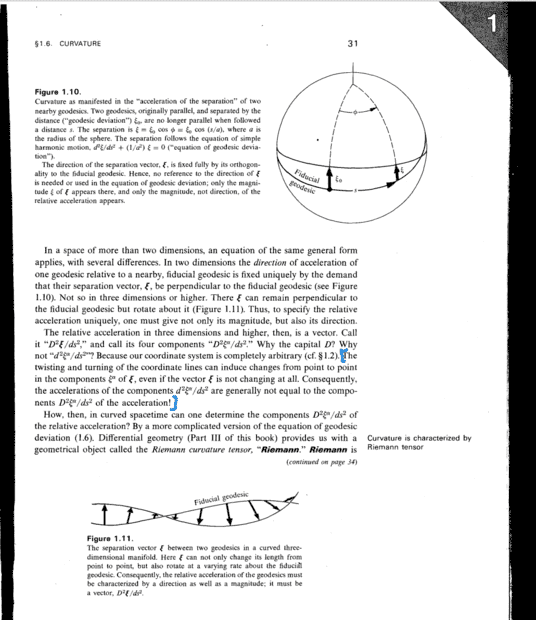
Hi I'm wondering if someone can illustrate with an example what I bracketed in blue? I'm having a hard time visualizing how it is that the accelerations of the components are NOT necessarily equal to the components of the acceleration...Much appreciated!
relative acceleration of geodesic in 3+ dimensions.png
 
Physics news on Phys.org
In plane polars, the position vector is [itex]r\mathbf{e}_r(\theta) = r(\cos \theta, \sin \theta)[/itex]. The accelerations of the components are therefore [itex]\ddot r[/itex] and zero. However, the acceleration is [tex] \ddot{\mathbf{r}} = \ddot r\mathbf{e}_r + 2\dot r \dot \theta \mathbf{e}_\theta + r(-\dot \theta^2 \mathbf{e}_r + \ddot \theta \mathbf{e}_\theta) = (\ddot r - r\dot \theta^2)\mathbf{e}_r + (2\dot r \dot \theta + r\ddot \theta)\mathbf{e}_\theta.[/tex]
 
How did you get the acceleration of the components as r-double-dot and zero?

I understand how you got the general acceleration of r-double dot but not the first part. Sorry it's been like 10 years since I took classical mechanics...