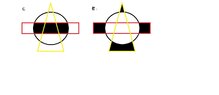
What Are the Areas of Shapes A, B, & C in the Figure?

  • Context: MHB 
  • Thread starter Thread starter bergausstein
  • Start date Start date
  • Tags Tags
    Area Shapes
Click For Summary
SUMMARY

The discussion focuses on the areas represented by sets A, B, and C in a geometric figure, specifically a rectangle, triangle, and circle. Participants analyze the union, intersection, and complement of these sets, providing definitions and checking answers for specific operations such as A∪B, A∩B, and A∩C. The consensus is that understanding the definitions of union, intersection, and complement is crucial for accurately identifying the shaded areas. Participants confirm that answers for operations c) and e) require careful consideration of the missing areas.

PREREQUISITES
  • Understanding of set theory operations: union, intersection, and complement
  • Familiarity with geometric shapes: rectangle, triangle, and circle
  • Basic knowledge of Venn diagrams for visual representation of sets
  • Ability to interpret and analyze geometric figures
NEXT STEPS
  • Study the properties of set operations in detail
  • Practice shading areas in Venn diagrams for various set combinations
  • Explore geometric interpretations of set theory using software tools like GeoGebra
  • Review examples of set operations in mathematical texts or online resources
USEFUL FOR

Students studying set theory, educators teaching geometry, and anyone interested in visualizing mathematical concepts through geometric representations.

bergausstein
Messages
191
Reaction score
0
in the figureView attachment 1105, the area of the interior of the rectangle represents set A, the triangle set B, the circle Set C, indicate the area represented by

a. $\displaystyle A\cup B$
b. $\displaystyle A\cap B$
c. $\displaystyle A\cap C$
d. $\displaystyle B\cup C$
e. $\displaystyle \left(A\cup B\right)\cap C'$
f. $\displaystyle \left(A\cup B\right)'\cap C$

I'm not sure if I drew the picture correctly because I'm using a black and white printed book.

any hints how to start the problem? thanks!
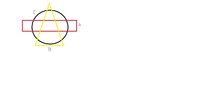
 

Attachments

  • vance 1.3.jpg
    vance 1.3.jpg
    14.5 KB · Views: 110
Physics news on Phys.org
First, I would ask you if you understand the definitions of union, intersection, and complement?

Once you understand the meanings of these operations, you should be able to shade in the appropriate areas for each statement.

So, can you give a brief definition of the above operations?
 

Attachments

  • vance 1.3.2.jpg
    vance 1.3.2.jpg
    51 KB · Views: 101
I find that c) and e) are not quite correct. Can you spot the missing areas?
 

Attachments

  • vance 1.3.3.jpg
    vance 1.3.3.jpg
    23.7 KB · Views: 109
Yes, that looks good! (Sun)
 
thank you so much!:)(Clapping)
 

Similar threads

  • · Replies 1 ·
Replies
1
Views
2K
  • · Replies 2 ·
Replies
2
Views
2K
  • · Replies 11 ·
Replies
11
Views
3K
  • · Replies 1 ·
Replies
1
Views
2K
Replies
1
Views
2K
  • · Replies 10 ·
Replies
10
Views
3K
  • · Replies 7 ·
Replies
7
Views
2K
  • · Replies 2 ·
Replies
2
Views
3K
Replies
9
Views
2K
Replies
3
Views
5K