evinda
Gold Member
MHB
- 3,741
- 0
Hello! (Wave)
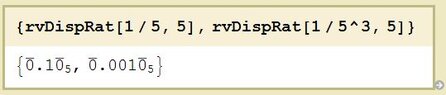
I want to find the p-adic expansion of $\frac{1}{p}$ and $\frac{1}{p^r}$ in the field $\mathbb{Q}_p$.
So, do I have to solve the congruences $px \equiv 1 \pmod {p^n}, p^r x \equiv 1 \pmod { p^n }, \forall n \in \mathbb{N} $, respectively?
But.. these congruences do not have solutions, right? (Thinking)
What else could we do, in order to find the p-adic expansion of $\frac{1}{p}$ and $\frac{1}{p^r}$ in $\mathbb{Q}_p$ ? (Worried)
I want to find the p-adic expansion of $\frac{1}{p}$ and $\frac{1}{p^r}$ in the field $\mathbb{Q}_p$.
So, do I have to solve the congruences $px \equiv 1 \pmod {p^n}, p^r x \equiv 1 \pmod { p^n }, \forall n \in \mathbb{N} $, respectively?
But.. these congruences do not have solutions, right? (Thinking)
What else could we do, in order to find the p-adic expansion of $\frac{1}{p}$ and $\frac{1}{p^r}$ in $\mathbb{Q}_p$ ? (Worried)