Discussion Overview
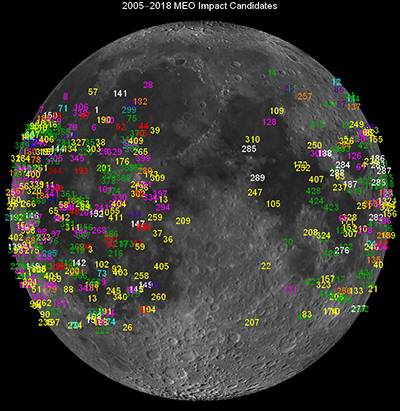
The discussion revolves around the observed 'impact gap' on the Moon, particularly the absence of impacts in the central region as noted in a lunar impact map from 2005 to 2018. Participants explore potential explanations for this phenomenon, considering factors such as gravitational shielding by Earth, the distribution of asteroids, and historical impact patterns over millions of years.
Discussion Character
- Exploratory
- Debate/contested
- Technical explanation
Main Points Raised
- Some participants suggest that the equatorial distribution of asteroids contributes to the observed impact gap, with fewer impacts expected towards the poles.
- Others propose that Earth's gravitational influence shields the Moon from impacts in the central region, leading to a lower density of craters there.
- A participant questions whether this shielding effect has been consistent over geological time, implying that more craters should exist on the sides than in the middle.
- There is mention of a consensus regarding the Moon's tidal locking shortly after its formation, which may have implications for impact frequency.
- Some participants discuss the potential influence of a 'cosine factor' related to the angle of incoming impacts, suggesting that the geometry of asteroid distribution could affect impact density.
- Another viewpoint raises the idea that the absence of impacts at the poles could be due to the geometry of the asteroid belt and the distribution of impacts over time.
- Participants reference the existence of lunar maria and their implications for ancient impacts, suggesting that early impacts may have melted the surface, affecting crater visibility.
- There is a discussion about the overlay of recent impacts and how they might create a 'shadow' effect on the lunar surface, influencing the observed impact distribution.
- One participant mentions a study tracking large impacts over the last billion years, noting a lack of discernible grouping patterns.
- Another participant interprets data suggesting a correlation between crater density and lunar highlands, indicating that older craters may remain visible due to a lack of subsequent lava flows.
Areas of Agreement / Disagreement
Participants express multiple competing views regarding the causes of the impact gap, with no consensus reached on a singular explanation. The discussion remains unresolved as various hypotheses are presented and debated.
Contextual Notes
Limitations include the dependence on observational data and the potential for missing assumptions regarding the historical impact patterns and the effects of Earth's gravity on impact distribution.