What is S = –2 hypernuclei and its nuclear emulation?

  • Context: Undergrad 
  • Thread starter Thread starter kodama
  • Start date Start date
Click For Summary
SUMMARY

The discussion focuses on the S = –2 hypernuclei and its nuclear emulation, particularly the potential V, which is identified as the binding energy of the Ξ- particle. The potential V has a dimension of mass/energy and is not a particle itself, while V0 represents the total potential well depth. The conversation also touches on the decay processes of the Ξ- particle, including its low probability decay into electrons, and speculates on the existence of a potential new particle around 17 MeV, possibly a boson, based on recent experimental observations.

PREREQUISITES
  • Understanding of hypernuclei and their properties
  • Familiarity with binding energy concepts in nuclear physics
  • Knowledge of particle decay processes and branching ratios
  • Basic grasp of Bayesian theory in experimental physics
NEXT STEPS
  • Research the binding energy of hyperons in nuclear physics
  • Explore the implications of the potential well depth in nuclear interactions
  • Investigate the significance of the 17 MeV anomaly in particle physics
  • Study the experimental methods used to observe decay processes in hypernuclei
USEFUL FOR

Physicists, nuclear researchers, and students interested in advanced particle physics and the study of hypernuclei, particularly those exploring new particle phenomena and decay mechanisms.

kodama
Messages
1,083
Reaction score
144
TL;DR
Experimental status of S = –2 hypernucle
i saw thisExperimental status of S = –2 hypernucle
Kazuma NAKAZAWA
Physics Department, Gifu University, Gifu 501-1193, Japan

link

https://journals.jps.jp/doi/pdf/10.7566/JPSCP.17.031001

and i would like to know more

its nuclear emulation

especially

page 3

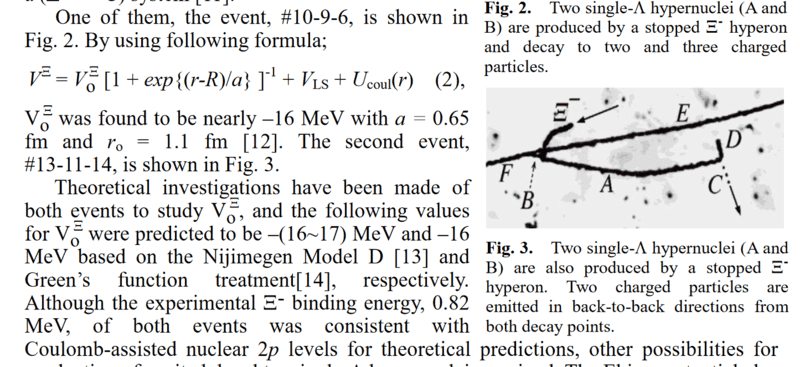
Screenshot 2024-01-02 at 20-26-13 jpscp.17.031001.pdf.png


from page 3

https://journals.jps.jp/doi/pdf/10.7566/JPSCP.17.031001

what is V ? figure 3

by nuclear emulation V has mass 16-17 MeV and decay in to charged particles
 
Physics news on Phys.org
kodama said:
View attachment 338041

from page 3

https://journals.jps.jp/doi/pdf/10.7566/JPSCP.17.031001

what is V ? figure 3

by nuclear emulation V has mass 16-17 MeV and decay in to charged particles
Not "V has mass". V has dimension of mass/energy.
Are you asking what is V or what is V0? These are different things (see equation (2)).
From my reading, V seems to be the actual binding energy of Ξ-. V0 is the total potential well depth - counting both the binding energy and zero point energy.
 
  • Like
Likes   Reactions: kodama
snorkack said:
Not "V has mass". V has dimension of mass/energy.
Are you asking what is V or what is V0? These are different things (see equation (2)).
From my reading, V seems to be the actual binding energy of Ξ-. V0 is the total potential well depth - counting both the binding energy and zero point energy.
but it decay in to 2 in to charged particles-(electron ?)
 
kodama said:
by nuclear emulation V has mass 16-17 MeV and decay in to charged particles
V is a potential. It's not a particle and it doesn't decay to anything.
##\Xi^-## bound in nuclei decay to other things.
 
  • Like
Likes   Reactions: Vanadium 50 and kodama
mfb said:
V is a potential. It's not a particle and it doesn't decay to anything.
##\Xi^-## bound in nuclei decay to other things.
is ##\Xi^-## a particle
 
kodama said:
is ##\Xi^-## a particle
Yes, it is.
Decay to electron is allowed but low probability. For a lone Λ, decay to electron has a branching ratio of 0,083%
 
  • Like
Likes   Reactions: kodama
kodama said:
That I don´t think likely at all.
Late 1940s and 1950s were "particle zoo" period. Scientists had no clue what particles exist, they had not yet spotted the quark model periodicity system, so they had eyes open for any new particles they could see.
If there were any exotic particles, charged and low energy but with such a low formation cross-section that it was missed through 1950s, it is a weird coincidence that one should have been spotted back in 1946 and then none in 1950s.

On the other hand, 17 MeV quite fits the explanation in the article - potential well depth (baryon binding energy in nucleus+the zero point energy) and the binding energies of the stronger bound nuclei (like α) are in that region!
 
  • Like
Likes   Reactions: kodama and ohwilleke
snorkack said:
That I don´t think likely at all.
LIf there were any exotic particles, charged and low energy
*uncharged but decay e+e-

snorkack said:
On the other hand, 17 MeV quite fits the explanation in the article - potential well depth (baryon binding energy in nucleus+the zero point energy) and the binding energies of the stronger bound nuclei (like α) are in that region!

not likely at all but it is possible 17 MeV could be a new unknown fundamental particle a boson?
 
Last edited:
  • #10
kodama said:
but it is possible 17 MeV could be a new unknown fundamental particle a boson?

And what answer do you expect?
 
  • #11
weirdoguy said:
And what answer do you expect?
not likely at all could suggest a possible exploration

in Bayesian theory

if
arXiv:2311.18632 (hep-ex)
Observation of structures at ∼17 and ∼38 MeV/c2 in the γγ invariant mass spectra in pC, dC, and dCu collisions at plab of a few GeV/c per nucleon
Kh.U. Abraamyan, Ch. Austin, M.I. Baznat, K.K. Gudima, M.A. Kozhin, S.G. Reznikov, A.S. Sorin

is true

and
arXiv:2308.06473 (nucl-ex)
[Submitted on 12 Aug 2023]
Observation of the X17 anomaly in the decay of the Giant Dipole Resonance of 8Be
A.J. Krasznahorkay,
what could be the 17 MeV in
Experimental status of S = –2 hypernucle
Kazuma NAKAZAWA
Physics Department, Gifu University, Gifu 501-1193, Japan

multiple experiment with 17 MeV decay in to e+e-
 
Last edited:

Similar threads

  • · Replies 7 ·
Replies
7
Views
3K
  • · Replies 50 ·
2
Replies
50
Views
10K