What is the best way to imagine a photon?

  • Context: High School 
  • Thread starter Thread starter Daniel Petka
  • Start date Start date
  • Tags Tags
    Photon
Click For Summary

Discussion Overview

The discussion revolves around the conceptualization of photons, exploring various models and interpretations related to their nature, including wave-particle duality, electromagnetic wave characteristics, and quantum mechanics. Participants express confusion over how to visualize photons and their interactions, particularly in relation to their wavelength and particle-like behavior.

Discussion Character

  • Exploratory
  • Debate/contested
  • Conceptual clarification
  • Mathematical reasoning

Main Points Raised

  • Some participants suggest that photons can be visualized as transverse waves with oscillating electromagnetic fields, while others argue that this does not adequately explain their behavior, particularly regarding interactions with smaller particles.
  • One participant proposes that the best visualization of a photon incorporates both wave and particle characteristics, reflecting wave-particle duality.
  • Another participant expresses skepticism about the wave-particle duality concept, suggesting it is outdated and that the community lacks a unified stance on the matter.
  • There are mentions of mathematical models, such as sine and cosine functions, to describe electromagnetic waves, but some participants clarify that these models pertain to classical wave theory rather than photons specifically.
  • Concerns are raised about the misleading nature of certain visual representations of photons, particularly regarding the concept of size and amplitude in relation to their behavior.
  • One participant emphasizes that a photon is a state of the quantized electromagnetic field and challenges the notion of visualizing it as a particle, arguing that traditional concepts like wave-particle duality are not applicable in modern quantum theory.

Areas of Agreement / Disagreement

Participants express multiple competing views on how to conceptualize photons, with no consensus reached on a single model or interpretation. Disagreement exists regarding the relevance of wave-particle duality and the implications of classical versus quantum descriptions.

Contextual Notes

Participants note limitations in visualizing photons, particularly concerning their interactions and the implications of their wave-like properties. The discussion reflects a range of assumptions and interpretations that are not universally accepted.

Daniel Petka
Messages
147
Reaction score
16
What is the best way to imagine a photon?

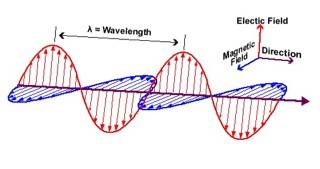
Sometimes I hear that they are simply transverse waves with oscillating EM fields, which just move forward. Other times, though, the photon is said to move along the wave.
The third image reminds me of a probability wave.

So which one is correct?
IMG_8556.JPG
IMG_8557.JPG
IMG_8558.JPG


In fact, none of them really explains, why a photon doesn't interact with a particle that is smaller than its wavelength. I am not able to imagine it well and that confuses me.
 
  • Like
Likes   Reactions: edguy99
Physics news on Phys.org
How about a guess? The answer to your first question: a particle (I think I'm on firm physics ground with this one).

But, we do know about wave/particle duality, so I suppose the visualization of it in your first diagram (a classic in 20th century physics and true) is the best, most accurate way to conceive of its "shape". I have to admit a certain skepticism of a particle traveling in the wobbly path conjecture, seems somehow...inelegant.

I personally visualize it in terms of W/P duality that there is a particle there (like in your second diagram of the little quantas shooting along) but its a wave as well (like the little quanta waves there). But I don't think the physics community as a whole collectively has anything to say past what they have said.
 
  • Like
Likes   Reactions: edguy99
woody stanford said:
we do know about wave/particle duality

It's an outadet concept, there are many discussions here about that.
 
Anyways it's always a sine function, right?
 
The best is not to try an imagine photons at all!

For the vast majority of situations, simply consider a classical EM wave, as in the first picture you posted. Even then, you have to be careful to remember that the axes perpendicular to the direction of propagation represent the electric and magnetic fields, and don't have a physical extension.
 
  • Like
Likes   Reactions: Truecrimson
If the photon has a wavelength larger than the particle there will be interference effects, which tend to cancel each other.
 
Daniel Petka said:
Anyways it's always a sine function, right?
The electrical component (I think). Interestingly you can model the magnetic component with cos(X) which places it at the right phase for the model.

Here is a very cool equation I found:

f(x) = y = A sin (kx+d)

To use it you realize that A affects amplitude, k inversely affects wave length and d provides a phase shifter. I thought it was very cool when I came across it. For example for red visible light of wavelength 500nm, you just set k=(2*PI)/5E-7 in your computer.

If you use g(x) = A cos (kx+d) you can get a really interesting model of the above diagram (the EM diagram of light). A simple way to do it.

AND if you like the little wiggly quanta things, to do that you take two sine waves, slowly adjust the phase of one, add the two and all of a sudden you have a wonderful little gadget that produces them...btw.
 
woody stanford said:
Here is a very cool equation I found:
...
AND if you like the little wiggly quanta things, to do that you take two sine waves, slowly adjust the phase of one, add the two and all of a sudden you have a wonderful little gadget that produces them...btw.
That will indeed give you little wiggly wave packets, and they are indeed fascinating (I don't think it's possible to tire of the things that can be done by superimposing waves)... But all of this is part of the classical wave model of electromagnetic radiation, of which @DrClaude spoke above. It has nothing to do with photons, and the wave packets that appear when you play with sine waves are not photons.

This thread, and especially the links in the first two posts, is worth a read.
 
Daniel Petka said:
... Sometimes I hear that they are simply transverse waves with oscillating EM fields, which just move forward. Other times, though, the photon is said to move along the wave ...

I like this picture as it reflects many aspects of the photon, including reinforcement, cancellation and wave nature that one can visualize diffraction around corners.

animated_photon_crop.gif


Landau & Lifshitz Vol. II. On page 108, the wave equation section talks about electromagnetic waves “in which the field depends only on one coordinate, say x (and on the time). Such waves are said to be plane”. Electromagnetic waves are ever changing “plane waves moving in the positive direction along the X axis”.
 
Last edited by a moderator:
  • Like
Likes   Reactions: mike1000
  • #10
Nugatory said:
This thread, and especially the links in the first two posts, is worth a read.
You forgot something there...
 
  • #11
edguy99 said:
I like this picture as it reflects many aspects of the photon, including reinforcement, cancellation and wave nature that one can visualize diffraction around corners.

animated_photon_crop.gif


Landau & Lifshitz Vol. II. On page 108, the wave equation section talks about electromagnetic waves “in which the field depends only on one coordinate, say x (and on the time). Such waves are said to be plane”. Electromagnetic waves are ever changing “plane waves moving in the positive direction along the X axis”.

I think the animation might be misleading, at least it is to me. What is the spot that changes size? In a normal wave, the maximum amplitude is always present.
I don't see how we can draw a photon based on QM description.
The wave and the particle don't exist at the same time. It is either one or another.
 
Last edited:
  • #12
calinvass said:
I think the animation might be misleading, at least it is to me. What is the spot that changes size? In a normal wave, the maximum amplitude is always present.
The spot is representing the Landau & Lifshitz plane wave moving along the X-axis.
 
  • #13
Nugatory said:
That will indeed give you little wiggly wave packets, and they are indeed fascinating (I don't think it's possible to tire of the things that can be done by superimposing waves)... But all of this is part of the classical wave model of electromagnetic radiation, of which @DrClaude spoke above. It has nothing to do with photons, and the wave packets that appear when you play with sine waves are not photons.

This thread, and especially the links in the first two posts, is worth a read.
A photon is, by definition, described as a normalizable one-quantum Fock state, and in this very specific sense you deal indeed with "wave packets".
 
  • #14
The photon doesn't change in "size" as some would suppose, the electric an magnetic fields don't have any influence on the position, do they?
 
  • #15
Btw I highly doubt the second picture (oscillating particle) I posted to be true, since it would mean that the amplitude has an influence on the position of the photon, which it doesn't, right?
 
  • #16
A photon is a state of the quantized electromagnetic field. It is highly misleading to think of it as a little billiard ball. Since it is a massless quantum of spin 1, you cannot even define what "position of a photon" should mean. There is also no wave-particle duality, as you can often read in popular-science books (and, horribile dictu, even in textbooks at the high school or university level; there are way too many bad textbooks on quantum theory around ;-)). This was a bunch of ideas floating around between 1900-1925 when the physicists where forced to rethink the very fundamentals of physics from scratch by observations and experiments. The upshot is that the theory found to describe matter until today is modern quantum theory, developed by Heisenberg, Born, Jordan and Schrödinger as well as by Dirac.

In the non-relativistic case (applicable to massive particles which are much slower than the speed of light) you can describe a particle's state with a wave function (in the formulation of modern QT as "wave mechanis" a la Schrödinger). Although Schrödinger first thought, he could think of the particle as being just this wave function, i.e., an extended object smeared over all space, this idea is not confirmed by observations. Whenever you measure, e.g., an electron, you find a single spot on the screen, not a smeared cloud of spots! On the other hand, using many electrons (e.g., running through a double slit) hitting the screen under certain circumstances leads to a pattern, which is well described by the wave function calculated from Schrödinger's equation. The up to today accepted interpretation of the wave function is that it's modulus squared is the probability density to find an electron at the given spot, i.e., ##|\psi(x)|^2 \mathrm{d} x## is the probability to find the electron in a little intervall of length ##\mathrm{d} x## around ##x##.

The relativistic case is more involved. There you don't have a fixed number of particles since in collisions at relativistic energies you may always create and destroy particles. So you need a formalism that deals with such reactions, changing the particle number, and the physicists figured out early that the most elegant way to describe it is Quantum Field Theory. Also in relativistic physics there is the additional possibility to have particles (or better said particle-like excitations of fields) that are massless (you cannot define such a thing in non-relativistic physics; at least if you formally do so it doesn't lead to anything observed in nature), and these massless quanta have quite weird properties which are not easily described in any everyday language.
 
  • #17
Daniel Petka said:
The photon doesn't change in "size" as some would suppose, the electric an magnetic fields don't have any influence on the position, do they?
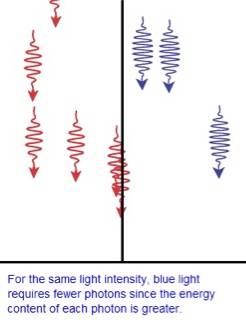
It is common to see the photons as little wiggles as in your first post. Sometimes "size" is used to signify wavelength (say 300nm) , ie. a little photon would signify high energy and fast wavelength, while splitting that photon into two with a crystal and getting two 600nm photons would be shown larger (physically) and slower to cycle in an animation.

Size in this kind of animation is trying to present visually, the equation E for energy = h / λ, that tells us a photon with low energy will take much longer to complete one cycle of the wave then a photon with high energy.
 
  • #18
So the amplitude doesn't matter, just the wavelength...it's really hard to imagine
 
  • #19
edguy99 said:
It is common to see the photons as little wiggles as in your first post. Sometimes "size" is used to signify wavelength (say 300nm) , ie. a little photon would signify high energy and fast wavelength, while splitting that photon into two with a crystal and getting two 600nm photons would be shown larger (physically) and slower to cycle in an animation.

Size in this kind of animation is trying to present visually, the equation E for energy = h / λ, that tells us a photon with low energy will take much longer to complete one cycle of the wave then a photon with high energy.

OK, question, if photons are particles of light, then can you have an RF photon? I mean its "light" (EM radiation) right? I'm pretty sure there are gamma and x-ray photons, so why not RF ones? And if there isn't where is the cut off point (and I want it down to one decimal place of precision...Mhz)...kidding. lol :D
 
  • #20
You can have photons of any frequency/wavelength.
 
  • #21
edguy99 said:
It is common to see the photons as little wiggles as in your first post. Sometimes "size" is used to signify wavelength (say 300nm) , ie. a little photon would signify high energy and fast wavelength, while splitting that photon into two with a crystal and getting two 600nm photons would be shown larger (physically) and slower to cycle in an animation.

Size in this kind of animation is trying to present visually, the equation E for energy = h / λ, that tells us a photon with low energy will take much longer to complete one cycle of the wave then a photon with high energy.
The "wiggles" are the usual symbol for a photon line in a Feynman diagram. It's not to be confused with a picture of particles running around on paths (wiggled, with and without arrow, dotted etc.) but it's just an ingenious notation for formulae leading to the S-matrix elements (either in perturbation theory or non-perturbative approximations like the Baym-Cornwall-Jackiw-Tomboulis 2PI formalism etc. etc.).

The wave packets in the animation are probability amplitudes, not particles!
 
  • #22
woody stanford said:
The electrical component (I think). Interestingly you can model the magnetic component with cos(X) which places it at the right phase for the model.

OK, I double-checked and this is incorrect, the magnetic field has to be modeled with sin(x) as well (to get the phases right...)
 
  • #23
Long frequency tends to behave like a wave and high frequency like a particle.
We simply are not able to measure the effects of a single RF photon because of its low energy.
 
  • #24
Daniel Petka said:
So the amplitude doesn't matter, just the wavelength...it's really hard to imagine
Amplitude, in its meaning of the "intensity" of the light, would be represented by the number of "quanta" or photons flying through the air. Bright red light has lots of photons, but each photon would have the same wavelength, hence the same size "visually" to represent that.
 
  • #25
vanhees71 said:
The "wiggles" are the usual symbol for a photon line in a Feynman diagram. It's not to be confused with a picture of particles running around on paths (wiggled, with and without arrow, dotted etc.) but it's just an ingenious notation for formulae leading to the S-matrix elements (either in perturbation theory or non-perturbative approximations like the Baym-Cornwall-Jackiw-Tomboulis 2PI formalism etc. etc.).

The wave packets in the animation are probability amplitudes, not particles!
To me, the "wiggles" in the OP illustration are trying to get the point across that you need more red photons then blue photons to get the same amount of energy. In that sense, I think the author of the illustration is assuming the "wiggles" are individual photons.

It is up to the author of an animation to be clear what visual element is being tied to which mathematical variable, and sometimes it is not clear what the visual element is representing. WRT calling them photons or probability amplitudes. I would argue they are the same "visually" in the sense that over time, the probability amplitude (or wiggle, or photon) will move in some direction at the speed of light. We call it a "photon" in the sense that it moves around, we call it a "wiggle" cause that's what it looks like, and we call it a "probability amplitude" because it is representing the area where the "photon" is expected to be found.
 
  • #26
"Thou shalt not make unto thee any graven image." :smile:
 
  • Like
Likes   Reactions: edguy99 and DrClaude

Similar threads

  • · Replies 17 ·
Replies
17
Views
2K
  • · Replies 16 ·
Replies
16
Views
3K
  • · Replies 27 ·
Replies
27
Views
3K
  • · Replies 8 ·
Replies
8
Views
2K
  • · Replies 8 ·
Replies
8
Views
2K
  • · Replies 12 ·
Replies
12
Views
2K
  • · Replies 38 ·
2
Replies
38
Views
7K
  • · Replies 24 ·
Replies
24
Views
4K
  • · Replies 24 ·
Replies
24
Views
2K
  • · Replies 15 ·
Replies
15
Views
2K