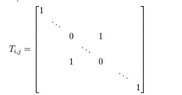
Let's "fill in the blanks" in my last example, and I'll use a different elementary matrix.
Suppose $A = \begin{bmatrix}a&b&c\\d&e&f\\g&h&k\end{bmatrix}$.
Let us suppose further that the $2,3$ entry (the third entry in the second row, in this case, $f$) is non-zero.
Now $E_{3,2}$ (note how we reversed the indices) is the matrix:
$E_{3,2} = \begin{bmatrix}0&0&0\\0&0&0\\0&1&0\end{bmatrix}$
Watch what happens to $A$ when we multiply by $E_{3,2}$ on the right:
$AE_{3,2} = \begin{bmatrix}a&b&c\\d&e&f\\g&h&k\end{bmatrix}\begin{bmatrix}0&0&0\\0&0&0\\0&1&0\end{bmatrix}$
$=\begin{bmatrix}0&c&0\\0&f&0\\0&k&0\end{bmatrix}$
As I indicated, we killed all the columns except the 3rd, which wound up in the 2nd column.
In particular, our $f \neq 0$ moved from the $2,3$ position, to the $2,2$ position (on the main diagonal).
Now let's multiply $A$ on the left by $E_{3,2}$:
$E_{3,2}A = \begin{bmatrix}0&0&0\\0&0&0\\0&1&0\end{bmatrix}\begin{bmatrix}a&b&c\\d&e&f\\g&h&k\end{bmatrix}$
$=\begin{bmatrix}0&0&0\\0&0&0\\d&e&f\end{bmatrix}$.
Here, $E_{3,2}$ moved the second row (where the $f$ we're interested in) to the third row, the other two rows are $0$.
Do you see how that works? I did the 3x3 case so you can work it out yourself, but the same logic applies to any $n\times n$ matrix. $E_{i,j}$ takes the $i$-th column and puts it in the $j$-th column (and all the other columns become 0), when we use it on the right.
$E_{i,j}$ takes the $j$-th row, and moves it to the $i$-th row, making all other rows 0.
In my example here, we saw the $2,2$ entry of $AE_{3,2} = f \neq 0$.
However, the $2,2$ entry of $E_{3,2}A = 0$.
In the general case, if $a_{ij} \neq 0$, for our matrix $A = (a_{ij})$, if we hit it on the RIGHT by $E_{j,i}$ (again, note the reversal of indices), we will take the $j$-th column (which is where our non-zero entry $a_{ij}$ lives), and move it to the $i$-th column, and now the non-zero $a_{ij}$ is the $i$-the entry down in the $i$-th column, that is, it has moved to the diagonal, in the $i,i$-th position.
When we hit $A$ from the LEFT with $E_{j,i}$, it's again going to preserve the $i$-th row, but since $i \neq j$, it's not going to KEEP it in the $i$-th row, but move it to the $j$-th row.
And the $i$-th row(which contains the $i,i$-th diagonal position), along with any other row besides the $j$-th is going to be 0. So in our products, we have that the $i,i$-th entry of $AE_{j,i} = a_{ij} \neq 0$, but the $i,i$-th entry of $E_{j,i}A$ is 0.
In particular, $A$ and $E_{j,i}$ cannot commute.
This shows that if a matrix $A$ HAS an off-diagonal non-zero entry, we can find some matrix $A$ doesn't commute with, and thus $A$ cannot lie in the center of the general linear group.
So, we are left with diagonal matrices.