chwala
Gold Member
- 2,844
- 434
- Homework Statement
- see attached
- Relevant Equations
- understanding of the ##v-t## graph
The question is below;
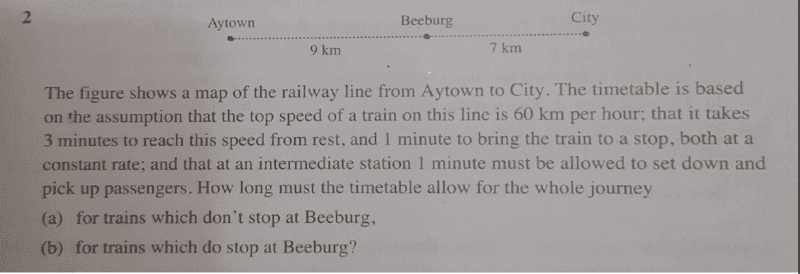 My approach;
and kindly note that i am comfortable in using the si units. Here i used,
##60##km/hr = ##16.66666##m/s.
For part (a),
using the ##v-t## graph,
##→s_1##=(##\frac {1}{2}##×##180×16.666)##+(##\frac {1}{2}##×##60##×##16.666##)
##=1500+500=2000##m
Total distance from Aytown to City is ##9000+7000=16000##metres
Therefore the remainder portion is ##16000-2000=14000##m. The time taken to cover this ##14000## m is given by;
##t##=##\frac{14000}{16.6666}##= ##840## seconds.
The timetable therefore should give an allowance of ##t=180+60+840=1080## seconds = ##18##
minutes.
For part (b),
using the ##v-t## graph,
Total distance from Aytown to Beeburg is ##9000##metres
##→s_1##=(##\frac {1}{2}##×##180×16.666)##+(##\frac {1}{2}##×##60##×##16.666##)
##=1500+500=2000##m
Therefore the remainder portion is ##9000-2000=7000##m. The time taken to cover this ##7000## m is given by;
##t##=##\frac{7000}{16.6666}##= ##420## seconds.
Total distance from Beeburg to City is ##7000##metres
##→s_1##=(##\frac {1}{2}##×##180×16.666)##+(##\frac {1}{2}##×##60##×##16.666##)
##=1500+500=2000##m
Therefore the remainder portion is ##7000-2000=5000##m. The time taken to cover this ##5000## m is given by;
##t##=##\frac{5000}{16.6666}##= ##300## seconds.
The timetable therefore should give an allowance of ##t=180+60+420+1+180+300+60=1201## seconds = ##20.016666##
minutes.
The time allocated should be ##21## minutes...bingo
any other approach guys...
and kindly note that i am comfortable in using the si units. Here i used,
##60##km/hr = ##16.66666##m/s.
For part (a),
using the ##v-t## graph,
##→s_1##=(##\frac {1}{2}##×##180×16.666)##+(##\frac {1}{2}##×##60##×##16.666##)
##=1500+500=2000##m
Total distance from Aytown to City is ##9000+7000=16000##metres
Therefore the remainder portion is ##16000-2000=14000##m. The time taken to cover this ##14000## m is given by;
##t##=##\frac{14000}{16.6666}##= ##840## seconds.
The timetable therefore should give an allowance of ##t=180+60+840=1080## seconds = ##18##
minutes.
For part (b),
using the ##v-t## graph,
Total distance from Aytown to Beeburg is ##9000##metres
##→s_1##=(##\frac {1}{2}##×##180×16.666)##+(##\frac {1}{2}##×##60##×##16.666##)
##=1500+500=2000##m
Therefore the remainder portion is ##9000-2000=7000##m. The time taken to cover this ##7000## m is given by;
##t##=##\frac{7000}{16.6666}##= ##420## seconds.
Total distance from Beeburg to City is ##7000##metres
##→s_1##=(##\frac {1}{2}##×##180×16.666)##+(##\frac {1}{2}##×##60##×##16.666##)
##=1500+500=2000##m
Therefore the remainder portion is ##7000-2000=5000##m. The time taken to cover this ##5000## m is given by;
##t##=##\frac{5000}{16.6666}##= ##300## seconds.
The timetable therefore should give an allowance of ##t=180+60+420+1+180+300+60=1201## seconds = ##20.016666##
minutes.
The time allocated should be ##21## minutes...bingo
any other approach guys...
Last edited: