What is the Pattern for Finding the Missing Number in a Sequence?

  • Thread starter Thread starter member 428835
  • Start date Start date
Click For Summary
SUMMARY

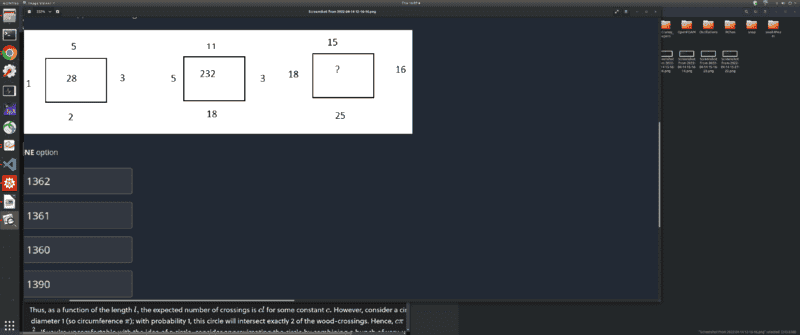
The discussion focuses on identifying patterns for finding missing numbers in sequences, specifically through the use of multiplication and addition. A participant successfully deduced that for the number 28, the factors 4 and 7 correspond to the sums of pairs (1+3) and (5+2), leading to the equation 4 * 7 = 28. This method demonstrates a systematic approach rather than random guessing, emphasizing the importance of recognizing additive relationships in sequences.

PREREQUISITES
  • Understanding of basic arithmetic operations (addition and multiplication).
  • Familiarity with factorization concepts.
  • Ability to recognize patterns in numerical sequences.
  • Basic problem-solving skills in mathematics.
NEXT STEPS
  • Study number theory, focusing on factorization techniques.
  • Explore mathematical patterns in sequences and series.
  • Learn about combinatorial mathematics to enhance problem-solving skills.
  • Practice with puzzles involving missing numbers and sequences.
USEFUL FOR

Mathematicians, educators, students, and anyone interested in enhancing their problem-solving abilities in numerical sequences and patterns.

member 428835
Homework Statement
what's the missing number
Relevant Equations
nothing comes to mind
I have no idea. I've tried squaring, cubing, summing numbers but can't make sense of anything. Literally no clue how to even approach this aside from randomly adding and subtracting numbers, their squares and cubes, but nothing makes sense. Any ideas?

Screenshot from 2022-04-14 16-07-13.png
 
Physics news on Phys.org
1360
 
  • Like
Likes   Reactions: Math100
fresh_42 said:
1360
But how? And how would I even go about doing this?
 
28=4*7=(1+3)*(5+2)
 
  • Like
Likes   Reactions: Math100 and member 428835
anuttarasammyak said:
28=4*7=(1+3)*(5+2)
How on Earth did you know to do this? Just random guessing? What all did you check prior to this?
 
joshmccraney said:
Just random guessing?
Not really. The very first thing I tried, for all of about 5 seconds, was addition, which seemed a dead end. Then I noticed that in the first problem 5 and 2 added to 7, and 3 and 1 added to 4 -- 4 * 7 = 28. The pattern was the same for the second problem.
 
  • Like
Likes   Reactions: member 428835
Mark44 said:
Not really. The very first thing I tried, for all of about 5 seconds, was addition, which seemed a dead end. Then I noticed that in the first problem 5 and 2 added to 7, and 3 and 1 added to 4 -- 4 * 7 = 28. The pattern was the same for the second problem.
Makes sense, thanks.
 

Similar threads

  • · Replies 3 ·
Replies
3
Views
3K
  • · Replies 11 ·
Replies
11
Views
2K
  • · Replies 7 ·
Replies
7
Views
2K
  • · Replies 11 ·
Replies
11
Views
3K
  • · Replies 3 ·
Replies
3
Views
955
  • · Replies 3 ·
Replies
3
Views
3K
  • · Replies 11 ·
Replies
11
Views
2K
  • · Replies 3 ·
Replies
3
Views
905
Replies
25
Views
4K
  • · Replies 1 ·
Replies
1
Views
2K