What Is the Purpose of the [Heart] Mini Widget?

  • Thread starter Thread starter DaveC426913
  • Start date Start date
Click For Summary
SUMMARY

The [heart] Mini Widget is identified as a thermostatic radiator valve actuator rather than a water filter, despite its garden hose thread attachment. The device operates dry and mechanically actuates a valve without passing water, which explains the gaps in its design. The discussion highlights that the widget lacks the valve component necessary for full functionality, leading to potential water leakage. Users can replace this type of actuator without risk of burns, making it accessible for general use.

PREREQUISITES
  • Understanding of thermostatic radiator valves and their components
  • Familiarity with mechanical actuators and their functions
  • Basic knowledge of plumbing fittings, specifically garden hose threads
  • Ability to interpret technical diagrams related to heating systems
NEXT STEPS
  • Research the function and installation of thermostatic radiator valves
  • Explore the mechanics of valve actuators in heating systems
  • Learn about common plumbing fittings and their applications
  • Investigate troubleshooting techniques for radiator valve issues
USEFUL FOR

This discussion is beneficial for HVAC technicians, plumbing professionals, and DIY enthusiasts looking to understand thermostatic radiator valve mechanisms and their applications in home heating systems.

DaveC426913
Gold Member
2025 Award
Messages
24,235
Reaction score
8,355
My boy brought this thing home for me to identify.

I am 95% certain it's a water filter, but it can't possibly function as one. And it doesn't make sense as one.

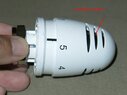
It's labeled [heart] Mini.
The attachment is garden hose thread.
The dial goes 0, *, 1, 2, 3, 4, 5 (The asterisk could be a snowflake.)
The dial screws in and out, causing the white cylinder to move in and out.
Note the orientation of the numbers. The widget is meant to be mounted on top of something, (not underneath, like a sink faucet).
The inside has a black plastic cylinder, which could be a case for a filter.
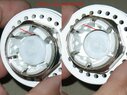
It looks like water could come out those 20 or so holes on the bottom edge.
But here's the thing: any water that goes into it will just some pouring straight out the gaps in the hose "clamp".
 

Attachments

  • IMG_8871b.jpg
    IMG_8871b.jpg
    71.5 KB · Views: 129
  • IMG_8874-5.jpg
    IMG_8874-5.jpg
    71.5 KB · Views: 155
  • IMG_8876b.jpg
    IMG_8876b.jpg
    35.4 KB · Views: 153
Computer science news on Phys.org
Thermostatic radiator valve
 
  • Like
  • Wow
Likes   Reactions: pbuk, Filip Larsen, Borek and 2 others
Jarvis323 said:
Thermostatic radiator valve

Lol. . .
 
Thank you. That's exactly what it is, although I still think there's a piece missing.
 
DaveC426913 said:
Thank you. That's exactly what it is, although I still think there's a piece missing.
Comparing this with the pictures in the Wikipedia article Thermostatic radiator valve, it looks like you have the "thermostatic" part, but not the "valve" part.
 
DrGreg said:
Comparing this with the pictures in the Wikipedia article Thermostatic radiator valve, it looks like you have the "thermostatic" part, but not the "valve" part.
Yeah I've no doubt there more to it, the problem I have is that I don't see how an extra part could mitigate the problem with this part. See the first pic in post #1. The teeth that are driven by the nut have great gaps between them, out of which any water will come gushing.
 
DaveC426913 said:
Yeah I've no doubt there more to it, the problem I have is that I don't see how an extra part could mitigate the problem with this part. See the first pic in post #1. The teeth that are driven by the nut have great gaps between them, out of which any water will come gushing.
Now, everything I know about "thermostat heads" I've learned in the last 10 minutes, so please don't shoot me if this isn't exactly correct.

From the diagrams I've looked at, it's coincidental that your device has a garden hose fitting. It operates dry, and simply pushes on the valve actuator. So anyone or their mother can replace one without being scalded.

Thermostatkopf.2021-10-02 at 3.44.52 PM.png

For more information on your particular head: https://herz-armaturen.at/catalog.php?prodID=5
 
  • Informative
Likes   Reactions: DaveC426913
Ah! You nailed it exactly!
Garden hose thread = coincidence. Meaning: it does not pass water. It's just a clamp. The pin mechanically actuates the cylinder in the widget.

Thank you! Now I can free up that portion of storage and processing to work on Dark Energy. :woot:
 
  • Like
Likes   Reactions: OmCheeto

Similar threads

  • · Replies 11 ·
Replies
11
Views
4K
Replies
8
Views
4K
  • · Replies 11 ·
Replies
11
Views
4K