Discussion Overview
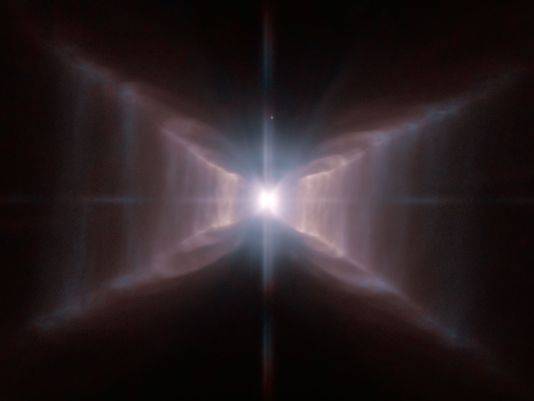
The discussion revolves around the mysterious red rectangle observed in space, specifically focusing on its appearance in images captured by telescopes. Participants explore various hypotheses regarding the source of this phenomenon, including the effects of telescope aperture shapes and the nature of the nebula itself. The conversation includes technical explanations and speculative reasoning about the underlying astrophysical processes.
Discussion Character
- Exploratory
- Technical explanation
- Debate/contested
Main Points Raised
- Some participants suggest that the rectangularity of the nebula could be influenced by the shape of the telescope's aperture, with rectangular apertures producing rectangular streaks.
- Others argue that the nebula's rectangular appearance is due to its orientation and the emission of cone-shaped gas clouds from the star, as stated by NASA.
- There is a contention regarding the nature of diffraction spikes, with some asserting that these spikes are related to the aperture shape, while others maintain they are independent of it.
- One participant mentions the unpredictability of natural phenomena, drawing a parallel to the unexpected hexagonal formation at Saturn's north pole.
- Another participant references ongoing discussions about "Extended Red Emission" and unusual molecular clusters as potential explanations for the red glow associated with the rectangle.
Areas of Agreement / Disagreement
Participants express differing views on the cause of the rectangular appearance, with no consensus reached regarding the influence of aperture shape versus the nebula's intrinsic properties. The discussion remains unresolved with multiple competing hypotheses presented.
Contextual Notes
Participants reference various sources and examples to support their claims, but the discussion includes uncertainties about the mechanisms at play and the interpretations of observational data.