What Makes the Cat's Eye Nebula's Core Appear So Energetic?

  • Context: High School 
  • Thread starter Thread starter skyshrimp
  • Start date Start date
  • Tags Tags
    Eye Nebula
Click For Summary

Discussion Overview

The discussion revolves around the visual characteristics and dynamics of the Cat's Eye Nebula, particularly focusing on the energetic appearance of its core and the implications of its formation and expansion over time. Participants explore the nature of the nebula's structure and the potential for observable changes over time, as well as the symmetry observed in its explosion.

Discussion Character

  • Exploratory
  • Conceptual clarification
  • Debate/contested

Main Points Raised

  • One participant notes the energetic appearance of the core and questions whether a video of the nebula would show rapid movement similar to solar flares.
  • Another participant explains that the nebula's formation occurred over a timescale of 1000 years, suggesting that observing changes would require years, making a video impractical.
  • A third participant references a source to discuss the angular expansion of the nebula and its estimated age, indicating that the expansion rate may provide insights into its formation history.
  • One participant questions the symmetry observed in the nebula's explosion, suggesting that it seems counterintuitive for a 1000-year-old explosion to exhibit such defined shapes rather than a uniform gradient.
  • Another participant responds by challenging the assumption that explosions must lack symmetry, pointing out that stars typically have an axis of rotation, which can lead to non-spherical but symmetrical structures.

Areas of Agreement / Disagreement

Participants express differing views on the implications of the nebula's symmetry and the nature of its expansion. There is no consensus on the reasons behind the observed characteristics or the interpretation of the nebula's dynamics.

Contextual Notes

Some assumptions about the nebula's expansion and symmetry are not fully explored, and the discussion includes references to external sources that may have limitations in their interpretations.

skyshrimp
Messages
39
Reaction score
122
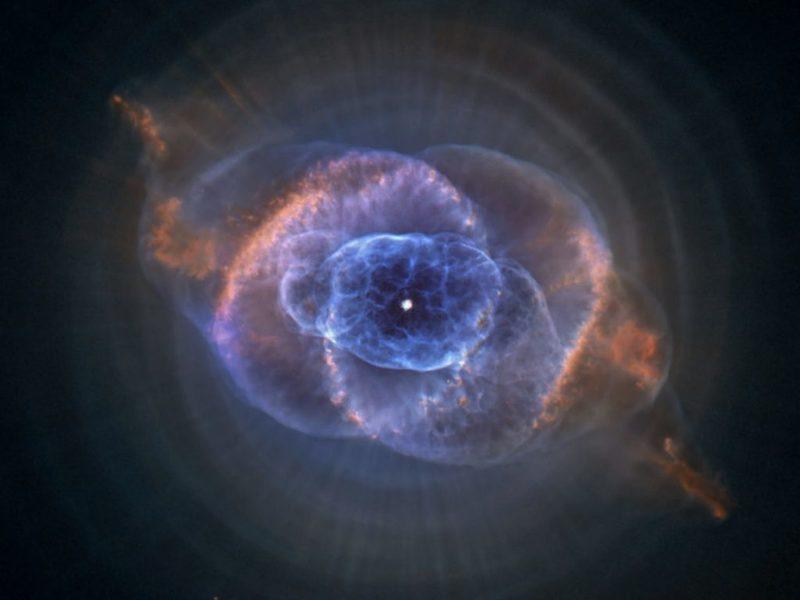
I'm just learning about space. The Cat's Eye nebula looks very energetic at the core.
catseye.jpg


I can see what looks like plasma firing off chaotically from the center star.

If this was video footage, would what we see in this still Hubble photo move rapidly (like solar flares seen in footage from our Sun), or would the said video footage be static?
 
Astronomy news on Phys.org
The nebula formed in a timescale of 1000 years, and has a diameter of several light years now. To observe changes, you have to wait years. A video would be completely pointless - and I think this image was a long-term observation anyway (= light was collected for a significant amount of time, minutes or even hours).
 
From wiki here: http://en.wikipedia.org/wiki/Cat's_Eye_Nebula#Age

The angular expansion of the nebula can also be used to estimate its age. If it has been expanding at a constant rate of 10 milliarcseconds a year, then it would take 1000 ± 260 years to reach a diameter of 20 arcseconds. This may be an upper limit to the age, as ejected material will be slowed as it encounters material ejected from the star at earlier stages of its evolution, as well as the interstellar medium.[21]
 
mfb said:
The nebula formed in a timescale of 1000 years, and has a diameter of several light years now.

One side of the explosion has the exact shape as the other but in reverse. How can a 1k yr old explosion that's several light years in diameter do that? You'd think it would be a gradient, uniformed explosion considering the immense size. Even the plasma looking 'blue' center has defined shapes similar to water refraction seen in swimming pools. That's why I assumed it was once moving faster than when Hubble received the still shot.
 
Why does it look surprising that an explosion can have a symmetry, without having a full spherical symmetry?
Note that stars always have an axis of rotation - they are not spherically symmetric, but they have two equivalent sides.
 

Similar threads

  • · Replies 3 ·
Replies
3
Views
4K
  • · Replies 42 ·
2
Replies
42
Views
5K
  • · Replies 25 ·
Replies
25
Views
3K
  • · Replies 0 ·
Replies
0
Views
2K
  • · Replies 8 ·
Replies
8
Views
3K
  • · Replies 21 ·
Replies
21
Views
3K
  • · Replies 17 ·
Replies
17
Views
4K
  • · Replies 1 ·
Replies
1
Views
2K
Replies
8
Views
6K
  • · Replies 25 ·
Replies
25
Views
5K