Why approximate g^kμ = η^kμ in the weak gravity limit

Join the discussion
Registration is free. Ask a follow-up in this thread, or start your own.
4 replies · 1K views
unscientific
Messages
1,728
Reaction score
13
Assume we have a free-falling particle in gravity in a static metric. Its worldline is described by:

[tex]g_{\mu \nu} = \eta_{\mu \nu} + h_{\mu \nu}[/tex]

where ##|h_{\mu \nu} << 1|##.

Taken from Hobson's book:
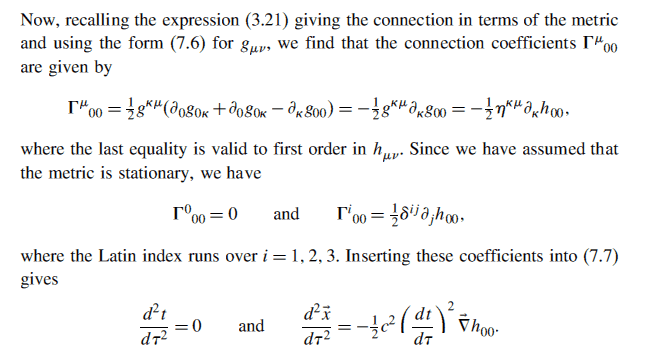
hobson1.png


Why did they let ##g^{k\mu} = \eta^{k\mu}##?
 
Physics news on Phys.org
They only keep terms up to first order in the perturbation ##h_{\mu\nu}##.
However, I assume (7.6) is the metric written as a flat metric (##\eta_{\mu\nu}##) with an additional perturbation h.

Then insert the expansion into the connection and see what you get. Remember that the Minkowski metric in the usual coordinates is diagonal and constant.
 
unscientific said:
Why did they let ##g^{k\mu} = \eta^{k\mu}##?

Because the derivative operator itself is first order, so when you contract the metric with it, the term in ##h^{\kappa \mu}## is second order and can be dropped.
 
PeterDonis said:
Because the derivative operator itself is first order, so when you contract the metric with it, the term in ##h^{\kappa \mu}## is second order and can be dropped.

[tex]\frac{1}{2}g^{k \mu} \partial_k g_{00} = \frac{1}{2}(\eta^{k \mu} + h^{k \mu}) \partial_k g_{00}[/tex]
[tex]= \frac{1}{2}\eta^{k \mu}\partial_k g_{00} + \frac{1}{2}h^{k \mu}\partial_k g_{00}[/tex]
[tex]= \frac{1}{2}\eta^{k \mu}\partial_k g_{00} + \frac{1}{2}h^{k \mu} \partial_k h_{00}[/tex]

How is the second term ##0##? Or are we making the assumption that we want only terms corresponding to first order, so ##h \times (\partial h)## is perturbation x perturbation which is second order?
 
unscientific said:
are we making the assumption that we want only terms corresponding to first order

Yes, that's what your source meant by "valid to first order".
 
  • Like
Likes   Reactions: unscientific