Why Do Euler-Lagrange Equations Fail for This Piecewise Smooth Function?

1 reply · 2K views · last reply
baby_1
Messages
159
Reaction score
16
Member warned about posting without the homework template
Hello
Here is my question

Printed problem statement: Part (a) asks for a PWS function that minimizes J[y] for F = [1 - (y')^2]^2 with y(0) = y(1) = 0. Part (b) asks to show F_y'y' > 0 and explain why this does not contradict Hilbert's theorem.

So I solved Euler DE and find
Handwritten equation F = (1 - y'^2)^2 with the implication arrow to y = aX + b, which is the linear form of the solution family.

and when we apply the boundary condition we obtain y=0 . My teacher said that we should write it as two different function as
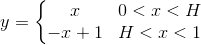
Piecewise function y equals x for 0 < x < H, and -x + 1 for H < x < 1.

where H is (1/2).He solved this equation with this way

Handwritten equation F = (1 - y'^2)^2 implies 1 - y'^2 = 0 implies y = x + c, showing the Euler-Lagrange derivation for a squared-derivative integrand.


So Here are my questions:
a) why don't we accept the y=0 as our desire function?
b)how can obtain (a) constant in my equation with Euler approach?because in multidisciplinary function we can't find a ?
 
baby_1 said:
Hello
Here is my question
View attachment 94931
So I solved Euler DE and find
Handwritten equation F = (1 - y'^2)^2 => y = aX + b, with the implication arrow pointing to a linear function of the form y = aX + b.

and when we apply the boundary condition we obtain y=0 . My teacher said that we should write it as two different function as
Piecewise definition of y: y = x for 0 < x < H, and y = -x + 1 for H < x < 1.

where H is (1/2).He solved this equation with this way
Handwritten-style equation: F = (1 - y'^2)^2 => 1 - y'^2 = 0 => y = x + c


So Here are my questions:
a) why don't we accept the y=0 as our desire function?
b)how can obtain (a) constant in my equation with Euler approach?because in multidisciplinary function we can't find a ?

What is a "multidisciplinary function"? I have never heard that term.

Anyway, is the subject matter one of Calculus of Variations, for ##J = \int_0^1 (1-y'^2)^2 dx##? If so, ##F_{y'} = -4 y'(1-y'^2) = -4 y' + 4 y'^3##, so the Euler equation gives ##F_{y} = 0 = (d/dx) F_{y'}##, or ##(3 y'^2- 1) y'' = 0##, so either ##y'' = 0## or ##y' = \pm 1/ \sqrt{3}##.

On the other hand, we can change variables to ##y'= z##, to get the problem
[tex]\min \:K(z) = \int_0^1 (1-z^2)^2 \, dx[/tex]
with no specified boundary conditions on ##z(0), z(1)##. Without using the Euler-Lagrange equation at all we see that we can make ##K(z) = 0## by taking ##z(t)^2 = 1## for all ##t##, and that gives ##x'(t) = \pm 1##, as your instructor said. Certainly that is an optimal solution, since ##K(z) \geq 0## for all PWS functions ##z(t)##, and ##K(z) = 0## is attained by the solution where ##z(t)^2 = 1 \; \forall \, t##.

The interesting thing about this problem is that the so-called necessary conditions of Euler and Lagrange give the wrong solution. In other words, the Euler-Lagrange equations fail! I suspect that the reason lies in some violation of the hypotheses that underlie the Euler-Lagrange derivation (and which are normally not stated or are ignored when solving problems).
 
Last edited:
  • Like
Likes   Reactions: baby_1
