Differential/Different Adjectives: A Non-Native English Speaker's Quandary

  • Thread starter Thread starter scherz0
  • Start date Start date
  • Tags Tags
    English
Click For Summary
SUMMARY

The discussion clarifies the distinctions between the adjectives "differential" and "different" in the context of literary theory. "Differential" refers to characteristics that involve quantitative differences, while "different" denotes a more general distinction. Participants noted that the use of "differential" may reflect a preference for a more sophisticated or academic style, particularly in works like Gregory Castle's "The Literary Theory Handbook" (2013) and Michael Ryan's "Literary Theory: A Practical Introduction" (2017). The conversation emphasizes the nuanced meanings and contexts in which these terms are applied, particularly in literary criticism.

PREREQUISITES
  • Understanding of basic linguistic terminology
  • Familiarity with literary theory concepts
  • Knowledge of the context in which adjectives modify nouns
  • Exposure to academic writing styles
NEXT STEPS
  • Research the implications of "differential" in literary criticism
  • Study the differences between "differential" and "different" in various academic contexts
  • Explore examples of "differential repetition" in literature
  • Examine the use of specialized vocabulary in academic writing
USEFUL FOR

Non-native English speakers, linguistics students, literary theorists, and anyone interested in the subtleties of language and its application in academic writing.

scherz0
Messages
6
Reaction score
1
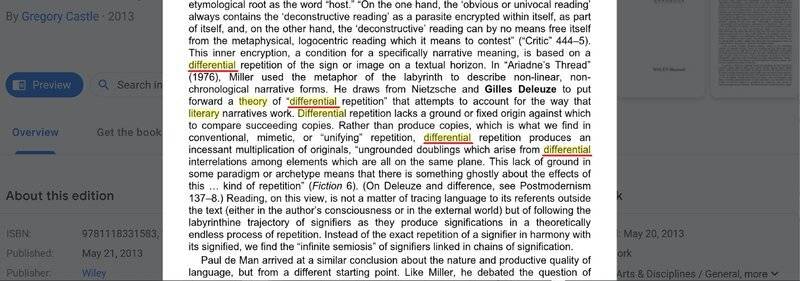
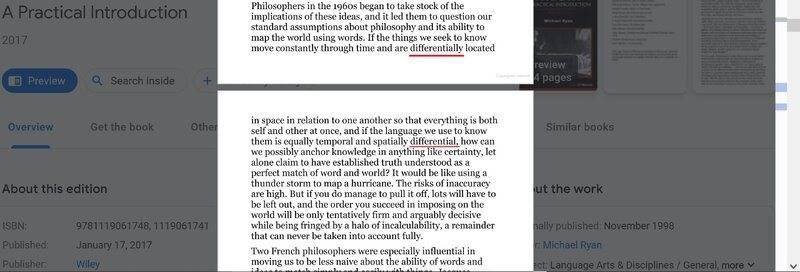
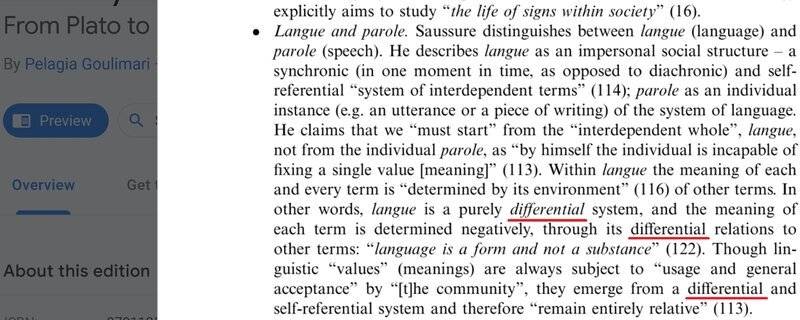
I don't understand the differences between 'differential' and 'different' as adjectives in the quotations below. English isn't my first language. Why do these books use 'differential' as an adjective? Why not just write 'different'?
differential 1.jpg

1. Gregory Castle, The Literary Theory Handbook (2013). Anyone know the page number?
differential 2.jpg

2. Michael Ryan, Literary Theory A Practical Introduction (2017). Anyone know the page number?
differential 3.jpg

3. Pelagia Goulimari, Literary Criticism and Theory From Plato to Postcolonialism (2014). p 149.
 
  • Like
Likes sysprog
Science news on Phys.org
A bit of thinking, and looking briefly at that dictionary passage on the bottom of your post, clues us to "differential" means 'different according to some quantitative differences'. This understanding may be very incomplete. Maybe someone who has a strong research familiarity in Linguistics would respond and give a better explanation.
 
  • Like
Likes sysprog
Attempting to keep it simple: as an adjective, 'differential' means 'having to do with difference or with differing', whereas 'different' means 'differring, or, having or showing difference' ##-## in the examples presented, it seems to me that the meaning would have been in some of the cases as adequately conveyed by 'different' as by 'differential', wherefore, it appears to me that the writer is exhibiting a preferential tendency toward a more ostentatious and overly pedantic style.
 
  • Like
Likes Bystander
sysprog said:
Attempting to keep it simple: as an adjective, 'differential' means 'having to do with difference or with differing', whereas 'different' means 'differring, or, having or showing difference' ##-## in the examples presented, it seems to me that the meaning would have been in some of the cases as adequately conveyed by 'different' as by 'differential', wherefore, it appears to me that the writer is exhibiting a preferential tendency toward a more ostentatious and overly pedantic style.
More likely, that word choice was for a reason. Still confusing to me. I made a check through a few wikipedia articles and still not clear.
 
symbolipoint said:
More likely, that word choice was for a reason. Still confusing to me. I made a check through a few wikipedia articles and still not clear.
Could you show one of the sentences as an example? I was vague in saying "some of"; I think that in others of the cases the writer intended something closely like unto the difference in meanings that I briefly delineated. I could have said "differential meanings", instead of "difference in meanings", but that would have fallen into the "some of" category.
 
Last edited:
sysprog said:
Could you show one of the sentences as an example? I was vague in saying "some of"; I think that in others of the cases the writer intended something closely like unto the difference in meanings that I briefly delineated. I could have said "differential meanings", instead of "difference in meanings", but that would have fallen into the "some of" category.
No. I can not do it. I looked for no examples and found no examples to give. Next step is I will check a normal dictionary instead of some online searched dictionary.
 
I think that Merriam Webster is normal.

(The select/copy/pate operation messed up the formatting somewhat, but the original source linked above is freely available.)

Definition of differential

(Entry 1 of 2)
1a: of, relating to, or constituting a difference : DISTINGUISHINGdifferential characteristics
b: making a distinction between individuals or classesdifferential tax rates
c: based on or resulting from a differential
d: functioning or proceeding differently or at a different ratedifferential melting
2mathematics : being, relating to, or involving a differential (see DIFFERENTIAL entry 2 sense 1) or differentiation
3physics
a: relating to quantitative differences (as of motion or pressure)
b: producing effects by reason of quantitative differences

Full Definition of different

(Entry 1 of 2)
1: partly or totally unlike in nature, form, or quality : DISSIMILARcould hardly be more different—often followed by from, than, or chiefly British tosmall, neat hand, very different from the captain's tottery characters— R. L. Stevensonvastly different in size than it was twenty-five years ago— N. M. Puseya very different situation to the … one under which we live— Sir Winston Churchill
2: not the same: such as
a: DISTINCTdifferent age groups
b: VARIOUSdifferent members of the class
c: ANOTHERswitched to a different TV program
3: UNUSUAL, SPECIALshe was different and superior
 
Here's my take. Full disclosure: not a native speaker either. But I did have some training in linguistics, for what it's worth.

'Differential' suggests that the modified noun is characterised by differences within the category it describes. So differential repetition in the example 1 above would mean reproducing the same narrative elements but not arranged in the same way.
Don't know the first thing about literary theory. But I'm guessing it's about copying tropes, signifiers, stylistic elements - as opposed to knocking off actual copies of the original. In my mind, it's the difference between writing a generic fantasy novel (differential repetition) vs a 58th iteration of the adventures of Conan the barbarian (mimetic repetition). Or making a film that is unmistakeably a horror movie but represents something new nontheless, vs making another remake of 'It'.
By using 'differential' as a modifier you bring into focus the sense that there is some change, some diversification, inherent in this kind of repetition.

'Different' suggests the modified noun is itself distinct from some other example of the same noun. E.g. different repetition would mean there is some other repetition we are aware of, and this one is not like that. Or, if the noun were in plural (different repetitions), it'd mean there exists a number of repetitions, and they differ among themselves.
It would be more concerned with superficial, concrete differences, rather than a deeper, more nuanced character of the modified noun.
 
  • Like
Likes sysprog
sysprog said:
it appears to me that the writer is exhibiting a preferential tendency toward a more ostentatious and overly pedantic style.
Which one would expect in an academic paper, even more so in the areas of Lit Crit or Lit Theory.
 
Last edited:
  • Like
Likes sysprog and Bystander
  • #10
Mark44 said:
Which one would expect in an academic paper, even more so in the areas of Lit Crit or Lit Theory.
. . . maybe a bit like people who use 'fesswise' to mean 'horizontal', even outside of a vexillological (flag-heraldic) context ##-## it displays erudition . . .
 
  • Haha
Likes green slime