Why does a box on a board on a frictionless surface accelerate together?

5 replies · 3K views · last reply
alomari
Messages
2
Reaction score
0
Homework Statement
A small box of mass m1 is sitting on a board of mass m2 and length L (Figure 1). The board rests on a frictionless horizontal surface. The coefficient of static friction between the board and the box is μs. The coefficient of kinetic friction between the board and the box is, as usual, less than μs.

Throughout the problem, use g for the magnitude of the acceleration due to gravity. In the hints, use Ff for the magnitude of the friction force between the board and the box.

Figure1 of 1
The figure shows a box of mass m 1 lying on a board of mass m 2 and length L. The board lies on a horizontal surface. Force F acts to the right on the board.
Part A
Find Fmin, the constant force with the least magnitude that must be applied to the board in order to pull the board out from under the the box (which will then fall off of the opposite end of the board).Express your answer in terms of some or all of the variables μs, m1, m2, g, and L. Do not include Ff in your answer.
Relevant Equations
Static friction force : Fs = μs N
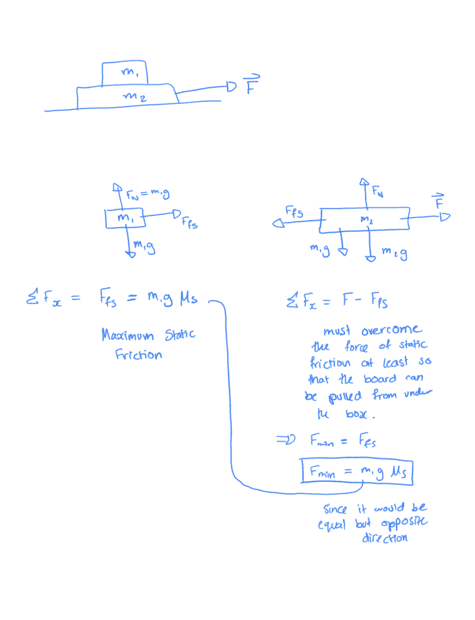
Hello, I'm struggling understanding why my answer to this question is incorrect. I know the right answer, but why is this way wrong? I have attached my solution and would really appreciate the help.
Thank you!
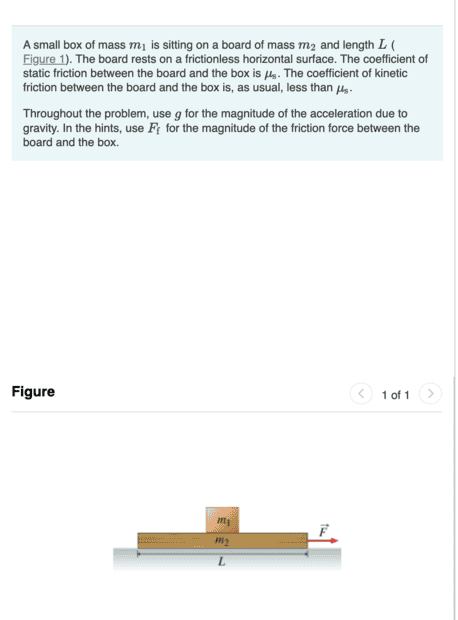
Diagram of a small box of mass m1 resting on a longer board of mass m2 and length L, with the board on a frictionless horizontal surface. A horizontal force F arrow points right, applied to the board.
Screenshot of a homework question, Part A: find F_min, the least constant force to pull a board out from under a box, answer in terms of mu_k, m1, m2, g and L, do not include F_l.

Handwritten physics sketch: a small block m1 sits on a longer board m2 pulled right by force F, with free-body diagrams of each showing friction and weight, and the equations Fmin = m1 g Mu s.
 
Attachments
Imagine that the mass ##m_2## is huge, say, the mass of Earth. According to your answer, pulling the Earth with the force ##F_{min}=m_1 g \mu_s## would move it out from under the box ##m_1## sitting on it...
 
Hill said:
Imagine that the mass ##m_2## is huge, say, the mass of Earth. According to your answer, pulling the Earth with the force ##F_{min}=m_1 g \mu_s## would move it out from under the box ##m_1## sitting on it...
I understand, and the answer (m1 + m2)g μs makes logical sense, but I don't understand why my working is not right? The force of friction acting on the box on top would be the same as the force of friction acting on the box on the bottom, and wouldn't we just have to apply a minimum force of the same magnitude to overcome it? Am I missing a force vector here?
 
alomari said:
Am I missing a force vector here?
No, you are not missing a force, but
alomari said:
we just have to apply a minimum force of the same magnitude to overcome it
is incorrect. We rather need to prevent them from moving together.
 
alomari said:
I understand, and the answer (m1 + m2)g μs makes logical sense, but I don't understand why my working is not right? The force of friction acting on the box on top would be the same as the force of friction acting on the box on the bottom, and wouldn't we just have to apply a minimum force of the same magnitude to overcome it? Am I missing a force vector here?
Start by considering that the force of static friction ##F_f## is the net force on ##m_1## in the horizontal direction. Remember that the force of static friction has an upper limit that it cannot exceed.