Why does air exit the system if its mass stays constant?

  • Thread starter tracker890 Source h
  • Start date
  • Tags Tags
    Fluid dynamic
9 replies · 2K views · last reply
tracker890 Source h
Messages
90
Reaction score
11
Homework Statement
Confusing in the conservation of mass.
Relevant Equations
Continuity Equation
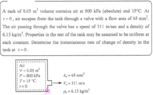
Textbook problem with a tank of 0.05 m^3 holding air at 800 kPa and 15 °C, with air escaping through a 65 mm^2 valve at 311 m/s and 6.13 kg/m^3; below it is a tank diagram with the same values and the control-volume mass balance equation.


Q: Why is air expelled from the system, yet the system's mass remains unchanged? Isn't mass related to volume?
 
Attachments
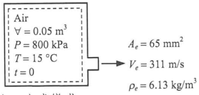
  • Schematic of a rigid tank with a dashed control volume containing air: volume 0.05 m^3, P = 800 kPa, T = 15 °C, t = 0, with an outlet arrow to the right labelled A_e = 65 mm^2, V_e = 311 m/s, rho_e = 6.13 kg/m^3.
    1694213871704.png
    34.8 KB · Views: 147
  • Diagram of a tank labelled Air, volume 0.05 m^3, P = 800 kPa, T = 15 °C, t = 0, with an outlet valve to the right showing Ae = 65 mm^2, Ve = 311 m/s and rho_e = 6.13 kg/m^3.
    1694213895256.png
    40.9 KB · Views: 134
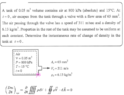
  • Printed problem text about a 0.05 m^3 air tank at 800 kPa and 15 °C with air escaping through a 65 mm^2 valve at 311 m/s and 6.13 kg/m^3; below it, a control volume sketch and the equation (Dm/Dt)sys = d/dt of the volume integral of rho dV plus the surface integral of rho V·dA = 0.
    1694215726931.png
    47.5 KB · Views: 131
Last edited:
The system includes the expelled air.
 
Control volume diagram of a tank holding air with volume 0.05 m^3, pressure 800 kPa, temperature 15 °C at t = 0, with an outlet nozzle on the right where air exits at area 65 mm^2, velocity 311 m/s and density 6.13 kg/m^3.

If the system includes air output, how should the cross-section be determined?
In a closed system, isn't it the case that fluids cannot cross the system boundaries? However, the following equation is indeed correct.
Surface integral equation: the closed-surface integral of rho times V vector dot dA vector equals rho_e A_e V_e, with the integral sign drawn as a closed surface.

Frabjous said:
The system includes the expelled air.
 
Last edited:
tracker890 Source h said:
View attachment 331684
If the system includes air output, how should the cross-section be determined?
View attachment 331685
The system is the total mass. It's not changing in time. The tank is the control volume. The portion of the systems mass inside the control volume is changing in time, so you get:

$$ \frac{d}{dt} \int_{cv} \rho ~d V \llap{-} = - \int_{cs} \rho \vec{V} \cdot d \vec{A} $$

which reduces to ( uniformily distributed properties):

$$ \frac{d}{dt} m_{cv} = - \rho_e A_e V_e $$
 
Last edited:
tracker890 Source h said:
Q: Why is air expelled from the system, yet the system's mass remains unchanged? Isn't mass related to volume?
Could you please explain why you are taking the time derivative of a 4-dimensional volume integral?

Equation of the Reynolds transport theorem in integral form: (Dm/Dt) of the system equals the partial time derivative of the triple volume integral of rho dV plus the closed surface integral of rho V dot dA, set equal to 0.
 
berkeman said:
Could you please explain why you are taking the time derivative of a 4-dimensional volume integral?

View attachment 331686
I was going to mention there are one too many integral signs. 😬
 
erobz said:
The system is the total mass. It's not changing in time. The tank is the control volume. The portion of the systems mass inside the control volume is changing in time, so you get:

$$ \frac{d}{dt} \int_{cv} \rho ~d V \llap{-} = - \int_{cs} \rho \vec{V} \cdot d \vec{A} $$

which reduces to ( uniformily distributed properties):

$$ \frac{d}{dt} m_{cv} = - \rho_e A_e V_e $$
So, my thoughts are as follows, is this correct?
Hand-annotated thermodynamics diagram of a tank of air with volume 0.05 m^3, pressure 800 kPa and temperature 15 °C, with a nozzle exit of area 65 mm^2, velocity 311 m/s and density 6.13 kg/m^3, inside a blue system boundary.
 
berkeman said:
Could you please explain why you are taking the time derivative of a 4-dimensional volume integral?

View attachment 331686
Accidentally typed the wrong characters, it has been corrected.
 
tracker890 Source h said:
So, my thoughts are as follows, is this correct?
View attachment 331687
Yeah, that's how you are to look at it. That first derivative being non-zero is not something you are going to encounter when it comes to mass as the property in R.T.T.

In essence the system is not the control volume, its "the stuff" moving through the control volume, be it mass, momentum , or energy. The "system" enters the control volume, exits the control volume, and/or accumulates within the control volume.
 
Last edited:
  • Like
Likes   Reactions: tracker890 Source h
erobz said:
Yeah, that's how you are to look at it. That first derivative being non-zero is not something you are going to encounter when it comes to mass as the property in R.T.T.

In essence the system is not the control volume, its "the stuff" moving through the control volume, be it mass, momentum , or energy. The "system" enters the control volume, exits the control volume, and/or accumulates within the control volume.
Thank you for the detailed and patient explanation. ^^
 
  • Like
Likes   Reactions: berkeman and erobz