Math Amateur
Gold Member
MHB
- 3,920
- 48
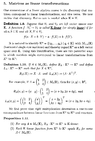
At the start of Chapter 9, M. A. Armstrong in his book, "Groups and Symmetry" (see text below) writes the following:
" ... ... Each matrix $$A$$ in this group determines an invertible linear transformation $$f_A: \mathbb{R} \to \mathbb{R}$$ defined by $$f_A(x) = x A^t$$ ... ... "I know that one may define entities how one wishes ... but why does Armstrong define $$f$$ in terms of the transpose of $$A$$ rather than just simply $$A$$ ... there must be some reason or advantage to this ... but what is it? Can someone help to explain ...
I note in passing that Kristopher Tapp in his book, "Matrix Groups for Undergraduates" (Chapter 1, Section 5) ... see text below ... defines the action of a linear transformation ( multiplication by a matrix $$A$$) as $$R_A = X \cdot A$$ ... thus not using the transpose of $$A$$ ...Hope that someone can help ...
Peter=======================================================================================
The above post refers to the start of Ch. 9 of M. A. Armstrong's book, "Groups and Symmetry" ... so I am providing the relevant text ... as follows:View attachment 9568
The above post also refers to Chapter 1, Section 5 of Kristopher Tapp's book, "Matrix Groups for Undergraduates" ... so I am providing the relevant text ... as follows:View attachment 9569Note that Tapp uses $$\mathbb{K}$$ to refer to one of the real numbers, the complex numbers or the quaternions ...Hope that helps,
Peter
" ... ... Each matrix $$A$$ in this group determines an invertible linear transformation $$f_A: \mathbb{R} \to \mathbb{R}$$ defined by $$f_A(x) = x A^t$$ ... ... "I know that one may define entities how one wishes ... but why does Armstrong define $$f$$ in terms of the transpose of $$A$$ rather than just simply $$A$$ ... there must be some reason or advantage to this ... but what is it? Can someone help to explain ...
I note in passing that Kristopher Tapp in his book, "Matrix Groups for Undergraduates" (Chapter 1, Section 5) ... see text below ... defines the action of a linear transformation ( multiplication by a matrix $$A$$) as $$R_A = X \cdot A$$ ... thus not using the transpose of $$A$$ ...Hope that someone can help ...
Peter=======================================================================================
The above post refers to the start of Ch. 9 of M. A. Armstrong's book, "Groups and Symmetry" ... so I am providing the relevant text ... as follows:View attachment 9568
The above post also refers to Chapter 1, Section 5 of Kristopher Tapp's book, "Matrix Groups for Undergraduates" ... so I am providing the relevant text ... as follows:View attachment 9569Note that Tapp uses $$\mathbb{K}$$ to refer to one of the real numbers, the complex numbers or the quaternions ...Hope that helps,
Peter
Attachments