Why does h = h(x,y,θ,φ) prevent (1.39) from being an exact differential?

  • Context: Graduate 
  • Thread starter Thread starter Happiness
  • Start date Start date
  • Tags Tags
    Differentials
Click For Summary
SUMMARY

The discussion centers on why the expression \( h = h(x,y,\theta,\phi) \) prevents equation (1.39) from being an exact differential. The key point is that when deriving \( dh \), the term \( \frac{\partial \theta}{\partial h} \) is nonzero, which disrupts the conditions necessary for an exact differential. Consequently, this leads to the conclusion that the solution cannot be expressed in the required exact form, despite initial appearances suggesting otherwise.

PREREQUISITES
  • Understanding of exact differentials in calculus
  • Familiarity with partial derivatives
  • Knowledge of multivariable functions
  • Basic concepts of differential equations
NEXT STEPS
  • Study the conditions for exact differentials in multivariable calculus
  • Explore the implications of nonzero partial derivatives in differential equations
  • Learn about the role of arbitrary constants in solutions to differential equations
  • Investigate the applications of multivariable functions in physics and engineering
USEFUL FOR

Students and professionals in mathematics, physics, and engineering who are dealing with multivariable calculus and differential equations, particularly those interested in understanding the nuances of exact differentials.

Happiness
Messages
686
Reaction score
30
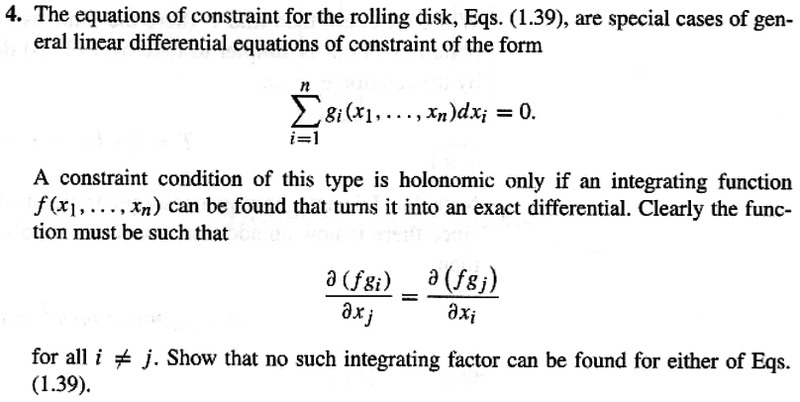
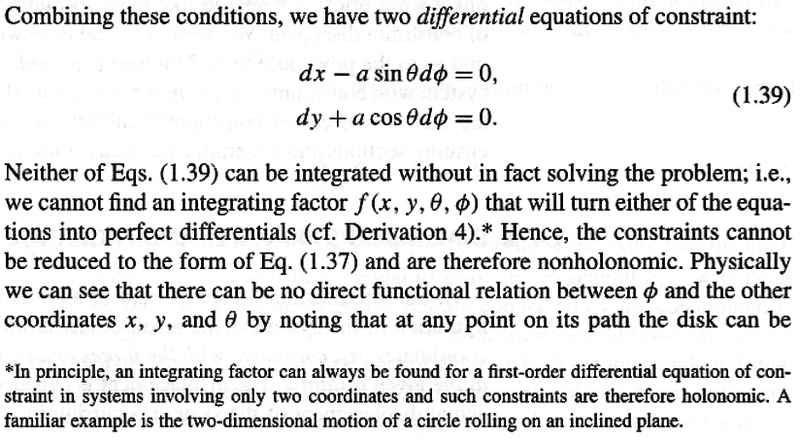
Why can't (1.39) be put in the form of an exact differential? Seems like I could and the solution to the first equation is

##x-a\phi\sin\theta=c##, where ##c## is an arbitrary constant.

Let ##x-a\phi\sin\theta## be ##h##.

By considering ##dh=\frac{\partial h}{\partial x}dx+\frac{\partial h}{\partial \phi}d\phi=0##, we get the first equation of (1.39). So it must be a solution. Isn't it?
Screen Shot 2016-03-02 at 12.04.16 am.png

Derivation 4:
Screen Shot 2016-03-02 at 12.04.37 am.png
 
Physics news on Phys.org
I don't know for sure, but I think it's because ##h = h(x,y,\theta,\phi)##, so
$$dh=\frac{\partial x}{\partial h}dx+\frac{\partial y}{\partial h}dy+\frac{\partial \theta}{\partial h}d\theta+\frac{\partial \phi}{\partial h}d\phi$$
and ##\frac{\partial \theta}{\partial h}## is nonzero, so you don't actually get back equation 1.39.
 
  • Like
Likes   Reactions: Happiness

Similar threads

  • · Replies 2 ·
Replies
2
Views
3K
  • · Replies 2 ·
Replies
2
Views
3K
  • · Replies 3 ·
Replies
3
Views
2K
  • · Replies 5 ·
Replies
5
Views
2K
  • · Replies 3 ·
Replies
3
Views
3K
  • · Replies 0 ·
Replies
0
Views
4K
  • · Replies 9 ·
Replies
9
Views
3K
  • · Replies 2 ·
Replies
2
Views
2K
  • · Replies 2 ·
Replies
2
Views
2K
  • · Replies 8 ·
Replies
8
Views
2K