Why is the energy of the OMG particle so low compared to its high velocity?

  • Context: Undergrad 
  • Thread starter Thread starter Reallyfat
  • Start date Start date
  • Tags Tags
    Energy
Click For Summary
SUMMARY

The discussion centers on the energy calculations of the OMG particle, a proton traveling at 0.9999999999999999999999951c, which has an energy of approximately 50 joules. Participants clarify that classical physics equations are inadequate for high-velocity particles, necessitating the use of relativistic formulas. The correct approach involves using the equation E = γmc², where γ is the Lorentz factor. The discrepancy in energy calculations arises from numerical precision limitations in calculators when handling extreme values.

PREREQUISITES
  • Understanding of special relativity and Lorentz transformations
  • Familiarity with relativistic energy equations, specifically E = γmc²
  • Knowledge of significant figures and numerical precision in calculations
  • Basic concepts of particle physics, including proton mass and energy units
NEXT STEPS
  • Study the derivation and application of the Lorentz factor in relativistic physics
  • Learn about the conversion between energy units, such as joules and electron volts
  • Explore the implications of significant figures in high-precision calculations
  • Investigate the properties of high-energy particles and their behavior at relativistic speeds
USEFUL FOR

Students and professionals in physics, particularly those focusing on particle physics and relativistic mechanics, as well as anyone interested in high-energy particle behavior and calculations.

Reallyfat
Messages
26
Reaction score
0
Hi everybody, I'm relatively new to particle physics. So I was reading up some stuff on high-velocity particles, and I found something on Fourmilab. The report is of a so-called OMG particle, traveling at some 0.9999999999999999999999951c. That's a ridiculously high speed, as far as I can tell. But anyways. I read that this particle was a proton, and it had an energy of around 50 joules. So I decided to use the classical physics equation:
EKinetic = m*v2*0.5
Just to test it. Needless to say, it did not work. I looked it up, and high-velocity particles have a relativistic formula where:
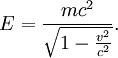
relativistic_energy.png

However, when I substitued my values for v and m, my energy came out as value which was to the power -10. Is there a reason that my energy value is some 10 orders of magnitude lower than it should be? And if so, could someone please guide me through the equation step-by-step so that I can work out where I went wrong?
I appreciate the responses, thanks.
 
Last edited:
Physics news on Phys.org
Do you think protons have a big mass?
 
I used the standard proton mass, 1.67e-27 kg. Whether or not you'd call it big is relative.
 
Reallyfat said:
0.9999999999999999999999951c

That's 25 significant figures. Squaring it accurately and then subtracting from 1 requires at least 50 significant figures. Can your calculator handle that many?
 
You can obtain a more or less accurate estimate writing: \beta=1-\epsilon with \epsilon=49\times 10^{-25}.
Then:
$$
E=\frac{m}{\sqrt{1-(1-\epsilon)^2}}=\frac{m}{\sqrt{2\epsilon-\epsilon^2}} \simeq \frac{m}{\sqrt{2\epsilon}}.
$$
In this way you only need to compute a number with 12 significant digits. Using the mass of the proton to be roughly 1GeV I obtained E\simeq 3.2\times 10^{10} GeV, which is more or less 5 Joule. I'm still out by an order of magnitude.
 
Doing the calculation in SI units directly:
$$E \simeq \frac{mc^2}{\sqrt{2\epsilon}}$$
I get 48 J.
 
I probably screwed some calculation :D
 
I used an online calculator with max precision.
Anyway, I see what you've done, but could you explain why you did it? What exactly do Beta and Epsilon represent? And also, why does the formula simply not work with the
E=E0/sqrt(1-v^2/c^2)
formula I used?
Thanks in advance.
 
You are assuming your calculator has unlimited precision - it doesn't. Your calculator can only store about 16-17 digits reliably.

When you take a number like 1 - (0.99999999...9)^2, you're going to end up with a number which looks like 0.000000000..., however if your numerical accuracy can't store more than the first 16-17 digits, then the result becomes identically zero.

This is why you can't just blindly plug numbers in a computer - you have to actually think about the calculation a bit, which is what Einj was demonstrating.
 
  • #10
In special relativity one defines \beta=v/c. I just defined \epsilon=49\times 10^{-25} as a small number, such that \beta=1-\epsilon.
 
  • Like
Likes   Reactions: 1 person
  • #11
Reallyfat said:
The report is of a so-called OMG particle, traveling at some 0.9999999999999999999999951c. That's a ridiculously high speed, as far as I can tell.
No, it's not even as much as the speed of light. :smile: But it's a good illustration of why people in high energy physics don't concern themselves with velocity! It's impossible to measure v to 20 decimal places or whatever this is, and equally impossible to do anything useful with it.

But anyways. I read that this particle was a proton, and it had an energy of around 50 joules... I used the standard proton mass, 1.67e-27 kg.
We also don't use SI units, which are suitable for everyday measurements but bring in very large exponents when we try to apply them to particle physics.

The mass of a proton is about 1 GeV/c2. The energy of this OMG particle, according to the article, was 3 x 10⁸ TeV. Since E = γmc2, the gamma factor is the ratio of these two numbers, 3 x 10¹¹.

Now γ = (1 - v2/c2)-1/2 so (1 - v2/c2)1/2 = 3 x 10-12, and (1 - v2/c2) = 10-23. Thus v2/c2 = one part in 1023 less than 1, and v/c is half a part in 1023 less.
 
  • Like
Likes   Reactions: 1 person
  • #12
Ah, I see where my mistake lies. I did my calculation in electron volts and it works now. Thanks so much everybody!
 

Similar threads

  • · Replies 2 ·
Replies
2
Views
2K
  • · Replies 5 ·
Replies
5
Views
2K
  • · Replies 8 ·
Replies
8
Views
2K
  • · Replies 18 ·
Replies
18
Views
3K
  • · Replies 4 ·
Replies
4
Views
3K
  • · Replies 20 ·
Replies
20
Views
3K
  • · Replies 3 ·
Replies
3
Views
4K
  • · Replies 7 ·
Replies
7
Views
2K
  • · Replies 6 ·
Replies
6
Views
2K
  • · Replies 10 ·
Replies
10
Views
2K