Why is the time transformation needed for the second event in Lorentz derivation?

Join the discussion
Registration is free. Start your own thread to ask a follow-up.
3 replies · 5K views
Kaguro
Messages
221
Reaction score
57
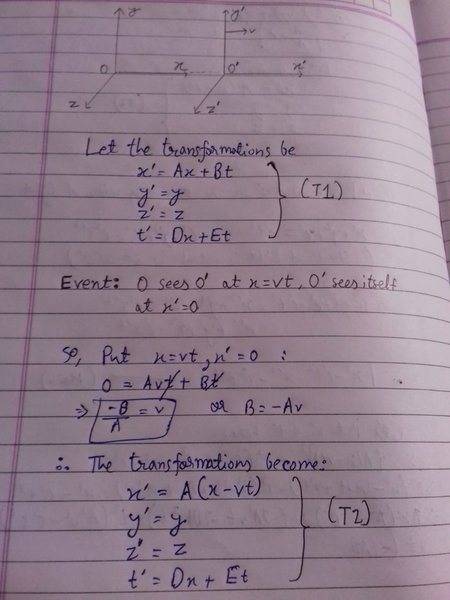
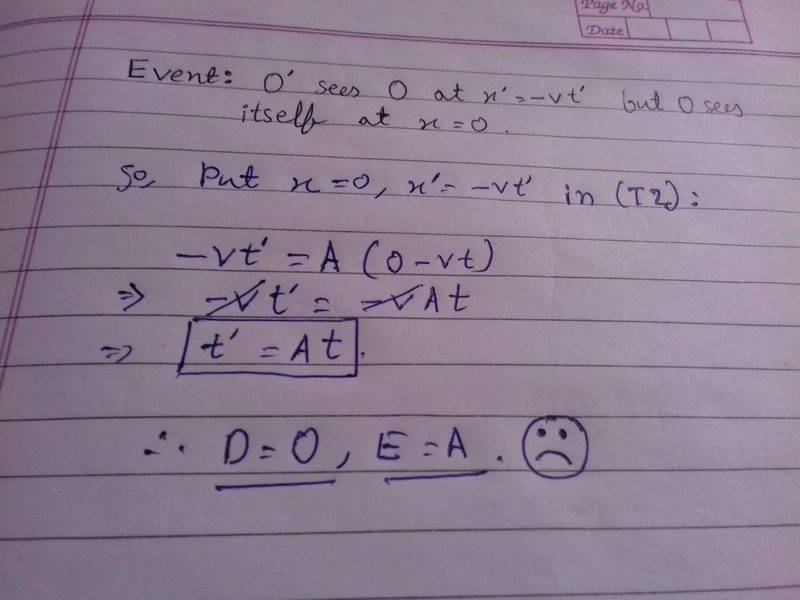
I have just started learning the Special Theory of Relativity. While deriving, I am facing some problems. I obviously have made some kind of mistake while using the equations...
What is wrong if I don't use the time transformation equation in Event #2?
pic1.jpg
pic2.jpg
 

Attachments

  • pic1.jpg
    pic1.jpg
    34.8 KB · Views: 2,520
  • pic2.jpg
    pic2.jpg
    47 KB · Views: 1,046
Physics news on Phys.org
Since y and z aren't involved, let's simplify to just talk about x and t.

Then a Lorentz transformation transforms a pair (x,t) into another pair, (x',t'). We're assuming that ##x' = Ax + Bt## and ##t' = Dx + Et##. Maybe it's clearer if we write them as functions:

##F_{x'}(x,t) = Ax + Bt##
##F_{t'}(x,t) = Dx + Et##

Then we have the assumptions:

Assumption 1: When ##x'=0##, ##x=vt##.

This means that the function ##F_{x'}(x,t)## satisfies ##F_{x'}(vt, t) = 0##. This implies that ##B = -vA##.

Assumption 2: When ##x=0##, ##x'=-vt'##.

This means that the functions ##F_{x'}(x,t)## and ##F_{t'}(x,t)## satisfy:

##F_{x'}(0, t) = -v F_{t'}(0, t)##.

So this implies that ##A\cdot 0 + B t = -v (D \cdot 0 + E t)##. So ##B = -vE##.

So you can conclude that ##E = A## and ##B = -vA##. But you can't conclude that ##D = 0##. To get ##D##, you need another assumption. That's usually the invariance of the speed of light:

Assumption 3: When ##x=ct##, then ##x' = c t'##.

In terms of functions,

##F_{x'}(ct, t) = c F_{t'}(ct, t)##
 
  • Like
Likes   Reactions: Kaguro
stevendaryl said:
Since y and z aren't involved, let's simplify to just talk about x and t.

Then a Lorentz transformation transforms a pair (x,t) into another pair, (x',t'). We're assuming that ##x' = Ax + Bt## and ##t' = Dx + Et##. Maybe it's clearer if we write them as functions:

##F_{x'}(x,t) = Ax + Bt##
##F_{t'}(x,t) = Dx + Et##

Then we have the assumptions:

Assumption 1: When ##x'=0##, ##x=vt##.

This means that the function ##F_{x'}(x,t)## satisfies ##F_{x'}(vt, t) = 0##. This implies that ##B = -vA##.

Assumption 2: When ##x=0##, ##x'=-vt'##.

This means that the functions ##F_{x'}(x,t)## and ##F_{t'}(x,t)## satisfy:

##F_{x'}(0, t) = -v F_{t'}(0, t)##.

So this implies that ##A\cdot 0 + B t = -v (D \cdot 0 + E t)##. So ##B = -vE##.

So you can conclude that ##E = A## and ##B = -vA##. But you can't conclude that ##D = 0##. To get ##D##, you need another assumption. That's usually the invariance of the speed of light:

Assumption 3: When ##x=ct##, then ##x' = c t'##.

In terms of functions,

##F_{x'}(ct, t) = c F_{t'}(ct, t)##
Wow! Thank you very much! You explained very nicely. I was finally able to derive the Lorentz Transformations.
 
stevendaryl said:
So you can conclude that ##E = A## and ##B = -vA##. But you can't conclude that ##D = 0##. To get ##D##, you need another assumption. That's usually the invariance of the speed of light:

Assumption 3: When ##x=ct##, then ##x' = c t'##.

In terms of functions,

##F_{x'}(ct, t) = c F_{t'}(ct, t)##

Just to highlight the difference to Newtonian mechanics. A different assumption (and an incompatible one at that) would be ##t' = t##, which directly would imply that ##D = 0## and ##E = 1## and therefore leads to the Galilei transformation
$$
x' = x - vt, \quad t' = t.
$$
It is important to note that the special principle of relativity is still valid in Newtonian mechanics, what really changes when going to SR is the assumption that the speed of light is invariant replacing the assumption that there is a universal time.
 
  • Like
Likes   Reactions: Kaguro